Key points about the largest release of oil reserves in history: Will it curb prices? Will it be enough?
The immediate effect will depend more on how quickly the oil reaches the market and the logistics of its transportation than on the unlocked amount
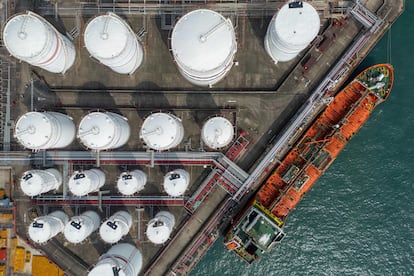

The war in the Middle East has made oil a central element of global geopolitics. The blockage of the Strait of Hormuz, through which 20% of the world’s oil passes, has sent prices soaring. Furthermore, concerns about a potential shortage have forced the world’s largest economies to coordinate and release part of their strategic reserves. The International Energy Agency (IEA) will launch the largest coordinated intervention in its history. Up to 400 million barrels will be made available to the market by its 32 member countries. Despite the agreement, doubts persist among investors regarding the pace, duration, and effectiveness of this measure. The price of Brent crude, the global benchmark for oil, has climbed again to around $100 a barrel.
Why is the price of oil rising?
The market has reacted skeptically to the reserve release agreement. According to Norbert Rücker, head of economic research at Julius Baer, “the oil market is unimpressed by the announced releases of strategic reserves. Current prices primarily reflect geopolitical uncertainty and the risk premium associated with the conflict.”
Although inventories in the 32 member countries of the IEA are well stocked—most have enough to last more than 100 days without new deliveries—the disruption of flows through the Strait of Hormuz and recent attacks on oil tankers are maintaining pressure. “The market continues to rise. The question is whether the crude will arrive on time and in sufficient quantities to meet demand until flows resume,” explain commodities experts at ING.
How much crude oil will be released?
The IEA has agreed to release 400 million barrels onto the market, making it the largest coordinated intervention in its history. Each country decides how much it will contribute and how, depending on its size, capacity, and available reserves.
The figures detailing each country’s contribution have not yet been released, adding uncertainty to the market, but experts estimate that the United States could unlock 172 million barrels. Japan has announced it can contribute 80 million barrels, and South Korea, 22.5 million. Germany has indicated it will contribute 19.5 million barrels; the United Kingdom, another 13.5 million; France, 14.5 million; and Spain, another 11.5 million. These seven countries alone would already reach 333.5 million barrels of oil, 83% of the combined target. Even India, which is not one of the 32 members of the IEA, has welcomed this measure and expressed its willingness to join.
At what rate will those barrels be released?
This is another issue the IEA has yet to address, and the answer is crucial. Analysts believe the release rate is more relevant than the total volume of barrels injected into the market, because only the daily flow can truly influence prices while the blockage in the Strait of Hormuz persists.
“The 400 million barrels represent only about four days of total daily global oil demand,” MUFG experts warn. To put this in context, before the conflict, approximately 20 million barrels of oil and refined products flowed daily through the Strait of Hormuz. If the countries release 100 million barrels over a month, the daily flow would be a mere 3.3 million barrels, insufficient to cover the total deficit, although it could temporarily alleviate prices and allow time to reorganize market logistics.
“The problem is that the daily flow from the release would only represent about 20% of the supply lost through the Strait of Hormuz. Furthermore, according to the U.S. Department of Energy, it typically takes about 13 days from the time the release is approved until the oil starts reaching the market, which adds some friction,” UBS analysts point out.
It’s important to remember that the oil stockpiled by countries is intended to cushion temporary crises, not to replace a constant flow. Releasing reserves provides a safety net while efforts are made to restore flows through the Strait of Hormuz. This reinforces the idea that the immediate effect on prices will depend more on how quickly the oil reaches the market and the logistics of its transportation than on the announced volume.
Does it matter where they are released?
Yes. The effectiveness of the release depends on both the origin and the transportation logistics. Barrels of oil can take days or weeks to reach the most affected markets. Therefore, even if 400 million barrels are released, the effect on prices depends on the ability to deliver them to the critical routes.
The disruption of the Strait of Hormuz is blocking most trade to Asia and the Middle East. Crude oil from Europe or the Americas will take days to reach Asian refineries, which are the most affected by the blockade, thus limiting the immediate impact on prices in that region. Furthermore, the issue is not so much the crude oil itself, but rather refined petroleum products such as diesel, gasoline and kerosene, which are the ones actually used in industry. Beyond the time needed to make crude oil available, there is also the capacity to refine it and produce these fuels.
Will they manage to stabilize the market?
Yes, but only temporarily. Strategic reserves are meant to cushion temporary crises, not to resolve prolonged disruptions. “There could be temporary relief in oil prices in the short term, but as long as the Strait of Hormuz remains de facto closed, the risk remains skewed to the upside,” UBS analysts explain. Citi strategists echo this sentiment: “As long as the military conflict continues, we expect higher prices due to the prolonged shortage, which supports our new base price range of $80 to $100 per barrel for the next two weeks.”
If the lockdown continues, Brent crude could climb to $150, some banks warn, and the impact could spill over into inflation, economic growth, and global financial stability. In the most likely scenario, production cuts would peak this week, and flows could normalize toward the end of the month, partially easing pressure on prices.
What happens when the 400 million barrels run out?
Reserves are a temporary measure, not a permanent source of supply. If the crisis continues, governments will have to decide between depleting more reserves—IEA member countries hold more than 1.8 billion barrels of oil in national and industrial reserves—or seeking alternative sources of oil.
Some of the organization’s members, such as the United States, Norway, Mexico and Canada, are oil producers. The question, once again, is the pace of production and stockpiling. “[The risk] has never been greater than it is now. External analysts estimate that Japan could extract 4.9 million barrels per day and South Korea 4.8 million, on paper. However, U.S. Extraction capacity is already at a low level, and repair and maintenance work could keep the maximum extraction rate close to 1 million barrels per day for now,” Citi analysts note.
For now, the release of reserves is a political indicator and a calming factor for markets, while traffic through the Strait of Hormuz is expected to resume. The duration of the blockage in the strait is the big unknown. Following recent attacks on oil tankers, geopolitical uncertainty persists. The strait is a critical artery for 25% of global maritime oil trade, and as long as it remains blocked, prices will incorporate a high risk premium. ING analysts expect flows to resume gradually, but warn that any military escalation could prolong the crisis.
Sign up for our weekly newsletter to get more English-language news coverage from EL PAÍS USA Edition
Tu suscripción se está usando en otro dispositivo
¿Quieres añadir otro usuario a tu suscripción?
Si continúas leyendo en este dispositivo, no se podrá leer en el otro.
FlechaTu suscripción se está usando en otro dispositivo y solo puedes acceder a EL PAÍS desde un dispositivo a la vez.
Si quieres compartir tu cuenta, cambia tu suscripción a la modalidad Premium, así podrás añadir otro usuario. Cada uno accederá con su propia cuenta de email, lo que os permitirá personalizar vuestra experiencia en EL PAÍS.
¿Tienes una suscripción de empresa? Accede aquí para contratar más cuentas.
En el caso de no saber quién está usando tu cuenta, te recomendamos cambiar tu contraseña aquí.
Si decides continuar compartiendo tu cuenta, este mensaje se mostrará en tu dispositivo y en el de la otra persona que está usando tu cuenta de forma indefinida, afectando a tu experiencia de lectura. Puedes consultar aquí los términos y condiciones de la suscripción digital.