The birth year of punk rock
The movement that caused a rupture in the musical genre was born 50 years ago, and even then it had a tendency to become bloated
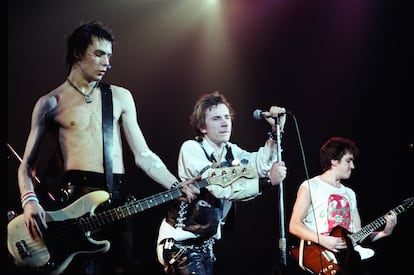

Don’t say you were not warned: stories, both in print and broadcast, are already being prepared about the 50th anniversary of punk rock. Indeed, 1976 saw the release of debut albums by the Sex Pistols, the Ramones, the Damned, and the first version of “Blank Generation,” Richard Hell’s anthem.
Of course, there are also nitpicky arguments for rejecting 1976 as the annus mirabilis. CBGB, the punk den of the New York scene, opened in 1974, and the following year Television, the Ramones, the Patti Smith Group and the Talking Heads all graced its stage. The same goes for the Sex Pistols, who debuted in London on November 6, 1975, with borrowed equipment and at such a volume that their performance was cut short after 20 minutes.
The term “punk” posed certain historical problems. In attitude and sound, they had connections to some American bands of the 1960s, anthologized in 1972 on the compilation album Nuggets by Lenny Kaye, future guitarist for Patti Smith. These bands were later dubbed “garage bands,” a reference to the spaces where they originated. At the time, they were also classified as punks, an insulting description (originally, in the 16th century, the term referred to prostitutes) that ended up being reclaimed as a defiant source of pride.
All these issues surrounding terminology and periodization are important for a country like Spain. In the 1970s, without YouTube or Spotify, music traveled at a snail’s pace: new releases took months to arrive, as there were few radio programs that played imported records. As a result, punk was known more through photo essays in magazines like Interviú than through the music itself. [...] It should be noted that ideological inconsistency shouldn’t be penalized: musical movements spring up in a wild, untamed way and are later attributed an ideology, which ends up shaping an orthodoxy.
The Sex Pistols are a prime example. A couple of brutes with one foot in crime teamed up with an angry young man who called himself Johnny Rotten; an opportunist like Malcolm McLaren suggested they transform their youthful energy—they were 20 years old—into torpedoes aimed at Queen Elizabeth II or the social structure of the United Kingdom. Significantly, the project was born around a London boutique. It was a pose that gained weight with the arrival of The Clash, initially just as disingenuous but with the ability to enrich their message with slogans and a wider sonic palette.
The media’s distillation led to the dissemination of an oppositional attitude, which each punk group or solo artist, regardless of their location, interpreted as they pleased. From a pantomime orchestrated on King’s Road, there emerged genuine rebellions, which made sense in specific contexts. Hence the truth of Basque Radical Rock, the purist American hardcore, or even an extramusical phenomenon like the Russian group Pussy Riot. So yes, it is certainly justified to celebrate 50 years of punk. And to learn from it.
Sign up for our weekly newsletter to get more English-language news coverage from EL PAÍS USA Edition
Tu suscripción se está usando en otro dispositivo
¿Quieres añadir otro usuario a tu suscripción?
Si continúas leyendo en este dispositivo, no se podrá leer en el otro.
FlechaTu suscripción se está usando en otro dispositivo y solo puedes acceder a EL PAÍS desde un dispositivo a la vez.
Si quieres compartir tu cuenta, cambia tu suscripción a la modalidad Premium, así podrás añadir otro usuario. Cada uno accederá con su propia cuenta de email, lo que os permitirá personalizar vuestra experiencia en EL PAÍS.
¿Tienes una suscripción de empresa? Accede aquí para contratar más cuentas.
En el caso de no saber quién está usando tu cuenta, te recomendamos cambiar tu contraseña aquí.
Si decides continuar compartiendo tu cuenta, este mensaje se mostrará en tu dispositivo y en el de la otra persona que está usando tu cuenta de forma indefinida, afectando a tu experiencia de lectura. Puedes consultar aquí los términos y condiciones de la suscripción digital.