Jung Chang, author: ‘If people thought China was so incredible, they would relocate there’
The writer of the 1991 bestseller ‘Wild Swans’ and a recent memoir sequel talks about being raised under Mao, the state of Chinese politics today, and whether Trump is driving the West into Beijing’s embrace
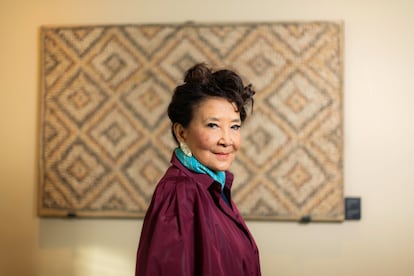

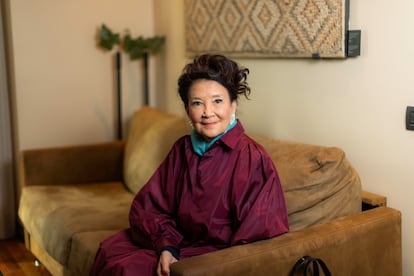
Jung Chang gained widespread recognition in 1991 with her memoir Wild Swans, a sweeping narrative rooted in the life of her grandmother, who became a concubine to a warlord general in the waning days of the Chinese empire; her mother, a Communist official later targeted by persecution; and herself, a teenage member of the Chinese Red Guard who grew disenchanted after the brutal crackdown of the Cultural Revolution. That same young woman, born 73 years ago in Yibin (Sichuan, China), eventually made her way to London, pursued her education, began writing, and attained acclaim—and now she returns with Fly, Wild Swans, reexamining a powerful family saga interwoven with the history of China across the last century.
Question. Your book reeks of fear. Do you still feel that way?
Answer. Yes, because I grew up under Mao’s rule and fear was ingrained in our hearts. Today I try to overcome it, not feel it and move on with my life, but it’s still there.
Q. You portray your mother as a great fighter. What was her main lesson?
A. Today she is past 90, extremely delicate, and we can’t have long conversations, but we still connect through video calls. She showed me how to be resilient, courageous, to stand by what I know is right, and to write, to speak the truth.
Q. Do you recognize today’s China, the China of Xi Jinping?
A. It’s vastly unlike Mao’s. I came of age during eras of public brutality, of terrifying denunciations where victims were marched through the streets, beaten—even children striking their own parents. And now it’s entirely different. There’s fear and control, but we can’t return to Maoism.
Q. Is China more capitalist or communist today?
A. In essence, it remains communist. In China, you still can’t own land—only acquire usage rights for 70 years. People are permitted some freedoms and the ability to accumulate wealth, but if the party so chooses, you can lose it all. There is liberty, provided you stay within the party’s boundaries.
Q. Your worst memory?
A. Watching my teachers get beaten at school, seeing my parents tortured, my grandmother endure unbearable pain. One of the most harrowing memories was witnessing my grandmother collapse as my mother was being paraded through the streets, degraded and tormented. My grandmother fainted right before me, her body going rigid, her head slamming into the pavement, losing consciousness—and that instant left me paralyzed with fear.
Q. Your grandmother’s life was defined by becoming a concubine at the age of just 15.
A. She was handed over to a general as his concubine in the 1920s, and when he passed away, my grandmother wished to marry, but her fiancé’s family refused, fearing the shame it would cause. His son took his own life. Life grew unbearable for my grandmother; my mother faced relentless harassment, and that forged her character. That’s why she joined the Communist movement, which pledged to abolish concubinage. Yet she was later heartbroken when the Communist women’s group meant to free them rejected her too, refusing even to sit beside her at the wedding.
Q. Is it possible to overcome these traumas?
A. When I traveled to China and spoke with many people for my books, I discovered that when the past was brought up, these people changed and began to tremble; they couldn’t find the words, they couldn’t speak coherently. I realized that the trauma hadn’t been processed into memory, and they couldn’t think about the past without getting lost; they didn’t know what to do, what to say; the pain was too deep. I wish psychologists could have treated it. The memory was deliberately erased, swept under the rug. People were told to ignore it and forget.
Q. You grew up fascinated by Mao.
A. I grew up under a cult of personality. Mao was our God. I myself began to be horrified by the Cultural Revolution when I was 14, yet I didn’t think to blame Mao. He was a given, like eating, dressing, and obeying. Gradually, over the years, when I finally managed to leave China in 1978 at the age of 26, Mao was far from being a god in my mind. The day he died, everyone was crying, but my eyes were dry; I had no tears for him. Later, I researched him for a biography I co-authored with my husband [Mao: The Untold Story, with historian Jon Halliday]. We uncovered horrific truths, and today I see him as one of the most evil people of the 20th century, alongside Hitler and Stalin.
Q. For some years now, you haven’t been able to return to China. Are your books and your fame known there?
A. Today, fewer people know me and my books than 10 years ago. When Wild Swans and the biography of Mao were published, although they were banned, there were pirated editions. But now control is much stronger because of technology. My name and the names of my books are completely blocked. The software and applications that are used there make life very easy; you can pay and do many things, but they facilitate control. That’s why fewer people know me today.
Q. Do you think you will ever see your books published there?
A. I don’t know. It’s unlikely. A lot is happening, like the new purge in the military; people who were key to Xi Jinping’s power base have fallen, and there’s a strong determination to take Taiwan by force. I hope it happens, but we’ll see; there are many variables I’m unaware of.
Q. Do you think Trump will succeed in making China Great Again, instead of America, given what we’ve seen?
A. What Trump has done to his allies is what China wants to see, but that doesn’t make, or shouldn’t make, China a better friend of the West. I don’t think Europeans are so naive as to join the other side simply because they’re unhappy with their own commander. And China doesn’t see democratic countries as friends; it basically wants to use them. These are two different things.
Q. But China’s reputation is improving while that of the U.S. Is regressing.
A. I’m not really sure. There are many people and countries that want Chinese money and that’s why they say nice things about China, but nothing more. Refugees risk their lives and cross seas to go to the U.S. And Europe, but nobody is rushing to China. If they really thought it was so wonderful, they would go there. In China, there was a political joke: “What do a Chinese person and a citizen of a democracy have in common? They can both abuse democratic government.”
Sign up for our weekly newsletter to get more English-language news coverage from EL PAÍS USA Edition
Tu suscripción se está usando en otro dispositivo
¿Quieres añadir otro usuario a tu suscripción?
Si continúas leyendo en este dispositivo, no se podrá leer en el otro.
FlechaTu suscripción está en uso en otro dispositivo y solo puedes acceder a EL PAÍS desde uno simultáneamente.
Si deseas compartir tu cuenta, actualiza tu suscripción al plan Premium, así podrás incluir a otro usuario. Cada uno iniciará sesión con su propio correo electrónico, lo que les permitirá personalizar su experiencia en EL PAÍS.
¿Tienes una suscripción de empresa? Accede aquí para contratar más cuentas.
Si no estás seguro de quién está utilizando tu cuenta, te sugerimos actualizar tu contraseña aquí.
Si decides seguir compartiendo tu cuenta, este mensaje aparecerá en tu dispositivo y en el de la otra persona que utiliza tu cuenta de manera permanente, impactando tu experiencia de lectura. Puedes consultar aquí los términos y condiciones de la suscripción digital.