How Rio de Janeiro’s famous carnival rescued the human scale of the city
During months of rehearsals, street bands and samba schools make space for pedestrians, creating islands of community spirit in a violent, unequal city where the car is still king
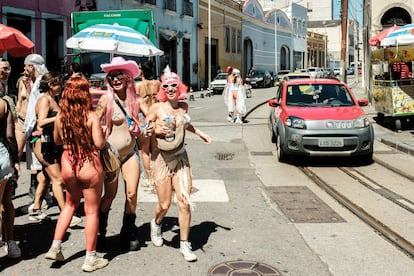
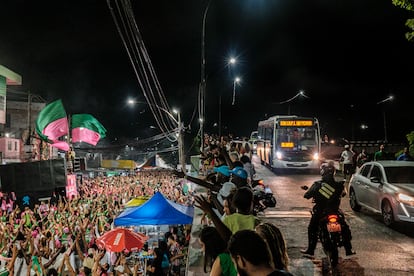
Since November, the scene has been repeated almost every day of the week in many of Rio de Janeiro’s neighborhoods: a street closed off, an avenue without cars, and thousands of people joyfully moving to the beat of drums. It’s the usual routine in the months leading up to Carnival; these are the rehearsals of the samba schools that will parade in the Sambadrome. Each rehearsal brings together some 3,000 members and thousands more neighbors and spontaneous spectators. It’s all free, out in the street, and with the tacit approval of the traffic officers. And it happens almost every day of the week for about three months—something unthinkable in many cities. When cars disappear for a few hours, spaces for community life flourish: families dancing, children running around, impromptu barbecues, and a sense of shared space that is invaluable in a city marked by inequality and sorely lacking in pedestrian areas.
Besides the samba schools, in January, as the festival approaches, the other side of the celebration also makes an appearance in the streets: the ‘blocos’, the lively street parades with bands of musicians playing wind and percussion instruments. These are the two main cultural expressions of the city and they move the masses, to the point that they force urban changes and help revitalize run-down areas.
From the beginning of the year until the peak of the festival (this year it’s from February 13th to 18), Rio will host more than 460 parades of “blocos” authorized by the city. These parades are expected to draw more than eight million people, residents and tourists alike. The city designs a complex logistical puzzle and mobilizes more than 300 traffic officers just to manage the passage of these bands. But in addition to the official blocos, there are countless other groups that don’t necessarily have permits but parade anyway. Bureaucracy is rarely an obstacle. The sheer number of musicians and revelers brings traffic to a standstill, and the police, if present, usually just manage the resulting chaos: it’s organized mayhem.
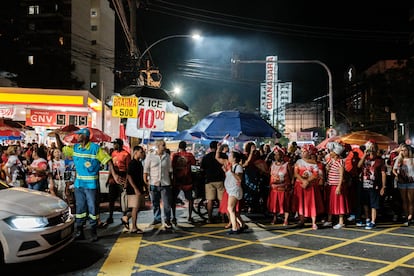
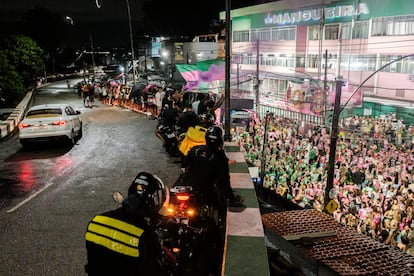
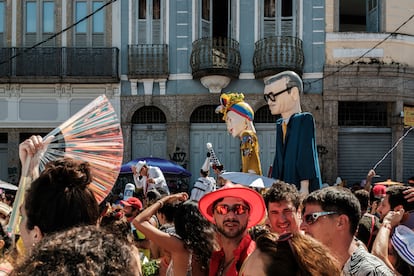
It wasn’t always like this: for decades, samba dancers, carnival enthusiasts, and other devotees of bohemian life were ruthlessly persecuted, as Victor Belart, author of the book Cidade pirata (Pirate City) about the blocos and Rio’s street culture, recalls. “Rio de Janeiro has been very violent toward cultural expressions and at the same time very interested in them; it’s an ambiguous relationship. Many blocos have been persecuted, but their image has also been used, there have been incentives… It’s a multifaceted relationship,” he says.
It’s undeniable that Carnival is in Rio’s DNA, to the point that its official anthem is a joyful ‘marcinha’ (a typical Rio Carnival genre): Cidade Maravilhosa (Marvelous City), a huge hit at the 1935 Carnival. The inescapable presence of the festivities in the streets has left clearly visible marks on the city’s architecture and urban planning. The clearest example is the Sambadrome, a kind of straight-line stadium with a capacity of 70,000 people. Designed by Niemeyer, it was built in 1984 in record time with clear popular support, even incorporating public schools into its lower levels. Its surroundings are a chaotic jumble of dilapidated streets, an unwelcoming viaduct, and even a smelly canal, but the magnetism of the venue for the city’s economy is driving change. The city government has announced a 1.75 billion reais (over $300 million) plan to pedestrianize the surrounding area, demolish the elevated highway and replace it with a tunnel, create public squares, housing for 100,000 new residents, and a large library designed by architect Francis Kéré. Carnival is also driving construction a few kilometers away, where the Cidade do Samba 2 (Samba City 2) is being built on old railway tracks. This complex of warehouses will house the floats of the samba schools that have previously worked in more precarious conditions.
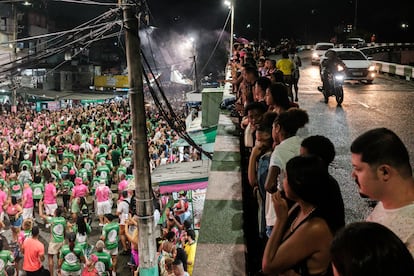
There are also less obvious movements. On many occasions, the government joins forces with popular culture to revitalize abandoned spaces. Samba circles, which take place throughout the year in many squares, have been key to revitalizing many areas of the city center, thanks to their ability to attract hundreds of people to places that are often uninviting. Just a few months ago, the city council itself promoted this occupation of space in the Passeio Público, the city’s oldest park, which used to be deserted on Sundays. The music has transformed it into a pleasant and bustling craft and food fair.
Similarly, the main value of the street bands and samba schools in their contribution to public space lies in the intangible, in their power to change the collective imagination and idea of what the city can be, especially its historic center, where most of the parades are concentrated. Rio is a violent, unequal, and contradictory city, where, as Belart says, “antagonistic projects” coexist. On one side, there are those who dream of moving to neighborhoods like Barra da Tijuca, with its Miami-like aspirations, its gated communities surrounded by walls and security cameras, like in so many Latin American cities. On the other, there is the extremely informal, street-based city, the one that crowds together, standing in flip-flops, drinking beer around a samba circle on a street corner. “That idea of the street always has to be contested, and Carnival allows new generations to experience sensations in the streets. Walking through the streets during the festivities is an emotional obligation to the city; the more you walk through the city, the closer you get to it, you position it as a possible space. Carnival greatly stimulates this; it’s important because it renews the hope of the street, it builds symbolic imaginaries of the street as a possibility.” In the days when King Momo takes the keys to the city, another Rio seems possible. When Ash Wednesday arrives, much of that friendly city evaporates, but a residue always remains: the next street closed to traffic, the next rehearsal.
Sign up for our weekly newsletter to get more English-language news coverage from EL PAÍS USA Edition
Tu suscripción se está usando en otro dispositivo
¿Quieres añadir otro usuario a tu suscripción?
Si continúas leyendo en este dispositivo, no se podrá leer en el otro.
FlechaTu suscripción se está usando en otro dispositivo y solo puedes acceder a EL PAÍS desde un dispositivo a la vez.
Si quieres compartir tu cuenta, cambia tu suscripción a la modalidad Premium, así podrás añadir otro usuario. Cada uno accederá con su propia cuenta de email, lo que os permitirá personalizar vuestra experiencia en EL PAÍS.
¿Tienes una suscripción de empresa? Accede aquí para contratar más cuentas.
En el caso de no saber quién está usando tu cuenta, te recomendamos cambiar tu contraseña aquí.
Si decides continuar compartiendo tu cuenta, este mensaje se mostrará en tu dispositivo y en el de la otra persona que está usando tu cuenta de forma indefinida, afectando a tu experiencia de lectura. Puedes consultar aquí los términos y condiciones de la suscripción digital.