Appeals court allows Trump to revoke TPS for more than 60,000 Hondurans, Nicaraguans, and Nepalese
The judges cited the Supreme Court’s decision that allowed the government to end the same protection for hundreds of thousands of Venezuelans


In yet another blow to migrant communities in the United States, a federal appeals court has allowed the Donald Trump administration to move forward with the elimination of the Temporary Protected Status (TPS) for more than 60,000 migrants from Honduras, Nepal, and Nicaragua. The ruling, issued Monday, represents a key victory for the government in its attempt to dismantle one of the oldest humanitarian programs in the U.S. Immigration system.
In an unsigned decision, a panel of three judges from the Ninth Circuit Court of Appeals lifted an injunction that had blocked the measure and concluded that the government is likely to be able to show that there were legitimate reasons for ending the protections. The court relied on a recent Supreme Court ruling that allowed the Trump administration to let TPS expire for hundreds of thousands of Venezuelan migrants.
“We are not writing on a blank slate,” the judges said, explaining that although the Supreme Court’s orders did not offer detailed reasoning, they must “inform” the decisions of lower courts.
TPS allows people from countries affected by war, natural disasters, or other extraordinary crises to live and work temporarily in the United States without fear of deportation. According to official data, about 51,000 Hondurans, 7,000 Nepalese, and nearly 3,000 Nicaraguans are currently covered by the program.
Migrants from Honduras and Nicaragua obtained this protection after a devastating hurricane in 1999, while those from Nepal were included after the 2015 earthquake that caused massive landslides and flooding. The status was renewed for years due to the continuing instability in those countries.
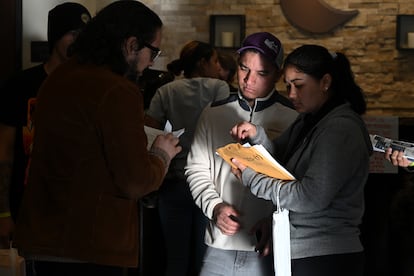
The court ruling comes after a sustained offensive by the Department of Homeland Security to drastically reduce the scope of the program. In total, the Trump administration has moved to eliminate TPS for more than one million people from at least eight countries.
In response to the ruling, Homeland Security Secretary Kristi Noem celebrated the decision on social media. “TPS was never designed to be permanent, yet previous administrations have used it as a de facto amnesty program for decades,” she wrote on X. “Given the improved situation in each of these countries, we are wisely concluding what was intended to be a temporary designation.”
However, federal trial judges had offered a very different view. In December, Judge Trina Thompson of the Northern District of California blocked the revocation of TPS, arguing that the administration did not adequately assess current conditions in the affected countries. She also noted that the decisions may have been motivated by racial bias.
Thompson wrote in a previous order that “by stereotyping the TPS program and immigrants as invaders that are criminals, Secretary Noem’s statements perpetuate the discriminatory belief that certain immigrant populations will replace the white population.”
However, the Ninth Circuit determined that Congress has limited the ability of courts to review decisions related to TPS. According to the panel, the Secretary of Homeland Security was not required to consider “intermediate conditions” in the countries of origin before concluding that emergencies no longer justified protection.
Two of the judges on the panel were appointed by Republican presidents — Donald Trump and George W. Bush — while the third was appointed by Democrat Bill Clinton. The latter, Judge Michael Hawkins, noted that his vote was based solely on recent Supreme Court precedents.
Migrant advocacy organizations condemned the ruling and warned of its impact. “Today’s decision allows mothers, fathers, students, and workers who have lived lawfully in this country for decades to be stripped of status without even acknowledging the devastation caused to them and their families or the contributions they have made to their communities,” said Jessica Bansal, an attorney with the National Day Laborer Organizing Network, one of the entities representing TPS beneficiaries.
Tu suscripción se está usando en otro dispositivo
¿Quieres añadir otro usuario a tu suscripción?
Si continúas leyendo en este dispositivo, no se podrá leer en el otro.
FlechaTu suscripción se está usando en otro dispositivo y solo puedes acceder a EL PAÍS desde un dispositivo a la vez.
Si quieres compartir tu cuenta, cambia tu suscripción a la modalidad Premium, así podrás añadir otro usuario. Cada uno accederá con su propia cuenta de email, lo que os permitirá personalizar vuestra experiencia en EL PAÍS.
¿Tienes una suscripción de empresa? Accede aquí para contratar más cuentas.
En el caso de no saber quién está usando tu cuenta, te recomendamos cambiar tu contraseña aquí.
Si decides continuar compartiendo tu cuenta, este mensaje se mostrará en tu dispositivo y en el de la otra persona que está usando tu cuenta de forma indefinida, afectando a tu experiencia de lectura. Puedes consultar aquí los términos y condiciones de la suscripción digital.