‘What’s your name, sir?’ Steve Guttenberg, the forgotten star
Ffity years after his screen debut, the protagonist of ‘Police Academy,’ ‘Cocoon’ and ‘Three Men and a Baby’ is familiar with both fame and anonymity
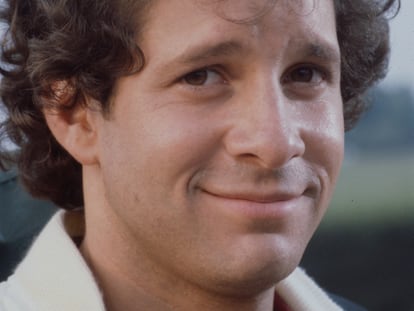

“You’re the last guy I’d pick to be a movie star,” an agent told Steve Guttenberg when he was 17 and had just arrived in Hollywood. “Forget being an actor. You don’t have the look, you don’t have the talent, and your name is ridiculous.” This is how Steve Guttenberg’s memoir, The Guttenberg Bible, begins. The agent obviously lacked a nose for success. Ten years later, Guttenberg was one of the highest-grossing stars in Hollywood, with a string of hits to his name and a face that appealed to young and old. But in the early 1990s he took a break that coincided with a shift in Hollywood. He returned only to be left out in the cold. He never got back into the mainstream.
Guttenberg was still around but was no longer a face the public recognized. As noted in a profile on the actor in the Los Angeles Times, the third most popular search for his name on Google were the three words ‘Steve Guttenberg dead.’ Who knows why his star fizzled out, or why it had shone so brightly in the first place? Some wonder if he rose to fame on the back of the Stonecutters’ song in the episode of The Simpsons, Homer the Great, that includes the line: “Who holds back the electric car? Who makes Steve Guttenberg a star?”
Guttenberg was an unlikely star and an even more unlikely heartthrob. “’You’re too short, too tall, too Jewish, too Italian, too New York, not New York enough, too Jewish, not Jewish enough, too slim, too fat, too ugly, too good-looking.’ I heard everything,” he said of the rejections he received during a 2017 interview with The Daily Beast.
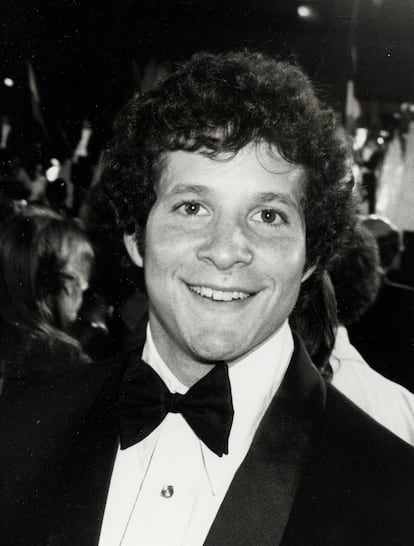
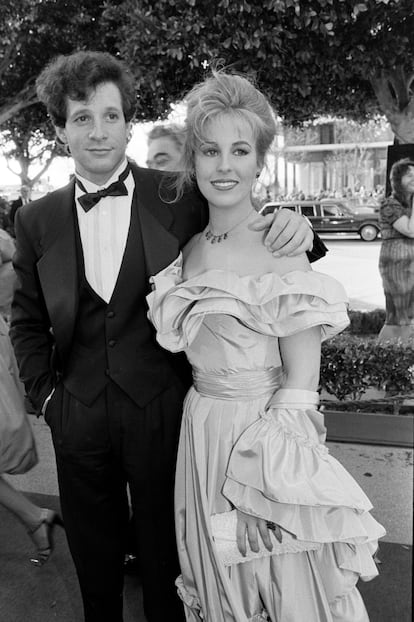
In the last 30 years, Guttenberg has not stopped working, but what brought him out of near-anonymity was his role during the fires that ravaged California in early 2025. After explaining to a reporter the importance of people leaving their car keys in their cars so that people like him could move them to let the fire trucks through, the reporter asked him, “What’s your name, sir?” Guttenberg was now the caring neighbor who moved the cars that had been left in the middle of the road to allow the firefighters to pass.
Helping is something Guttenberg is familiar with. When his father was diagnosed with kidney failure, he drove 400 miles (640km) every week to care for him. The actor slowed down his work pace to devote himself to his father, an experience he shared in his book Time to Thank, written after his father’s death: “Caring for My Aging Father Was the Honor of My Life. Here’s What I Learned — and What I Want Everyone to Know,” was the headline he went with.
Guttenberg had a lot to thank his father for. When he was in the middle of the Hollywood maelstrom, he had a daily appointment that he never missed. His father called him every day at 6 p.m. To bring him back down to earth. “I always had to be home at six o’clock. Even if I got home at five to six! I had to answer that phone. He was my anchor,” he said. It was a support that he considered essential. “My work ethic and my nature come from my mom and dad. We’re working-class people and even at times when I got paid enormous amounts of money, that didn’t change the way I worked: I got up early, I made sure I had my tools, and I worked. The reality is, it’s a job. If you believe you’re a celebrity, you’re fucked, pardon my French,” he told The Guardian in 2021.
$300 and a two-week window
When Guttenberg wanted to move to Los Angeles at 17 to try to become a movie star, his parents supported him. Two days later, he was on a plane to L.A. “My parents gave me $300 and said, ‘You got two weeks,’” Guttenberg told CBS News. “And I got a Kentucky Fried Chicken commercial. And my parents let me stay another two weeks. And I got a little movie [The Chicken Chronicles]. And I got more commercials. Then, I actually stayed a year, before I quit and went back to school.”
Hollywood wasn’t Guttenberg’s vibe. “I hated it. It was all about whoever was the hottest and most popular in the room,” he told the Daily Beast. “If you had a hit movie you were able to be the loudest at the party. I don’t measure people by their success. I measure them by their manners.”
Five months after going back to school, he received a call that changed everything — an audition for Boys from Brazil (1978) with Gregory Peck, Laurence Olivier, James Mason and Uta Hagen. “It’s hard to turn that down, right?” He became Barry Kohler, an investigator working on a case about a group of Nazi refugees in Paraguay and, although his appearance is brief, he is essential to the plot.
It is a very different character from the one he would play in Can’t Stop the Music, a biopic of the Village People where he coincided with Caitlyn Jenner before his transition. In it, he played the DJ who brings the members of the group together. “It was crazy. It didn’t make any sense. I really enjoyed making it, but I have no idea what was going on in it,” he said of the movie which tanked in 1980.
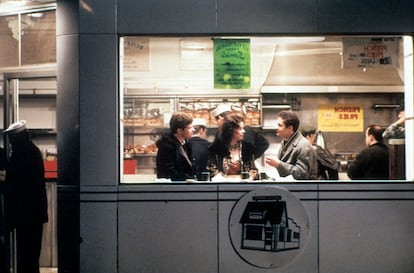
His next project was a better bet. He was one of the protagonists in Barry Levinson’s Diner (1982), a comedy about the ramblings of a group of twenty-somethings in the late 1950s, co-starring with Mickey Rourke and Kevin Bacon. It was not a massive success with the public but the critics, led by the usually ruthless Pauline Kael, loved it. Vanity Fair considers it one of the films that changed cinema and in 2009, and The New Yorker television critic, Nancy Franklin, stated that “Levinson should get royalties any time two or more men sit together in a coffee shop.”
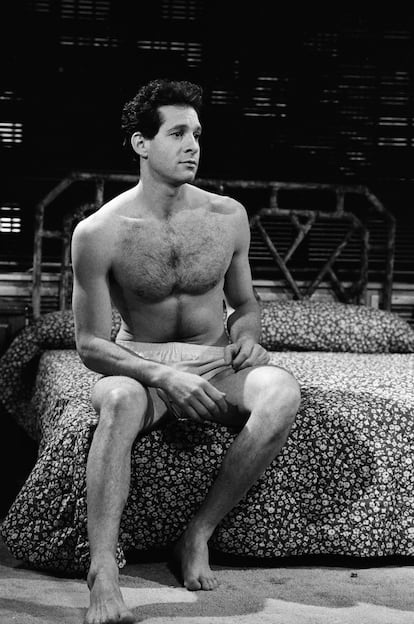
Guttenberg started to feel more at home in Hollywood. He auditioned for Splash (1984), though the producers opted for Tom Hanks, someone with a similar profile: a normal guy, a bit silly-looking, but so charming that he could play a believable heartthrob. Hanks and Michael Keaton were his rivals; all three aspired to the same type of roles. Guttenberg was liked by men, women and children, and was even embraced by the gay community after appearing half-naked in the comedy The Man Who Wasn’t There (1983). “I know, I’m very proud of that,” he says of the appreciation. Has he ever had sex with men? “Never,” he says apologetically. “I like the other ice cream. But it’s nice to have someone saying hello, getting a little attention.”
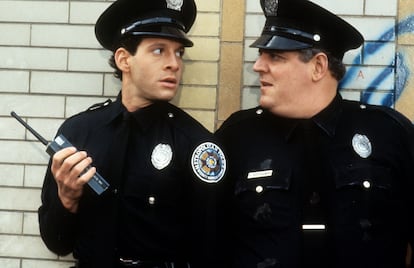
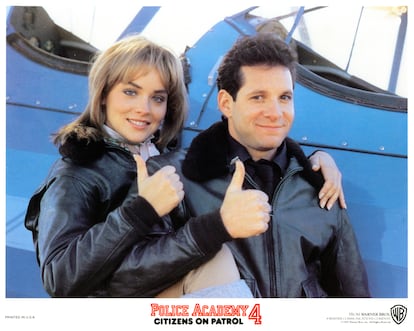
He went on to make the producers of Police Academy (1984) fall in love with him. His winning move was to show up to the audition in a New York police shirt that had belonged to his father. The crazy comedy about a group of rookie cops, in which he starred with Bubba Smith and Kim Cattrall, became one of the highest grossing movies of 1984. And at the center of that group of disastrous law enforcement officers was his character Carey Mahoney, the biggest role of his career.
There were three sequels, but he dropped out of the fourth when they refused to pay him what he believed he was worth. At that point he was already a star. Cocoon (1985) had also triumphed — the story of a group of old people who are rejuvenated thanks to aliens. The movie also starred Jessica Tandy, Gwen Verdon and Don Ameche. One day Guttenberg asked Tandy and her husband Hume Cronyn, who was also in the film, for advice. He thought they would tell him to read the classics, but they were more practical: “Save your money,” they said.
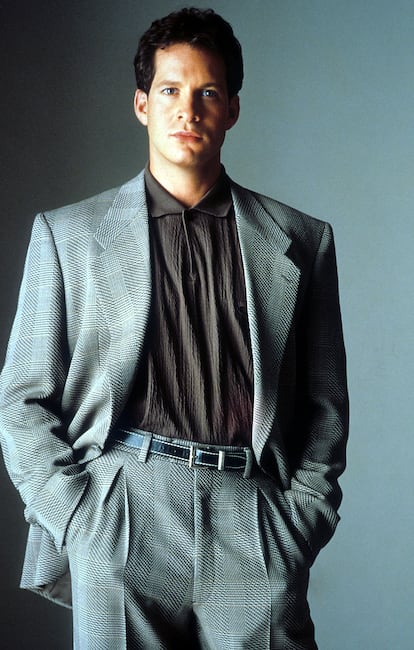
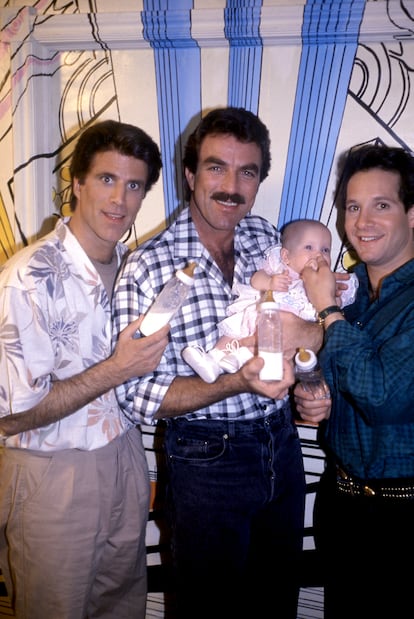
A tireless worker, Guttenberg continued to string together one project after another until the script of Short Circuit (1986) crossed his path. It is the story of a robot that acquires human consciousness after being struck by lightning; As soon as he read it, he knew it would be a hit. If Short Circuit looked like a winner, the highest-grossing film of his career, Three Men and a Baby (1987) looked even more promising. The American version of a successful French comedy, the movie reunited him with Tom Selleck and Ted Danson. “Selleck could stop a hockey stadium with his presence,” he said of his co-star. Both Danson and Sellek partied, he did not. “My idea of a good time was watching sports and eating pizza,” he said. “Ted and Tom are older than I am, but in actuality, I felt the oldest.”
Guttenberg, the man unknown to the L.A. Reporter, was, in short, one of the biggest stars of the 1980s: more than six films in which he participated grossed over $100 million and for years he appeared in box office hits. However, his image could not have been further from that of a prototypical Hollywood star of the time. He stayed away from scandals and especially from cocaine, the go-to 1980s party drug. “I tried it, but it wasn’t a part of my life,” the star told People. “Some people I know would do it all the time, and I’d be like, ‘How can you do this every day? Don’t you feel lousy in the morning?’ They’re like, ‘Yeah, you got to get it back together in the morning.’ That wasn’t for me.”
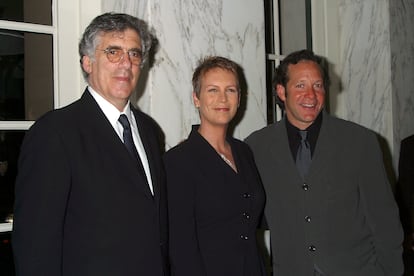
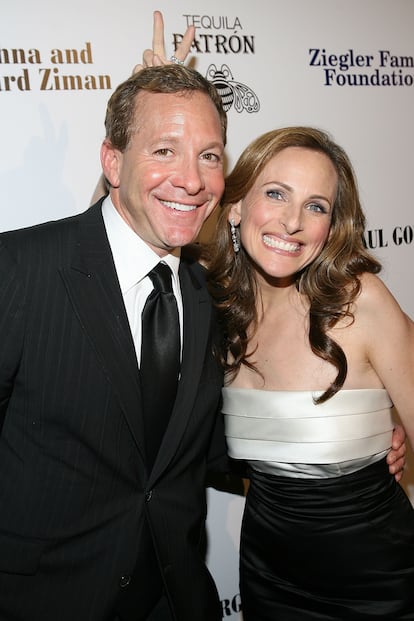
Guttenberg’s luck began to change as the decade ended. The sequel to Cocoon (1989) more or less bombed as did Three Men and a Little Lady (1990), and Guttenberg took a break from the set. When he returned five years later, he failed to find his niche.
Healthy perspective
“It fucks you up. But you have to have a healthy mind about it, and you also have to worry about how you’re going to eat next week, your rent and all. One day our acting class went to the zoo, and someone pointed out a rhinoceros and said we needed the hide of that.”
That perspective would serve him well for the rest of his career. After his return, he had a small role in Home for the Holidays (1995), Jodie Foster’s second film as a director. It is the last relevant film of his career.
For the past 30 years, he has been combining film, television and theater. He has also directed and written several books. His only notable roles have come through series such as Party Down, where he played himself, and also a pedophile on Veronica Mars. He was also in Original Gangster, a British thriller in which he played a sadistic killer with a crazy wig. Guttenberg still hopes that a reputable director will revive his career, as has happened with other stars of commercial cinema in the 1980s. In the meantime, he continues to work tirelessly and has five films waiting for release.
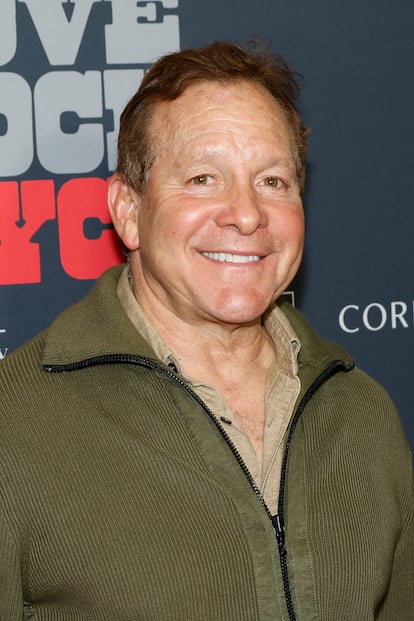
Still, there are plenty of people who like to keep Guttenberg in his place, telling him he is not Tom Hanks. But he is not too bothered. In 2021, he told The Guardian, “You know, [mob boss] John Gotti had a great line that I think about when people come up and say: ‘You’re not Tom Hanks, you’re not Olivier.’ He said: ‘I became everything I wanted to become — how about you?’ And I did! I wanted to be a movie star, and I achieved my little plan. This business has been better than terrific to me. It allowed me to help my sisters, my parents, my grandmother. It’s been extraordinary, and I’m grateful every day.”
Sign up for our weekly newsletter to get more English-language news coverage from EL PAÍS USA Edition
Tu suscripción se está usando en otro dispositivo
¿Quieres añadir otro usuario a tu suscripción?
Si continúas leyendo en este dispositivo, no se podrá leer en el otro.
FlechaTu suscripción se está usando en otro dispositivo y solo puedes acceder a EL PAÍS desde un dispositivo a la vez.
Si quieres compartir tu cuenta, cambia tu suscripción a la modalidad Premium, así podrás añadir otro usuario. Cada uno accederá con su propia cuenta de email, lo que os permitirá personalizar vuestra experiencia en EL PAÍS.
¿Tienes una suscripción de empresa? Accede aquí para contratar más cuentas.
En el caso de no saber quién está usando tu cuenta, te recomendamos cambiar tu contraseña aquí.
Si decides continuar compartiendo tu cuenta, este mensaje se mostrará en tu dispositivo y en el de la otra persona que está usando tu cuenta de forma indefinida, afectando a tu experiencia de lectura. Puedes consultar aquí los términos y condiciones de la suscripción digital.