Baz Luhrmann returns to Elvis Presley, but this time in the King’s own words
The Australian filmmaker presents ‘EPiC,’ a film featuring footage of concerts in Las Vegas from 1970 and previously unreleased statements from the singer
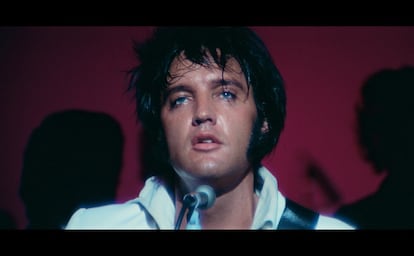
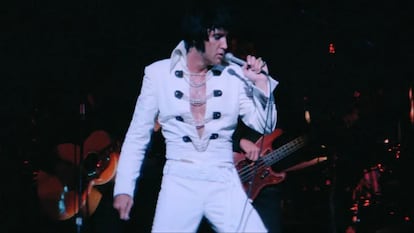
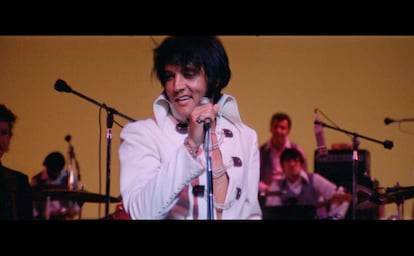
Las Vegas, 1970. Dressed in his iconic white suit with high lapels, Elvis Presley takes the stage at the International Hotel, where he’s been performing for two years, before an audience of 2,200 people — the hotel was the largest entertainment venue in the city at the time — comprised of lifelong fans and celebrities like Cary Grant and Sammy Davis, Jr., who wouldn’t miss seeing the man already known as the King of Rock and Roll in concert. Elvis bursts onto the stage; he’s in top form, singing with volcanic power, looking physically fit, joking even during songs with the musicians and backing singers, among them the Sweet Inspirations, with Whitney’s mother, Cissy Houston, on board, and blessing every devoted fan who manages to hug him with kisses on the lips. He seems exuberant, doing what he loves most: bringing joy to the audience through music. The show is a phenomenal success.
Moments like these are what EPiC (Elvis Presley in Concert) shows and which, in the words of its director, Baz Luhrmann, “is not exactly a documentary or a concert video, but a poem in which Elvis tells his story.” Indeed, because the film is not solely composed of live music: in addition to the 8mm negatives that the filmmaker rescued from an MGM warehouse in Kansas, which capture the performances, the footage is interspersed with statements from the artist himself, taken from a previously unreleased 40-minute audio recording, in which he reveals another side: the offstage Elvis. In his monologue, the King confesses his disappointment over the poor quality of his films and his anxiety, as well as frustration, about the European and Japanese tour that he is struggling to put together.
“He never actually performed there,” Luhrmann explains, “and he kept going back to Las Vegas. It was like a bird crashing into a window. He didn’t know why he wasn’t able to go to Europe. He ended up performing in Las Vegas for seven years.” Then came the transition between the regal Elvis and the caricatured one: “The Elvis in his Halloween costume, the joke Elvis, is the one from four or five years later. He went into decline because, to quote his song [Suspicious Minds], he was ‘caught in a trap’ and couldn’t get out.”
The reason for that fateful confinement in a gilded cage has already been addressed by Luhrmann in his previous work about the singer, Elvis (2022), a biography told through the eyes of his manager, the infamous Colonel Parker, who was neither a colonel nor named Parker. “He conceived of the artist as a circus character,” the director notes, “but he becomes one of the most incredible creative forces in the United States.” Parker received 50% of Elvis’s earnings, an unbreakable agreement: every time the singer tried to end their relationship, the manager presented him with a million-dollar bill he couldn’t afford. The fake colonel, an undocumented Dutchman (as was later revealed), couldn’t leave the United States without risking being denied re-entry, which thwarted Elvis’s plans to perform further afield.
Although both films seem linked, even down to similar, gold-saturated opening credits, their director doesn’t consider EPiC a continuation of the biopic, but rather “a kind of counterpoint.” “This new film focuses more on letting Elvis tell you, as he says, his version of the story.” It’s unusual for a director to dedicate two projects to the same subject, which, in Luhrmann’s case, suggests a certain fascination with Elvis. “When I was a kid, I loved his movies, but that wasn’t the driving force behind making the first one. It was more about exploring America through Elvis. It’s the story of a charlatan who takes something pure, American, and authentic and sells and resells it until it all goes wrong. With the new film, I learned that, as Elvis says in the recordings, it’s very hard to live up to an image. I think I’ve come to know the man by watching all those hours of footage: that shy, vulnerable, empathetic, and kind man who liked to make people feel comfortable.”
Indeed, Luhrmann has become an expert on all things Elvis in this process. “He’s much more than a music icon,” he notes. “He’s an inextricable part of the fabric of America in the fifties, sixties, and seventies; he was the thread that held that fabric together. Today that fabric is frayed, and it’s a good time, once again, to look at the foundations that shaped it and made America a fresh and reinvented place.”
Luhrmann manages, through concerts and interviews, to open up the artist’s soul during a bittersweet period. “I think he was absolutely content when he was in front of an audience,” he says. “He didn’t have stage fright; he was frightened about leaving the stage. That’s why he felt so comfortable out there. He found peace on stage, but not off it. The films he made were money-making machines. He was the highest-paid actor in Hollywood, although, if you look at his early films, like King Creole, he can actually act. While he was performing in Las Vegas, there was talk that he would film A Star Is Born with Barbra Streisand [a role that would go to Kris Kristofferson], and once again someone — I won’t say who — sabotaged it,” he says, alluding to Parker.
Only one other pop singer has reached Elvis’s status, according to Luhrmann: “Michael Jackson and Elvis were strangely connected, beyond Lisa Marie [Presley’s daughter, whom Jackson married in 1994]. Michael thought, ‘If Elvis is called the King of Rock and Roll, I want to be the King of Pop.’ They were both obscenely famous. They were among the most famous men on the planet. No human being is ever truly prepared for that level of fame. Ultimately, it’s destructive. I have a lot of respect for Michael, whom I knew. We can say whatever we want about these iconic figures, but none of us have lived a life even remotely like theirs. Normal things, like romantic relationships or lying on a beach in the sun, aren’t for them. What they are made for is connecting with the public.”
Elvis died in 1977, at the age of 42, after a gradual self-destruction fueled by pills and hamburgers. “I’m not sure he chose it,” Luhrmann hesitates. “Every time he couldn’t understand why he was caught up in that circus, he’d pull himself together and you could see the great Elvis, like in the 1968 comeback special for NBC. That show is totally him. It’s Elvis saying, ‘Okay, I’m going to show everyone what I can do.’ But he didn’t understand why he had this kind of miasma around him. He lost the will to fight.”
Had he not succumbed, what would have become of Elvis? “I have the feeling,” Luhrmann muses, “that if he had done the world tour he dreamed of, he would have understood that he didn’t need the colonel. That’s what we’ve tried to do: give Elvis the world tour he dreamed of but never had. That’s EPiC. Now he’s on his EPiC world tour.”
Sign up for our weekly newsletter to get more English-language news coverage from EL PAÍS USA Edition
Tu suscripción se está usando en otro dispositivo
¿Quieres añadir otro usuario a tu suscripción?
Si continúas leyendo en este dispositivo, no se podrá leer en el otro.
FlechaTu suscripción se está usando en otro dispositivo y solo puedes acceder a EL PAÍS desde un dispositivo a la vez.
Si quieres compartir tu cuenta, cambia tu suscripción a la modalidad Premium, así podrás añadir otro usuario. Cada uno accederá con su propia cuenta de email, lo que os permitirá personalizar vuestra experiencia en EL PAÍS.
¿Tienes una suscripción de empresa? Accede aquí para contratar más cuentas.
En el caso de no saber quién está usando tu cuenta, te recomendamos cambiar tu contraseña aquí.
Si decides continuar compartiendo tu cuenta, este mensaje se mostrará en tu dispositivo y en el de la otra persona que está usando tu cuenta de forma indefinida, afectando a tu experiencia de lectura. Puedes consultar aquí los términos y condiciones de la suscripción digital.