LAM, the museum that displays a portrait made with sausages and a sculpture of moldy grapes
Located in The Netherlands, the center has an art collection focused on food, drink and consumption where the goal is to ‘tell stories that use something as everyday as food as a starting point’

About 40 minutes by car from Amsterdam lies the town of Lisse, famous for the spectacular Keukenhof Tulip Gardens, which transforms into a colorful tourist attraction every spring. Although the name “Keukenhof” immediately brings flowers to mind, it also contains the word “keuken,” which means “kitchen” in Dutch. Therefore, it makes perfect sense that a museum dedicated to food should be located here.
The Lisser Art Museum (LAM) opened its doors in 2018 on a site that, in the 15th century, was part of the estate of Teylingen Castle, the residence of Countess Jacqueline of Bavaria. Before becoming the flower-filled garden that it is today, this was the grounds where the castle staff obtained everything they needed for their kitchen: herbs, berries and game. “With the LAM museum and the theme of its art collection, we’ve brought cooking back to this place in a more contemporary way,” explains Sietske van Zanten, the museum’s director.
For a work to be included in the LAM, it must have some kind of relationship with food, drink or consumption. The museum often refers to its collection as “food art.” However, as its director suggests, “perhaps it deserves a new name.” Indeed, the works exhibited here are related to food, “but a pretty photograph that simply shows something to eat isn’t enough for us,” she clarifies. “The work has to have more layers; [it must] tell stories that use something as everyday as food as a starting point. We want to contemplate the ordinary in a new and extraordinary way.”
Until the museum finds another way to refer to the type of art that it houses, the LAM claims to possess the world’s largest collection of food art. This includes paintings, sculptures, installations, videos, as well as sound and digital art pieces by both established and emerging artists. The museum doesn’t organize temporary exhibitions, but the curators do create thematic programs that allow for the works in their collection to frequently be rearranged.
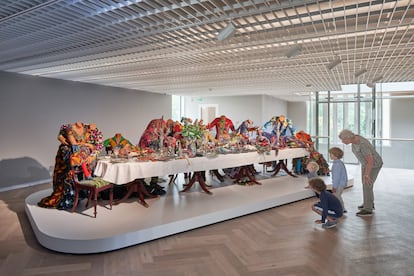
Last summer, for example, they focused on snacks. Currently, the theme is Feast at the Table, a celebration of everything that happens around a dining table. And, in the coming months, the curators note, they will explore the theme of food portraits and the phenomenon of finding faces in what we eat, with Tasty Faces. “Our goal is to provide a fresh perspective with each visit. By regularly rearranging the works and presenting them with a focus on different themes, a piece that previously went unnoticed can suddenly capture your attention, or tell a new story when placed next to another,” the museum director says. Furthermore, the LAM collection grows every year with new acquisitions.
This museum’s connection to food goes beyond the works it exhibits: the VandenBroek Foundation – which is behind the project – belongs to the Van den Broek family. They’re the owners of Dirk, a Dutch supermarket chain. In addition to this museum, the foundation supports other art and music projects, through institutions such as the Royal Concertgebouw Orchestra, the De Ateliers art school and the Rijksmuseum’s Teekenschool.
What’s on display in a museum dedicated to food? Well, just inside the LAM, the staff recommends going up to the top floor of the three-story building, which was designed by Arie Korbee. Next to the elevator, you’ll find Min of Meer (“More or Less”), a work by Guda Koster and Frans van Tartwijk: it’s made out of shopping bags, which form the shape of a person. On special occasions, this piece comes to life and recites a poem that is, in fact, a shopping list.
Inside the glass elevator, another surprise awaits: on the ceiling, a package of Skittles made of felt and embroidery appears to have fallen and spilled. It’s actually a work by textile artist Dagmar Stap.
Upon reaching the upper floor, we’re greeted by Ron Mueck’s hyperrealistic sculpture, Woman with Shopping (2014). A woman – having just left the supermarket – carries a baby tucked into her coat. The baby stares intently at her, trying to get her attention, while she remains lost in thought. In the museum, we’re invited to look at what’s inside the shopping bags (a bottle of wine is clearly visible) and to reflect on the almost imposed happiness that’s supposed to accompany motherhood.
Very close to this piece, there are heads that appear to be sculpted out of clay. A LAM employee encourages us to smell them and try to decipher their aroma. “It’s chocolate,” he reveals. They were conceived by Renzo Martens and are part of a larger series dedicated to denouncing the precarious conditions faced by workers on cocoa plantations.
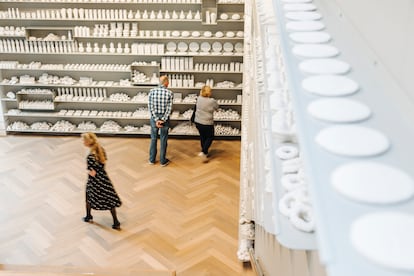
One of the museum’s most striking works is by the artist Itamar Gilboa. Spanning two floors, it features shelves that display 8,000 reproductions of food made from white porcelain. It represents all the food that the artist consumed during a year living in Amsterdam, which he meticulously recorded in a diary. It’s titled Food Chain Project. By transforming food into art, that very art – through its market value – can be transformed back into food, thus returning to the food chain.
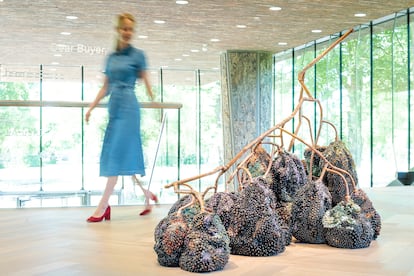
Another gem at the LAM is the sculpture of moldy grapes by the artist Kathleen Ryan, made with glass beads and precious stones. “It’s a contemporary vanitas (the artistic genre that evokes the transience of life and material things). On the one hand, its sheen is tempting; on the other, the moldy grapes generate a feeling of revulsion.” It’s not the only work that encourages us to observe the process of food decomposition with different eyes: by using some simple colored pencils, the artist Lisette de Greeuw conveys the various tones that a tangerine acquires as it decomposes.
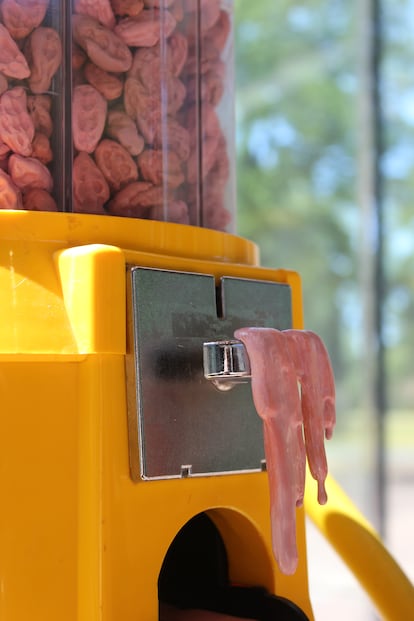
Kira Fröse is behind one of the museum’s most striking pieces: a machine dispensing chewing gum – made with a mixture of sugar, syrup and water, encased in plastic – that evokes a combination of tenderness and disgust. The intention is to make us think about contrasts.
Kitchen towels, popcorn, potato chips, a bowl of cereal and takeout containers are some of the everyday objects and foods featured in other works at the museum. There are no labels at the LAM, but information about the exhibited pieces can be accessed via QR codes, which are located on each floor. This is how we discovered that a portrait made with sausages is actually inspired by cave paintings. Its creator Ceel Mogami asks: if our ancestors drew bison in caves, what would we draw today? What food would we consider important to depict? Sausages, perhaps? Thanks to the QR code, we also discovered that slices of cured meats – arranged to recreate the mechanism of a clock – prompt reflection on ultra-processed meats and whether it’s time to stop consuming them.
A museum that thinks (a lot) about its visitors
One of the first things that visitors to the LAM are encouraged to do upon entering is to ask questions of the staff, whom the museum refers to as “viewing coaches.” These staff members can also ask questions of the public, in order to generate conversation around any of the works. “People who come to the museum perceive things that we don’t. Every day, we learn from our visitors,” Sietske van Zanten explains. “We anonymously share stories and discoveries in an online journal that we all read. This allows us to directly apply the experiences and knowledge of our visitors and constantly improve.”
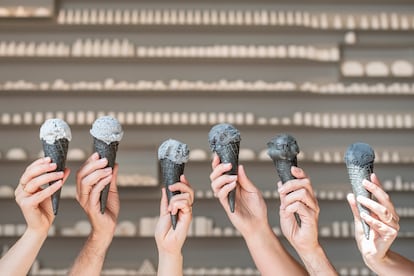
The LAM also organizes special events and art activations, which always manage to surprise visitors. One of the most popular was Taste an Artwork, for which the curators developed flavors inspired by specific pieces in the collection. During the summer of 2023, the public encountered the disconcerting work Escala de Cinzas (“Gray Scale”) by Brazilian artist João Loureiro. “Outside the museum, we set up an ice cream cart with six flavors, in six different shades of gray. How festive is ice cream if it has no color? And what does it taste like when the color that’s so familiar to us disappears?” Van Zanten asks.
The museum’s very concept attracts a diverse audience: there are art lovers and tourists wandering through the Keukenhof Gardens, as well as many families in search of an activity suitable for all ages. Hence, the staff wants to ensure that everyone feels welcome. “A good day is one in which we hear our visitors laughing and talking loudly. It’s a sign that they’re comfortable,” the LAM director concludes.
Sign up for our weekly newsletter to get more English-language news coverage from EL PAÍS USA Edition
Tu suscripción se está usando en otro dispositivo
¿Quieres añadir otro usuario a tu suscripción?
Si continúas leyendo en este dispositivo, no se podrá leer en el otro.
FlechaTu suscripción se está usando en otro dispositivo y solo puedes acceder a EL PAÍS desde un dispositivo a la vez.
Si quieres compartir tu cuenta, cambia tu suscripción a la modalidad Premium, así podrás añadir otro usuario. Cada uno accederá con su propia cuenta de email, lo que os permitirá personalizar vuestra experiencia en EL PAÍS.
¿Tienes una suscripción de empresa? Accede aquí para contratar más cuentas.
En el caso de no saber quién está usando tu cuenta, te recomendamos cambiar tu contraseña aquí.
Si decides continuar compartiendo tu cuenta, este mensaje se mostrará en tu dispositivo y en el de la otra persona que está usando tu cuenta de forma indefinida, afectando a tu experiencia de lectura. Puedes consultar aquí los términos y condiciones de la suscripción digital.