Wagner Moura, Oscar nominee: ‘We’re in a very ugly time, even I am afraid of running into ICE’
The actor, who catapulted into fame with ‘Narcos’ and stars in ‘The Secret Agent’, was a leading voice against Bolsonaro: ‘The similarities between the recent history of Brazil and the United States are obvious’


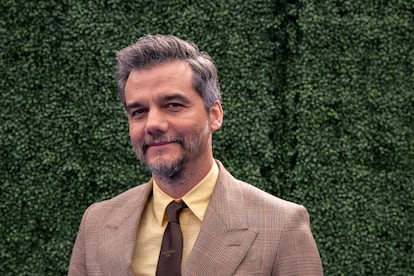
Brazilian actor Wagner Moura, 49, can be seen seated in front of a computer in Los Angeles. He has lived in the city for years with his three children and wife, the photographer Sandra Delgado. In just a few hours, he will be on the red carpet at the Independent Spirit Awards, one of many he will have trekked since the release of The Secret Agent, Kleber Mendonça Filho’s thriller that premiered at Cannes, where Moura won the award for best actor. “It’s been going on for awhile,” laughs the performer, who is now nominated for an Oscar — one of four nominations for the film.
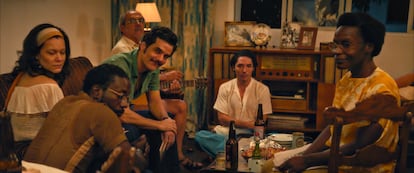
Yes, The Secret Agent is a thriller, and at the same time, a stripped-down portrait of the cruelty of the 1970s Brazilian dictatorship, as well as the importance of resistance against injustice, even in the smallest of ways, and the preservation of the memory of the oppressed. Moura and Mendonça Filho met at Cannes in 2005 when the former was presenting the movie Lower City and the latter was attending in the capacity of film critic. “Both of us are from northeastern Brazil. When Kleber made the leap into directing, I began to follow his projects. I told him that if some day he had a project for me…,” Moura trails off in a perfect Spanish that he learned to bring Pablo Escobar to life in the series Narcos. “We were talking, not much else. And then came Bolsonaro’s coup.”
That was when the director and actor became spokespeople for intellectuals opposed to the arch-conservative’s uprising. “We began to communicate, to see how each other was doing, and we became close. Bolsonaro launched a campaign of censorship against my movie Marighella [a bio-pic that Moura directed in 2019 about a writer-turned-Brazilian Communist Party leader], which was not released until 2021. He had his own battles. So when he began to write The Secret Agent, I came along for the ride. We both make political art.”
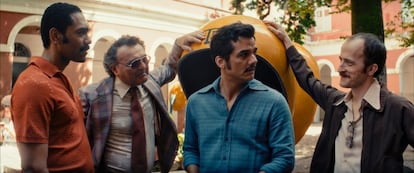
Question. Your character is not a kingpin or a leader, but rather someone who fights the dictatorship in their day-to-day life.
Answer. And that is a fundamental part of it. Like the people in Minneapolis who were recording ICE with their phones. I had already directed a film about a revolutionary, about Marighella, now it was the common man’s turn, because that is who is the common victims of dictatorships. That is who the people are who being persecuted here in the United States because of the color of their skin, their phenotype, their accents, their religion, their political ideas. Authoritarian regimes go after them, so I have loved playing a man who wants to stay true to his values. He doesn’t need to be Che Guevara, just to resist evil.
Q. Do you agree that there are parallels between what has been happening in recent years in Brazil and the United States?
A. At least we have freed ourselves from Bolsonaro. The similarities between the recent histories of Brazil and the United States are obvious. And what really stands out to me is how it is the same kind of person who has been elected specifically to be in power and whose ideological pattern is the same. That’s true for right now, and in similar historical moments. I am very proud of how politically skillful Lula was when Trump pressured him to set Bolsonaro free. The way that Brazil reacted to the invasion of its institutions has a lot to do with our memory of the military dictatorship. The Americans have never gone through a dictatorship, and that’s why they don’t have fear of it. Many think that democracy is a given. Others do not, and there is a beautiful legacy here of battles for civil rights under leaders like Martin Luther King. We’ll see, because United States is the nation that has exported ideals of democracy and social equality to the rest of the world, and look at what is happening.
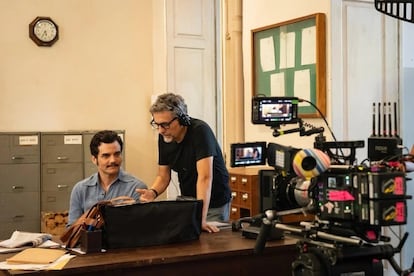
Q. Tension is building, almost to the point that the events of Civil War, the Alex Garland film in which you played a journalist in a dystopian U.S. Civil war, may be possible.
A. That’s wild, isn’t it? How the relationship between the states and the president has become so fraught. We’re in a very ugly time, even I am afraid of running into ICE. I’m saying that because I react in a very explosive way when there is a situation of injustice or authoritarianism before me. And now, I don’t know if I’ll be able to do that, because those assholes can kill you, as we have seen. I know many Latinos who are hiding in their homes, who aren’t bringing their children to school. We are in very sad times. It’s strange how the same patterns that took place in Brazil are repeating themselves. For example, demonizing actors, artists, journalists and universities. The extreme right in Brazil was very effective in turning Brazilian artists into the enemy of the people. They used a discourse whose messages were that these people were living off of public funds. And how they managed to make the truth disappear.
Q. Facts no longer exist, everything is opinion.
A. Exactly, caused by technology that has been applied to social media. The truth as we know it is over. The facts no longer matter. Now people are dealing with versions of reality. It’s crazy to me. What you see is different than what is seen by a MAGA or a Bolsonaro supporter. And it may be that person isn’t bad, just that they’re living in a parallel world, with different information and content, a deceptive world disconnected from reality.
Q. Is social media to blame?
A. A decade ago in Brazil, we were very naive. A decade ago, we thought that Facebook could be a tool for connection, for mobilizing people and democratizing information. Today, the alliance between the tech oligarchs and the far right is clear. In a certain way, we progressives have lost the battle of social media. But we have to keep at it, it’s important to keep committing small acts of disobedience.
Q. Is there any hope?
A. Yes, and it’s called solidarity. In moments of sadness, of darkness, of authoritarianisms, or when environmental tragedies take place, solidarity is there. That is exciting to me, and I believe that human beings have a tendency to take care of each other, to come to agreements. Ah, and memory. Today, Brazil is taking a healthy approach to historical memory. That includes sending Bolsonaro to jail, because the past coup cannot be erased. That’s why it’s beautiful to me that The Secret Agent, whose ending underlines the importance of historic memory, is playing at this time.
Q. How is the Oscar campaign going?
A. Well, it’s a lot of work, more than promoting a film. Since May, when Neon bought the U.S. Rights, we’ve been at it. I also try to enjoy it, because this doesn’t happen every day, you know? At least to me [laughs]. Well, it’s beautiful, but you have to know what is reality, and reality catches up to me when I go home and my kids are waiting.
Question. Before The Secret Agent, you went a decade without acting in the Portuguese language. Why?
Answer. Well, because I did Narcos for two years in Spanish, the biopic about Brazilian diplomat Sérgio Vieira de Mello, which was filmed in English because of his international work, because I filmed in Europe and for series… And because I was working on promoting my film about Marighella, which was in Portuguese, but I didn’t act in it. That’s how it happened.
Question. Why are all your characters ultimately so melancholic?
Answer. It’s true [laughs]. My life is a constant battle against melancholy and baldness.
Question. And how is it going?
Answer. The hair part, bad. I have to do my hair in a very particular way. And the same with the melancholy. In conclusion, another two battles lost. Look, the most beautiful characters are those that carry pain with them.
Question. Do you choose your projects carefully?
Answer. As much as I can, yes. I have an agent who told me, “Do this to get that.” And I told him, “That’s not my thing.” I’m proud to say that, even when I was young and I struggled to make rent, I never did anything I was ashamed of to pay the bills. I mean look, I’ve made bad movies, but with the best of intentions.
Question. Are you still working on The Trial: Enemy of the People [a modern stage version of Ibsen’s Enemy of the People, created by Brazilian director Christiane Jatahy]?
Answer. Yes, and in the summer I will perform it in Spain. Before that, I’ll film a version of Abbas Kiarostami’s Taste of Cherry with Lisandro Alonso and afterwards, I will direct my second feature film, Last Night at the Lobster.
Sign up for our weekly newsletter to get more English-language news coverage from EL PAÍS USA Edition
Tu suscripción se está usando en otro dispositivo
¿Quieres añadir otro usuario a tu suscripción?
Si continúas leyendo en este dispositivo, no se podrá leer en el otro.
FlechaTu suscripción se está usando en otro dispositivo y solo puedes acceder a EL PAÍS desde un dispositivo a la vez.
Si quieres compartir tu cuenta, cambia tu suscripción a la modalidad Premium, así podrás añadir otro usuario. Cada uno accederá con su propia cuenta de email, lo que os permitirá personalizar vuestra experiencia en EL PAÍS.
¿Tienes una suscripción de empresa? Accede aquí para contratar más cuentas.
En el caso de no saber quién está usando tu cuenta, te recomendamos cambiar tu contraseña aquí.
Si decides continuar compartiendo tu cuenta, este mensaje se mostrará en tu dispositivo y en el de la otra persona que está usando tu cuenta de forma indefinida, afectando a tu experiencia de lectura. Puedes consultar aquí los términos y condiciones de la suscripción digital.