Rebecca Hall: ‘We lost counterculture somewhere along the way’
The painter, actress and director works from a very personal, and at the same time communal place, saying, ‘when you paint a face, that creates an exchange’
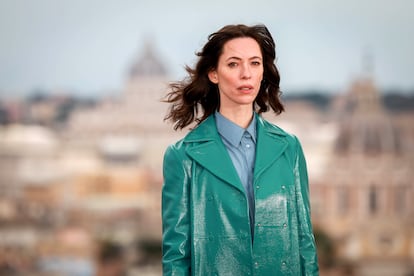
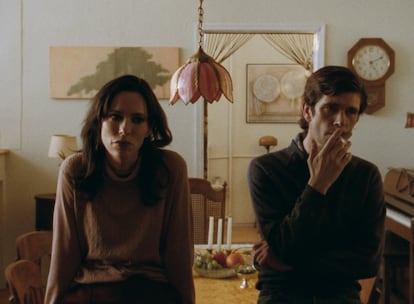
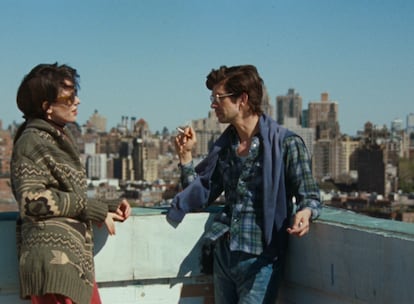
In Peter Hujar’s Day, the new film by Ira Sachs, actors Ben Whishaw and Rebecca Hall spend 75 minutes in dialogue, mentioning “between 70 and 80 names” from New York’s 1970s art scene. Set in 1974, the film brings to the screen the transcript of a real conversation between photographer Peter Hujar and his close friend, writer Linda Rosenkrantz.
In this exchange chat, Hujar describes what a typical day in his life looked like as a central figure in the vibrant artistic world of downtown Manhattan, where he knew everyone and everyone knew him. “There are names that not even Linda remembered, that not even the great photography critic Vince Aletti knew,” says Sachs.
Simply by invoking those people and places — without ever leaving Hujar’s apartment in the legendary Westbeth Artists Community — the film evokes the essence of New York in the era of Andy Warhol and Edie Sedgwick. Hujar was a master portraitist, and both his photographs and the film’s dialogue reveal why: he drew meaning from every second spent with someone.
“His work is poetry,” says Sachs. “His photograph Orgasmic Man? It represents an art and an artist who was honest and different, the kind of art you don’t see that much anymore.”
The film resonates strongly for Rebecca Hall, a 43‑year‑old London‑born actor and painter, because it arrives at a point in her career when she has also stepped forward as a director with Passing, inspired by the story of her mother, opera singer Maria Ewing. Hall, whose father is Sir Peter Hall, founder of the Royal Shakespeare Company, began acting as a child, and confesses that she has also always had a love of painting. “When I waited for my parents at their rehearsals, I was always drawing the actors’ faces,” she remembers.
For years, she kept that art to herself. In a moment of social media crisis (“I was about to leave Instagram, because I didn’t know what to post, I hated it…”) she decided to start sharing her oil paintings, and began to sell them. Last year she had her first exhibition and is now trying to find a way to fit all her talents, plus her family (she is married to actor Morgan Spector and the two have a daughter) into a 24-hour day.
Question. What is a normal day like in the life of an artist?
Answer. [Laughs] Mine aren’t like Peter Hujar’s. I suppose they are full of mundane details. I get up, I make myself coffee, toast.
Q. Your work as a painter includes a lot of portraiture and self-portraiture. How much have you discovered of yourself through painting?
A. I have always been interested in the portrait. And I have always painted and drawn portraits… As an actress, in a certain way, I draw the character. I think that when you paint a face, you observe it for enough time, that it creates an exchange. There’s a kind of natural compassion and empathy. I understand them, or I feel something for them that I can’t express with any other medium. That’s why it was interesting to play Linda in Peter Hujar’s Day because in many ways, hers is that role of observer or compassionate listener. The film is the portrait of a person, of a relationship and of a friendship. I didn’t paint Ben [Whishaw], but I should have. I would like to.
Q. How much time do you now spend on painting and film?
A. My mind is quite fair, I feel like they are the same thing. I don’t separate them. It’s simply about whether I have enough hours in the day. If I am acting, I go and I film, but while I’m on set, I’m always drawing. When I’m at home and not working on any film, I drop off my daughter at school and I go to the studio to paint. And then I take calls about acting or directing projects, or about trying to raise money for my next film.
Q. Passing was a very personal project. Are you already working on your next movie?
A. I want to direct more, but I probably want to do too much [laughs]. I would also like to keep up the acting career I have, because it’s very rewarding. I want to have a career as an artist. I am trying to raise the money for two projects that I have written and I think I am close to doing that; when it happens, it happens, but meanwhile, I’m not going to stop painting or acting. We are in a complicated moment in which people are afraid of taking risks, at least in independent film. Drama is complicated.
Q. Will Four Days Like Sunday — which is inspired by your childhood — be your next film as a director?
A. I don’t know, I’m still trying to make it happen, but it’s not about my mother or my childhood. It’s a novel, but it is inspired by those things. It is a fictionalized account of things that are important to me. I think, actually, that it has a lot to do with the queer community I grew up in. My mother had a lot of young, queer, interesting characters in her life who became very important for me in my family. I don’t think a movie has ever explored the relationship or perspective of a young woman who may or may not end up being heterosexual, but who finds family, or sees herself reflected in these unlikely mirrors. So it’s really about the relationship between a young woman and a queer family. It’s about the idea of what is a family. Where does it come from? How do you make one? Also, how do they see you in your childhood, and how does that form your identity? It is also a story about a very complex mother-daughter relationship, and I think that is always relevant.
Q. What do you remember about your childhood?
A. What do I remember about my childhood? Oof, the images are very… [smiles] I don’t know. I can’t answer that question. I’m not really interested in that kind of self-reflection. I channel it into art. Perhaps some day I will be able to write a book, but that day is very far off.
Q. Peter Hujar represents that kind of artist who worked only in service of art, not for commercial reasons. Do you think that is still possible to do?
A. I don’t know. I am moved by seeing that film because I think about all the artists who lived in Manhattan during the 1970s and yes, they were very concerned about money, but there was also a kind of freedom in that scene, because there was no fast way of accessing commercial art, money, and that allowed you to distance yourself from everything else. I think that we lost counterculture somewhere along the way… The problem today is that artists like Peter Hujar can’t live in Manhattan. Where is that community of people who support each other and create art together for art’s sake? It really doesn’t exist. I think that now, you reach success and you earn money in a lot of ways, but you are isolated, and that sense of creative community is hard to find.
Q. From Godzilla x Kong to Peter Hujar’s Day… it seems like you are also trying to navigate that balance between commercial film and independent projects.
A. We all have to earn money, right? And I think that one facilitates the other. It’s true, that saying, “one for me, one for them.” But I try to approach everything the same way. I look for something that will be fun and enjoyable, regardless of the medium, something that I like. Entertainment has as much value for me as anything that is, I guess, more intellectual. I’m lucky to have been working for enough time in this that they think of me in both spaces.
Sign up for our weekly newsletter to get more English-language news coverage from EL PAÍS USA Edition
Tu suscripción se está usando en otro dispositivo
¿Quieres añadir otro usuario a tu suscripción?
Si continúas leyendo en este dispositivo, no se podrá leer en el otro.
FlechaTu suscripción se está usando en otro dispositivo y solo puedes acceder a EL PAÍS desde un dispositivo a la vez.
Si quieres compartir tu cuenta, cambia tu suscripción a la modalidad Premium, así podrás añadir otro usuario. Cada uno accederá con su propia cuenta de email, lo que os permitirá personalizar vuestra experiencia en EL PAÍS.
¿Tienes una suscripción de empresa? Accede aquí para contratar más cuentas.
En el caso de no saber quién está usando tu cuenta, te recomendamos cambiar tu contraseña aquí.
Si decides continuar compartiendo tu cuenta, este mensaje se mostrará en tu dispositivo y en el de la otra persona que está usando tu cuenta de forma indefinida, afectando a tu experiencia de lectura. Puedes consultar aquí los términos y condiciones de la suscripción digital.