The week in which Puerto Rico celebrates its Afro-descendant heritage
The island hosted the fifth international summit for students, professors, and researchers. It is an academic and cultural space dedicated to critically examining racial history
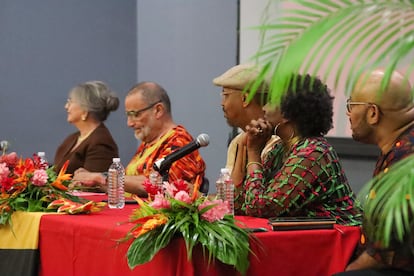
The colors red, black, and yellow adorn a flag with the silhouette of Africa rising from the center of a table. This is the Bandera Cimarrona, a flag conceived at the first edition of the International Summit of Afro-descendants in Puerto Rico in 2022, which stands as a symbol of the resistance, the pursuit of freedom, and the strength of Afro-descendants on the island and throughout the Americas.
“Where are my people?” Someone asks from a corner as the guests, both local and international, begin to gather. “Afro Summit, here!” They respond with the force of a war cry.
In a country that for decades defined itself through the myth of harmonious racial mixing, this celebration, also known as the Afro Summit in Puerto Rico, is an academic and cultural space that aims to critically examine the island’s racial history in order to envision new horizons of justice, reparations, and possible futures. The event, held this week for the fifth time, is the brainchild of the Center for Research and Digital Archives on Afro-descendants (Prafro) at the University of Puerto Rico, Río Piedras Campus in San Juan, which also serves as its venue.
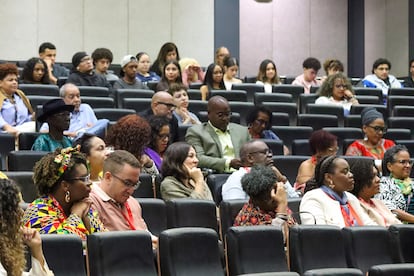
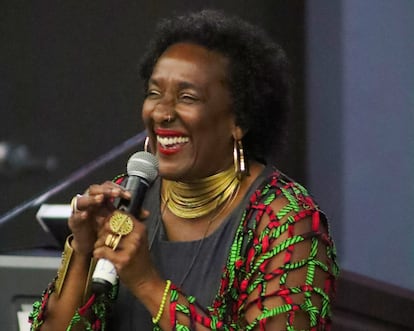
While the first edition of the event focused on affirming Afro-descendant identity during the week of the Eradication of Racism and Affirmation of Afro-descendants on the island, this year it was held under the theme of Black Humanisms: We Are Root and Future. “Rooted in that profound knowledge, we can project a future without Afro-descendants becoming a passing fad,” emphasizes Mayra Santos-Febres, Afro-Puerto Rican writer and principal researcher at Prafro. The theme also emphasizes the importance of honoring the memory passed down from generation to generation. For this reason, the fifth edition of the gathering was dedicated to Dr. Miriam Jiménez Román, an Afro-Puerto Rican researcher and key figure in reaffirming the Afro-diasporic mission of the Schomburg Center and the Afro-Latino Forum in New York.
Furthermore, the event integrated students from the Prafro Center’s internship program in multiple ways. According to Darian Figueroa Viera, the project coordinator, the students are not mere attendees, but rather coordinators and content creators who benefit from the hands-on experience and increased visibility. “Without the internship program, many things wouldn’t work,” she reiterates.
Recognition, integration and visibility
While Latin America re-examines its African heritage, Puerto Rico continues to grapple with its own contradictions: a national identity that celebrates Afro-descendant culture in music and cuisine, yet has historically obscured structural racism. For this reason, the Afro Summit aims to place the island on the map and within the Afro-descendant agenda of the continent. Having achieved official recognition from the University of Puerto Rico, the vision now is to expand. “The ultimate goal of the Prafo Center is its own dissolution,” emphasizes Santos-Febres. That is, to reach a point where its existence is no longer necessary, because Afro-descendant information and knowledge are already fully integrated and accessible. “We will reach our destination when we are no longer relevant, when that information is networked and on par with any other information in the world.”
The creation of Prafro, Santos-Febres recalls, arose from an “existential moment.” “After decades of work on projects diversifying academic research and producing Afro-descendant knowledge, profound questions were needed that went beyond conventional politics and traditional ideological models.” This conviction, along with the murder of George Floyd and the Black Lives Matter protests in the United States, led her to launch the first undergraduate concentration in Afro-descendant studies in June 2020.
But the challenges have been numerous. First, there was the lack of funding, which Santos-Febres overcame when, through colleagues, she discovered that the Andrew W. Mellon Foundation had offered money that had not been used. “Because I am a writer, I maintained connections with several organizations that work in the humanities,” she recalls.
In 2021, the team received an initial grant of $700,000 over three years to develop 25 courses. The result was immediate: the academic offerings increased by 500%. In 2023, they were awarded a second grant of $1.8 million to continue creating courses and conferences.
A key ally in the program’s development has been the School of General Studies (FEG) at the University of Puerto Rico, Río Piedras Campus. According to its chancellor, Carlos Sánchez Zambrana, the purpose of Prafro and the Afro Summit aligns with some of the faculty’s existing areas of specialization, such as Transdisciplinary Research on Afro-descendants, Women’s and Gender Studies, and Human Rights. “The true purpose of the university lies in the pursuit and creation of knowledge, which dismantles myths and ignorance,” he says. “It is an effort to move the university curriculum away from a purely Western approach and integrate African roots into fundamental studies.”
In addition to obtaining their own building, the initiative also aims to expand a visual archive and promote the recognition of Afro-Brazilian knowledge outside of traditional academia; they seek to establish close contact with African diasporas in Europe, particularly Spain, to understand their struggles against modern racism.
The summit audience is made up of people who traveled from Germany, Peru, Colombia, Mexico, and Ivory Coast. Santos-Febres addresses them: “Remember that races don’t exist; racialization and dehumanization do.” “Welcome to the Afro Summit.”
Sign up for our weekly newsletter to get more English-language news coverage from EL PAÍS USA Edition
Tu suscripción se está usando en otro dispositivo
¿Quieres añadir otro usuario a tu suscripción?
Si continúas leyendo en este dispositivo, no se podrá leer en el otro.
FlechaTu suscripción se está usando en otro dispositivo y solo puedes acceder a EL PAÍS desde un dispositivo a la vez.
Si quieres compartir tu cuenta, cambia tu suscripción a la modalidad Premium, así podrás añadir otro usuario. Cada uno accederá con su propia cuenta de email, lo que os permitirá personalizar vuestra experiencia en EL PAÍS.
¿Tienes una suscripción de empresa? Accede aquí para contratar más cuentas.
En el caso de no saber quién está usando tu cuenta, te recomendamos cambiar tu contraseña aquí.
Si decides continuar compartiendo tu cuenta, este mensaje se mostrará en tu dispositivo y en el de la otra persona que está usando tu cuenta de forma indefinida, afectando a tu experiencia de lectura. Puedes consultar aquí los términos y condiciones de la suscripción digital.