US-Mexico trade ties remain strong despite tariffs and USMCA threats
The Latin American country surpasses China and Canada, sending over $447 billion worth of goods to the US in the first 10 months of 2025
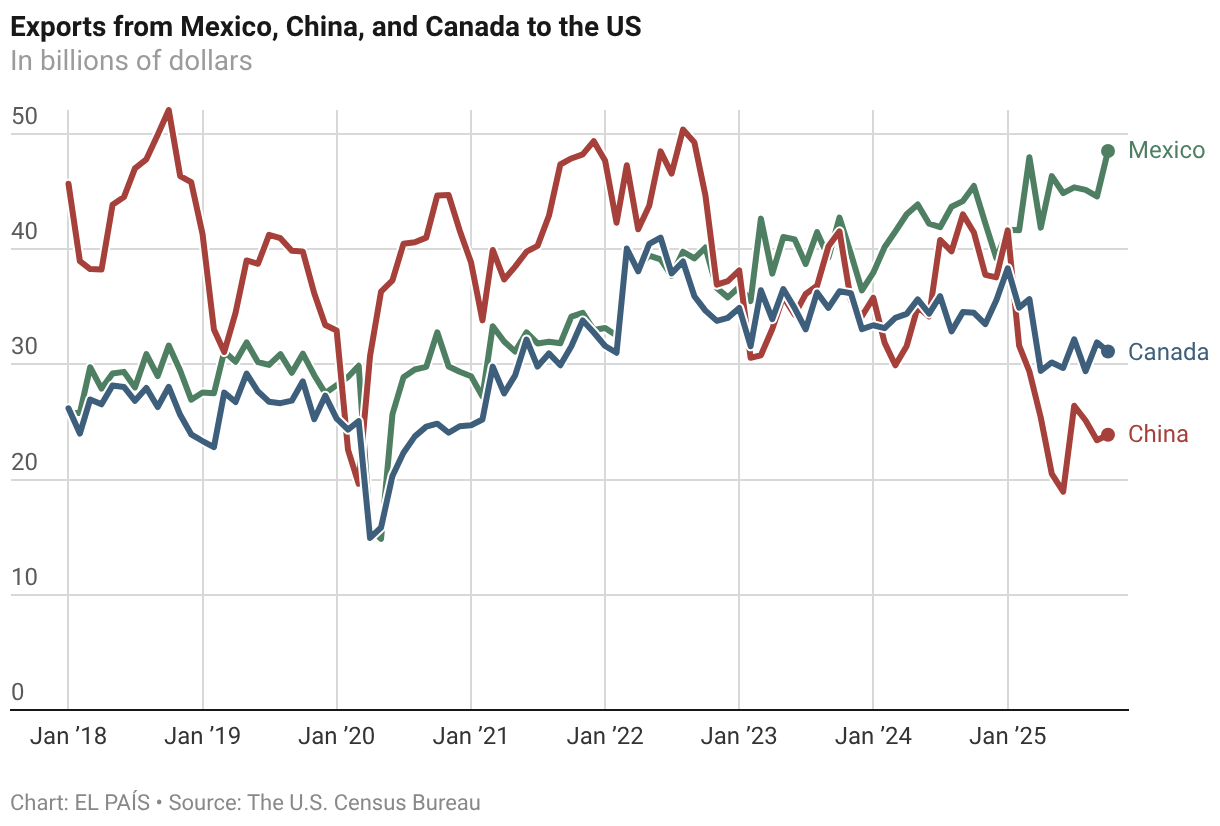

Mexico has consolidated its position as the United States’ top trading partner, despite tariffs and repeated threats from President Donald Trump to withdraw from the USMCA trade agreement and to toughen measures against the country unless drug trafficking is curbed. In October, the Latin American country surpassed China and Canada as the leading exporter of goods to the U.S., with shipments reaching $48.52 billion in October 2025, a record figure representing a 6.7% increase compared to the same month of the previous year. According to U.S. Trade figures, in the first 10 months of last year, Mexican shipments to Washington exceeded $448 billion, equivalent to 15% of total U.S. Imports.
Despite Trump’s imposition of sectoral tariffs on steel and aluminum, as well as on products not covered by the USMCA, Mexico has weathered these storms and maintained its upward trend in exports to the U.S. Official figures show that after Mexico, the main exporters to the U.S. Market in the first 10 months of 2025 were Canada, with a 12.9% share; China, 7.6%; Taiwan, 4.3%; and Germany, 4.2%. Latin America’s second-largest economy has remained the United States’ leading supplier since displacing China in 2023.
Meanwhile, U.S. Sales to Mexico also picked up in 2025. Through October 2025, U.S. Exports to Mexico totaled $283.18 billion, slightly below shipments to Canada, another USMCA partner, which amounted to $283.85 billion. By contrast, China reported imports from the U.S. Of just $90.91 billion over the same period. Amid the tariff war between the two countries, the Asian giant reduced its purchases from the U.S. Market by 18% compared with the first 10 months of 2024.
Within the broad trade relationship between Mexico and the U.S., Grupo Financiero Base highlights a rise in Mexican exports of machinery, equipment, and electrical material, among other goods. “The increase in Chapter 84 is due to the category of automatic data-processing machines — that is, computer equipment — which recorded an 84% increase year to date compared with the same period last year,” the firm said in a recent report.
Unlike the computer equipment sector, Mexican auto and auto parts shipments fell 6.6% in October, dropping from $153.1 billion to just over $143 billion, according to U.S. Trade data. For years, U.S. Automakers with operations in Mexico — such as Ford, General Motors, and Stellantis — have made the country a vital hub for assembling vehicles for the United States. Mexico must pay a tariff proportional to the non-U.S. Content per unit, a factor that has reduced shipments but not halted them entirely.
Mexican authorities maintain that despite Trump’s tariff threats against Mexico, more than 80% of exports to the U.S. Are tariff-free because they meet the requirements of the USMCA, which is scheduled for its major review next July and which Trump has called “irrelevant” to the United States. “We could have it or not, it wouldn’t matter to me,” Trump recently told reporters during a visit to a Ford plant. In response, Mexican President Claudia Sheinbaum defended the agreement and North American economic integration: “Our economies are very interconnected. Those who most strongly defend the treaty are American business leaders, and of course, Mexicans as well,” she stated.
The trade agreement is a significant issue. The United States and Mexico have forged a close relationship through the USMCA. For years, the U.S. Trade deficit with Mexico has been growing, even in the face of the tariff wall. From January to October, this deficit for Washington exceeded $164 billion. This large imbalance has been one of Trump’s favorite arguments to impose tariffs on Mexican exports and question the USMCA. However, international trade experts warn that given the productive integration between the two countries, sustained tariff increases would have a counterproductive effect on the U.S. Economy by triggering inflationary pressures.
A recent report from Grupo Financiero Banamex notes that the strength of Mexico’s non-automotive exports could continue, driven by higher demand for electrical and electronic goods, benefiting the production hubs in the North and Bajío regions. “During 2026, attention will focus on the progress of the USMCA negotiations between Mexico, the United States, and Canada. Current trade tensions stemming from the imposition of tariffs on imports by the U.S. Could continue to impact manufacturing production, especially export-oriented production, and significantly, the production of transportation equipment,” the report explains.
Analysts agree that, based on current figures, Mexico enjoys a relatively favorable tariff position compared to the rest of the world in the U.S. Market. Tariff exemptions for USMCA-compliant exports and the geographic proximity that reduces logistical costs are two of the country’s key export advantages. Nevertheless, uncertainty remains, and most of the cards regarding the future of this trade relationship will be played during the upcoming USMCA review in July 2026.
Sign up for our weekly newsletter to get more English-language news coverage from EL PAÍS USA Edition
Tu suscripción se está usando en otro dispositivo
¿Quieres añadir otro usuario a tu suscripción?
Si continúas leyendo en este dispositivo, no se podrá leer en el otro.
FlechaTu suscripción se está usando en otro dispositivo y solo puedes acceder a EL PAÍS desde un dispositivo a la vez.
Si quieres compartir tu cuenta, cambia tu suscripción a la modalidad Premium, así podrás añadir otro usuario. Cada uno accederá con su propia cuenta de email, lo que os permitirá personalizar vuestra experiencia en EL PAÍS.
¿Tienes una suscripción de empresa? Accede aquí para contratar más cuentas.
En el caso de no saber quién está usando tu cuenta, te recomendamos cambiar tu contraseña aquí.
Si decides continuar compartiendo tu cuenta, este mensaje se mostrará en tu dispositivo y en el de la otra persona que está usando tu cuenta de forma indefinida, afectando a tu experiencia de lectura. Puedes consultar aquí los términos y condiciones de la suscripción digital.