Eric Schmidt: ‘Europe doesn’t have an AI strategy. If it doesn’t invest heavily, it will end up using Chinese models’
The former Google leader warns about the risks to Europeans of their technological dependence
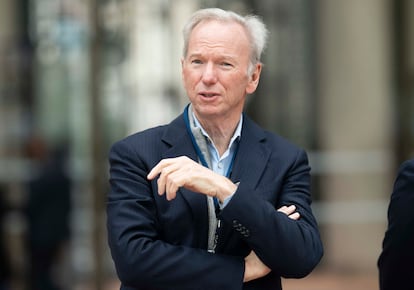

Eric Schmidt has been a central figure at Google for nearly two decades, serving as CEO and executive chairman of the company and of Alphabet, the conglomerate of which Google is a part, between 2001 and 2017. An active supporter of the Democratic Party, he maintained a close relationship with Barack Obama from the beginning. He is currently, among other things, CEO and investor in Relativity Space, an aerospace company. Last week, he met with a group of international journalists in Davos, where he warned that “Europe doesn’t really have any AI strategy” and that “unless it is willing to spend lots of money for the European models, it will end up using the Chinese models.”
Schmidt is emblematic of a time when Silicon Valley showed a majority inclination toward liberal and Democratic ideas. In January 2017, for example, Sergey Brin—co-founder of Google—joined a street protest against the immigration policies of Donald Trump, who had just taken office for his first term. Accounts from that time tell us that Sam Altman was also there. Today, much has changed. Schmidt continues to position himself in favor of the Democrats, but much of Silicon Valley has opted for a strong rapprochement with the Trump administration, as evidenced by the image of tech leaders attending Trump’s second inauguration—Musk, Bezos, Zuckerberg, and Brin himself among them.
On the subject of AI, Schmidt issued a serious warning to Europeans. “It is really important that Europe come up with an open source European-led model. The U.S. Companies are largely moving to closed source, which means they’ll be purchased and licensed. China is largely open-weight, open-source in its approach. All the leading models in China are open-source and open-weight. So unless Europe does something and unless Europe is willing to spend lots of money for the European models, Europe will end up using the Chinese models. That’s probably not a good outcome for Europe,” Schmidt argued at the meeting.
“To achieve this, Europe needs to address its energy prices. It doesn’t have very large data centers. It has tremendous, tremendous top technical talent and it needs a lot of money. So lots of money and lots of hardware,” noted Schmidt, who detects a lack of strategic clarity in Europe in this sector.
“Europe doesn’t really have any AI strategy. The USAI strategy can be understood as AGI, a quest for artificial general intelligence. And the Chinese strategy can be understood as not that. The Chinese strategy is to apply AI in everything, everywhere, all of us. They are different strategies. They have different potential trajectories,” said Schmidt.
Everything Schmidt says points to the need for common European action, given the scale of the required investments and the energy and data demands. Christine Lagarde, President of the ECB, summarized it this way in a panel discussion: “AI is capital-intensive, energy-intensive, and data-intensive. And it thrives when there is an abundance of all of these. If we don’t work cooperatively, if we don’t define the new rules of the game, there will be less data available to process. There will be less capital flowing around. And that doesn’t favor the prosperity of a sector that is currently leading the way and is very promising in terms of productivity. So we are in a situation where there are no alternatives.”
Regarding the AGI rollout, Schmidt believes it will take longer than most experts think. “In San Francisco people believe this will occur in two to three years. I do not. I call this the San Francisco consensus because everyone there believes it. I don’t; I think it will take a bit longer.”
He places the next step, superintelligence, on a horizon of 10 to 20 years.
“The broad consensus on AGI means a computer system that shows the kind of general intelligence that humans have. Current models, based on language, do what they have been trained to do, what they have been incentivized to do. They don’t have the ability to take their own action yet. Now we are moving from language to reasoning: beginning to solve problems. The next big step is systems that can choose which problem to work on. And then there is superintelligence, which is generally defined as the point at which computer systems become more intelligent than the sum of all humans. If computers—not when, but if—can become superintelligent, then we’re in a very, very different regime of humanity.”
Despite the enormous prominence of geopolitical tensions, AI, its prospects—its promises and its risks—were very much present in the Davos debate, as was the awareness of the close ties of many of its major players to the Trump administration, as in the case of Elon Musk—decisive for the tycoon’s victory before disagreements arose—or Peter Thiel, founder of Palantir, a company with an extraordinary link to the U.S. Administration through a sensitive contract worth $10 billion to provide the Pentagon with software and AI for the warfare of the future.
Sign up for our weekly newsletter to get more English-language news coverage from EL PAÍS USA Edition
Tu suscripción se está usando en otro dispositivo
¿Quieres añadir otro usuario a tu suscripción?
Si continúas leyendo en este dispositivo, no se podrá leer en el otro.
FlechaTu suscripción se está usando en otro dispositivo y solo puedes acceder a EL PAÍS desde un dispositivo a la vez.
Si quieres compartir tu cuenta, cambia tu suscripción a la modalidad Premium, así podrás añadir otro usuario. Cada uno accederá con su propia cuenta de email, lo que os permitirá personalizar vuestra experiencia en EL PAÍS.
¿Tienes una suscripción de empresa? Accede aquí para contratar más cuentas.
En el caso de no saber quién está usando tu cuenta, te recomendamos cambiar tu contraseña aquí.
Si decides continuar compartiendo tu cuenta, este mensaje se mostrará en tu dispositivo y en el de la otra persona que está usando tu cuenta de forma indefinida, afectando a tu experiencia de lectura. Puedes consultar aquí los términos y condiciones de la suscripción digital.