Loose ends in the disappearance of the Sinaloa miners: Another case of horror in Mexico
Harfuch points to a criminal misunderstanding as the cause of the workers’ abduction. The bodies of at least five have been found in a mass grave, with another five yet to be identified
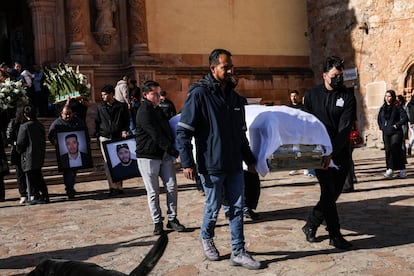

The trickle of information about what happened to the miners kidnapped in Sinaloa has kept uncertainty high in yet another episode that exposes the horror of violence in northwestern Mexico, even as the government of Claudia Sheinbaum announced on Tuesday a 42% drop in intentional homicides nationwide over the past five months.
The explanations offered on Tuesday by the Security Cabinet, led by Omar García Harfuch, about why the miners were abducted have not dispelled doubts about how easily the criminals took them from their camp. According to the authorities, the disappearance of the workers — at least 10 of them — on January 23 was the result of a mix‑up by a criminal group linked to Los Chapitos, a faction of the now‑defunct Sinaloa Cartel. Harfuch said the group believed the workers belonged to a rival gang.
The miners’ case coincides with other violent incidents recorded in the state in recent weeks — events just as serious, or worse — all of them painting a troubling picture. On Tuesday, five men disappeared in the municipality of Ahome, north of Culiacán, the capital of Sinaloa. Last week, four tourists from the State of Mexico met the same fate in Mazatlán, the jewel of the coastal tourism industry. A few days earlier, criminals opened fire on two local lawmakers from the Citizens’ Movement party. But the miners’ case stands out, both for its scale and for the authorities’ stance, as they release information only in dribs and drabs.
Harfuch’s explanations about the supposed mix‑up contrasted on Tuesday with the accounts given by relatives and colleagues of the missing men, which have flooded the press. They say that armed men went directly to the workers’ camp — known as Clementinas — located near the municipal seat of the town where the mine operates, Concordia, in the southern mountains of Sinaloa. It wasn’t that the criminals ran into them on a road, out in the hills, the usual setting for clashes in the region. Nor did it happen at night. They came for them early in the morning, at the place where they lived and rested. And from there, they were abducted.
To make matters worse, the identification of the bodies of five of the kidnapped miners in clandestine graves makes it difficult to imagine any outcome other than that all 10 missing men were killed. The Attorney General’s Office (FGR), which took over the investigation last week, reported on Monday the discovery of the human remains in a village not far from the municipal seat of Concordia, known as El Verde. Another five bodies remain on the forensic examiner’s table, awaiting identification. Information has trickled out slowly, amid talk of the large number of bodies that may actually be buried in that and other graves in the area, and growing discouragement over the persistence of organized crime in the region.
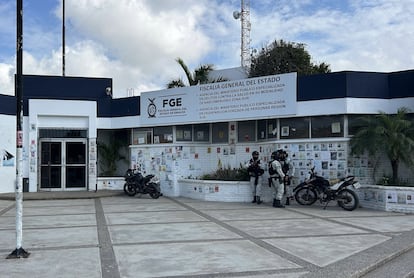
By now, few in Mexico are unaware that the southern mountains of Sinaloa had long been a troubled region, even if much of the violence stayed out of sight. The war between Los Chapitos — the faction led by the sons of the former kingpin Joaquín “El Chapo” Guzmán — and Los Mayos, the group headed by followers of Ismael “El Mayo” Zambada, has spread beyond its traditional trenches in Culiacán, its districts, and the surrounding municipalities, igniting violence in other regions as well. In the south, in municipalities such as Concordia, Escuinapa, El Rosario, and Mazatlán, the fighting has recently intensified. This comes despite dozens of arrests and seizures over the past 16 months, the time the current government led by Claudia Sheinbaum has been in office.
According to a source within the security forces deployed in Sinaloa, two groups are battling in the mountainous area of Mazatlán. One is linked to Los Chapitos and led by Gabriel Nicolás Martínez, known as “Gabito” or “El 80,” supported by his brother Óscar, alias “Casco.” “They’re fighting with Los Cabrera,” the source says, referring to another group that emerged between Durango and Coahuila — longtime allies of Mayo Zambada and now of his son, Ismael Zambada Sicairos, known as “Mayito Flaco.” The conflict revolves around the routes connecting Sinaloa and Durango, the operation of clandestine labs producing synthetic drugs, and influence over the formal economy, where mining plays an important role.
Harfuch said on Tuesday that the Security Cabinet was unaware of any pressure or extortion against Vizsla Silver, the mining company that operates the deposits in that part of Concordia, in the Pánuco community. The company has also not commented. The implications of paying extortion money to groups linked to the Sinaloa Cartel are serious, as the U.S. Government, under President Donald Trump, designated this group as a terrorist organization exactly one year ago. As a result, any support, voluntary or not, could be interpreted as financing terrorism. Sheinbaum also announced on Tuesday that the Security Cabinet will meet with the mining business association to learn about the difficulties they are facing.
Sheinbaum’s call for dialogue, however, contrasts sharply with the region’s recent history. In April 2025, Vizsla Silver announced a “pause” in its “field work” due to the “security conditions” in the mountains of Sinaloa, particularly in the communities of Concordia, a mandatory passageway between Mazatlán and Durango. Shootouts in the more remote villages of the municipality were already becoming routine, a situation compounded by homemade explosives dropped from drones. That same month, authorities discovered an arsenal — nearly 3,000 explosive devices, including land mines and aerial bombs — in a community in Concordia.
Sign up for our weekly newsletter to get more English-language news coverage from EL PAÍS USA Edition
Tu suscripción se está usando en otro dispositivo
¿Quieres añadir otro usuario a tu suscripción?
Si continúas leyendo en este dispositivo, no se podrá leer en el otro.
FlechaTu suscripción se está usando en otro dispositivo y solo puedes acceder a EL PAÍS desde un dispositivo a la vez.
Si quieres compartir tu cuenta, cambia tu suscripción a la modalidad Premium, así podrás añadir otro usuario. Cada uno accederá con su propia cuenta de email, lo que os permitirá personalizar vuestra experiencia en EL PAÍS.
¿Tienes una suscripción de empresa? Accede aquí para contratar más cuentas.
En el caso de no saber quién está usando tu cuenta, te recomendamos cambiar tu contraseña aquí.
Si decides continuar compartiendo tu cuenta, este mensaje se mostrará en tu dispositivo y en el de la otra persona que está usando tu cuenta de forma indefinida, afectando a tu experiencia de lectura. Puedes consultar aquí los términos y condiciones de la suscripción digital.