Scientific journals show diminished confidence in female scientists
A study of over 36 million articles authored by women reveals that the gender disparity in research is likewise evident in niche publications
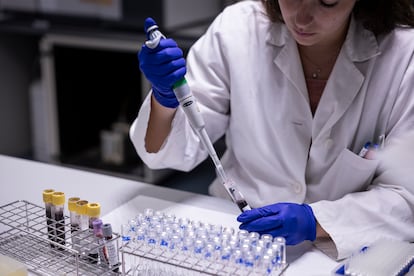

Women have slowly gained ground in scientific careers. In Spain, they account for 39.6% of research staff. Yet, their growing numbers have not led to equal conditions, and the disparities that remain also affect scientific communication. This is shown by a major study recently published in the journal PLOS Biology. The researchers examined 36.5 million scholarly papers and found that biomedical and life sciences research led by women undergoes a longer peer-review period than research led by men.
The study analyzed a collection of texts indexed in PubMed, the biomedical literature database, and examined the time between manuscript submission and final acceptance. The findings indicate that research with women as first or corresponding authors faced this delay.
For researcher David Álvarez-Ponce, a professor at the University of Nevada in the United States, and one of the study’s authors, this delay poses a series of long-term disadvantages for female scientists. “If a person publishes 50 articles during their career, those days they wait multiply. In the end, we’re talking about a significant difference,” he says.
Ana González, director of the Center for Advanced Social Studies at the Spanish National Research Council (CSIC), concurs. For the sociologist, who was not involved in the study, the most evident impact concerns women’s career progression and the financing of their research. “If publications are delayed, there are fewer articles, which are still the primary means of scientific advancement,” she notes.
It also influences the very production of knowledge. “We are going against the integrity of science,” she argues. “There is a discussion about whether men and women conduct research differently. We have examples of how women began to analyze animal behavior in a different way,” observes González, a member of the board of directors of the Association of Women Researchers and Technologists (AMIT).
Although the study acknowledges certain exceptions—such as molecular biology, genetics, or women’s health—this disparity persists even when accounting for factors like the research discipline and the publication year.
“It’s discrimination”
The study’s authors point to several factors that may be affecting the outcomes. “Bias on the part of editors or reviewers is a plausible explanation, but not necessarily the only one,” says Álvarez-Ponce.
Although the underrepresentation of women in scientific leadership roles went unmentioned in the study, another study published in the journal Nature in 2023 revealed that just 14% of editors were women, with this figure falling to 8% among editors-in-chief. The finding is based on a dataset encompassing over 81,000 editors from 1,167 journals across 15 fields spanning five decades. The share of women as authors was similarly notable: only 26%.
Álvarez-Ponce notes that women usually carry a heavier load in teaching and administrative tasks, further burdened by additional duties like household chores. “This can affect the response time when journals request reviews,” he says.
Although she recognizes that this plays a part, González finds that explanation overly simplistic. “In the scientific world there are more measures to support collaboration and work–life balance than in other sectors. More than childcare, what really has an impact are the responsibilities tied to caring for older adults and dependent people, which are far less regulated,” she says.
González also points out that additional research reveals women without children still face setbacks in their career progression—a phenomenon that does not occur for men. “It’s discrimination for being a woman, not just for having children,” she emphasizes.
Men with more extensive backgrounds in science
Another factor emphasized by Álvarez‑Ponce is experience. Since women have entered scientific careers incrementally, after enduring years of obstacles, “men tend to be, on average, somewhat older and more experienced, which may also influence how quickly their articles are accepted,” he adds.
The authors explained that they could not ascertain how much of the delay stems from the journals versus the time authors spend responding to revisions. “We don’t have those data, although recent studies suggest that both factors play a role,” says Álvarez‑Ponce.
The psychological impact
The gender gap in science has also surfaced at a psychological level. A recent study from Binghamton University in the United States found that 97.5% of women in STEM graduate programs—science, technology, engineering, and mathematics—have encountered imposter syndrome, a psychological condition in which competent individuals question their accomplishments.
The study found that these experiences are linked to poorer mental health, increased burnout, and a greater chance of contemplating withdrawal.
Continuous resources and ongoing evaluation needed
For González, while equality policies in science have been essential, they require “leaders to drive them forward, resources, and constant evaluation.” She also emphasizes the institutional duty to address sexist behaviors and language that have been normalized for decades.
Biases remain, she notes. Even at the very top. “People still question whether a brilliant woman has sacrificed her family for her career, a question rarely raised in the case of men,” the sociologist contends.
She adds that nurturing scientific vocations, particularly among girls and young women, is another vital focus. “Education is key, but it’s not solely the school’s responsibility,” she points out. Family and social environment “play a decisive role.” “Boys are told they’re smart; girls, that they’re pretty. That difference matters.”
Sign up for our weekly newsletter to get more English-language news coverage from EL PAÍS USA Edition
Tu suscripción se está usando en otro dispositivo
¿Quieres añadir otro usuario a tu suscripción?
Si continúas leyendo en este dispositivo, no se podrá leer en el otro.
FlechaTu suscripción está en uso en otro dispositivo y solo puedes acceder a EL PAÍS desde uno simultáneamente.
Si deseas compartir tu cuenta, actualiza tu suscripción al plan Premium, así podrás incluir a otro usuario. Cada uno iniciará sesión con su propio correo electrónico, lo que les permitirá personalizar su experiencia en EL PAÍS.
¿Tienes una suscripción de empresa? Accede aquí para contratar más cuentas.
Si no estás seguro de quién está utilizando tu cuenta, te sugerimos actualizar tu contraseña aquí.
Si decides seguir compartiendo tu cuenta, este mensaje aparecerá en tu dispositivo y en el de la otra persona que utiliza tu cuenta de manera permanente, impactando tu experiencia de lectura. Puedes consultar aquí los términos y condiciones de la suscripción digital.