Portland residents sue ICE for using tear gas that seeps their homes and endangers their health
The document states that federal agents allowed chemical munitions fired during protests to enter an affordable housing complex, affecting children, veterans, and people with disabilities
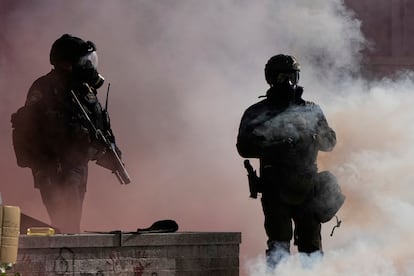

Residents of an affordable housing complex in Portland, Oregon, have filed a lawsuit against the Department of Homeland Security (DHS) and Secretary Kristi Noem for the repeated use of tear gas in front of an Immigration and Customs Enforcement (ICE) office, arguing that federal agents have allowed chemicals to enter their homes for months. The use of tear gas is prohibited by various protocols and conventions in wartime contexts, but it is continually deployed in domestic contexts in the United States and other countries.
The Gray’s Landing complex is located less than 100 feet from the federal building. According to the lawsuit, the government is “knowingly releasing poison gas into the homes of its own citizens.” Residents claim that the gas sticks to walls, carpets, furniture, and children’s toys, causing ongoing exposure beyond the visible moments of dispersal.
The lawsuit was filed after months of clashes between federal agents and protesters outside the ICE facility in Portland’s South Waterfront neighborhood. Although DHS has defended the use of chemical munitions in response to riots, local authorities have described several of the protests as peaceful.
The residents’ lawsuit claims that they are “suffering immense physical and psychological harm” from repeated exposure to the gases. The document describes how “children living at Gray’s Landing have become accustomed to weapons of war exploding outside their homes,” and that some of them “sleep in closets to reduce exposure to gas entering through gaps in their windows.”
Whitfield Taylor, one of the plaintiffs, stated that his daughters “are constantly unable to sleep because of the booming flashbangs that federal officers deployed outside their unit.” Some nights, according to the court filing, “they have slept inside their bedroom closet, building a makeshift shelter to feel protected.”
Other residents report persistent physical symptoms. Susan Dooley told KATU that after repeated exposures, she began to experience breathing problems and disorientation: “I forget a lot of things, and I know my speech isn’t like it used to be, because I feel like I’m out of breath.” She was later diagnosed: “I finally went to the doctor, and got a diagnosis Wednesday for mild heart failure.”
Dr. Anthony M. Szema, chair of the American Thoracic Society’s Section on Terrorism and Inhalation Disasters, told The New York Times that there are risks when tear gas is kept in enclosed environments. “It’s an indiscriminate weapon and a respiratory hazard, period.“ He added that if the substance is introduced into enclosed spaces, it is a ”setup for disaster.”
However, DHS rejects the accusations. Spokeswoman Tricia McLaughlin stated that “the First Amendment protects freedom of speech and peaceful assembly, not riots.” She added that agents have “followed their training and used the minimum amount of force necessary to protect themselves, the public, and federal property,” and that the agency is taking “appropriate and constitutional measures to uphold the rule of law and protect our officers and the public from dangerous rioters.”
Meanwhile, the ACLU of Oregon filed another lawsuit on behalf of protesters and journalists, arguing that the use of chemical munitions constitutes retaliation that inhibits First Amendment rights. In response, Federal Judge Michael Simon issued a 14-day temporary restraining order limiting the use of chemical munitions against individuals who do not pose an imminent threat.
In his ruling, Simon wrote that the nation “is now at a crossroads,” arguing that in a constitutional republic, “free speech, courageous newsgathering, and nonviolent protest are all permitted, respected, and even celebrated.”
Meanwhile, after federal agents fired large amounts of tear gas at protesters, including children, last weekend, City Councilman Sameer Kanal announced that he will propose a total ban on tear gas in the city.
Sign up for our weekly newsletter to get more English-language news coverage from EL PAÍS USA Edition
Tu suscripción se está usando en otro dispositivo
¿Quieres añadir otro usuario a tu suscripción?
Si continúas leyendo en este dispositivo, no se podrá leer en el otro.
FlechaTu suscripción se está usando en otro dispositivo y solo puedes acceder a EL PAÍS desde un dispositivo a la vez.
Si quieres compartir tu cuenta, cambia tu suscripción a la modalidad Premium, así podrás añadir otro usuario. Cada uno accederá con su propia cuenta de email, lo que os permitirá personalizar vuestra experiencia en EL PAÍS.
¿Tienes una suscripción de empresa? Accede aquí para contratar más cuentas.
En el caso de no saber quién está usando tu cuenta, te recomendamos cambiar tu contraseña aquí.
Si decides continuar compartiendo tu cuenta, este mensaje se mostrará en tu dispositivo y en el de la otra persona que está usando tu cuenta de forma indefinida, afectando a tu experiencia de lectura. Puedes consultar aquí los términos y condiciones de la suscripción digital.