British police arrest Andrew Mountbatten-Windsor for his links to pedophile Epstein
The brother of King Charles III was stripped of all his privileges after being implicated in the network of the American financier
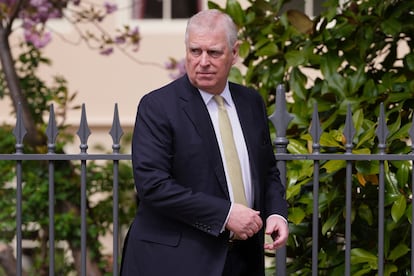

At least eight police vehicles stormed the British royal family’s Sandringham estate at 8 a.m. On Thursday, where former Prince Andrew of England has been living since his brother, King Charles III, evicted him from his Windsor mansion. It was the 66th birthday of Elizabeth II’s third child. The police operation has come as a seismic shock that is on track to become the biggest crisis the modern British royal family has faced. The officers arrested Andrew, accused of misconduct in public office, over his relationship and dealings with disgraced American financier Jeffrey Epstein.
Hours earlier, in an interview with the BBC, Prime Minister Keir Starmer pointed out that “nobody is above the law,” referring to the police investigations into the former prince.
Following the police operation, King Charles III said in a statement released by Buckingham Palace: “I have learned with the deepest concern the news about Andrew Mountbatten-Windsor and suspicion of misconduct in public office. What now follows is the full, fair and proper process by which this issue is investigated in the appropriate manner and by the appropriate authorities.“ The monarch added: ”Let me state clearly: the law must take its course. As this process continues, it would not be right for me to comment further on this matter. Meanwhile, my family and I will continue in our duty and service to you all.”
Thames Valley Police issued a statement confirming the arrest without naming Andrew: “As part of the investigation, we have today arrested a man in his sixties from Norfolk on suspicion of misconduct in public office and are carrying out searches at addresses in Berkshire and Norfolk. The man remains in police custody at this time. We will not be naming the arrested man, as per national guidance,” the police statement said.
Under British law, Andrew, who will have been held in a police cell until the start of his interrogation, could be detained for up to 96 hours, but that would require complex extension requests and court applications. The normal period is between 12 and 24 hours, during which officers decide whether to charge the suspect and whether to release them on bail.
The new batch of documents and files on Epstein published by the U.S. Department of Justice has once again highlighted the close and complicit friendship between the former prince and the deceased financier, as well as a series of allegedly criminal acts carried out between the two that have shocked the British public.

One of the emails, which prompted the police action on Thursday morning, reveals how Andrew allegedly passed confidential government financial information to Epstein while he was serving as special envoy for international trade. The emails relate to the U.K.’s relationship with Hong Kong and Singapore in 2010.
According to the police, this leak could constitute misconduct in public office, an extremely serious charge.
The former prince has consistently denied all allegations against him, not only those relating to the alleged leak of financial information, but also new evidence linking him to the sex trafficking of women, many of them minors, organized by his friend Epstein.
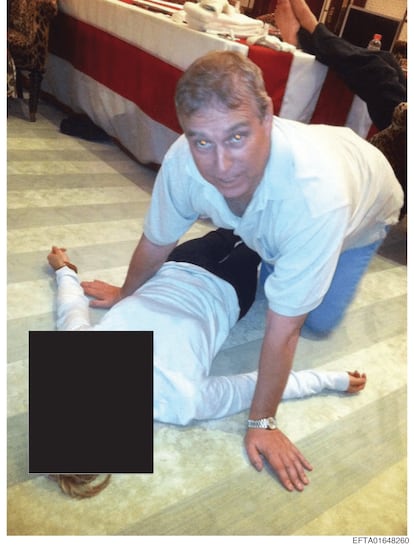
The new documents released by the U.S. Government include photos of Andrew on the floor, reclining on top of a woman whose face is not visible. The former prince appears to be massaging the young woman’s stomach while she lifts her head and looks at the camera. Neither the date nor the location of the photo is specified, but alongside it is an exchange of emails between the two men in August 2010, in which Epstein informs him that he is sending a 26-year-old Russian woman to the UK to meet the then-prince.
Essex police have opened investigations into the financier’s use of London Stansted Airport to transport dozens of his victims, most of them from Latvia and Russia, to and from the UK. At least one of those flights shows a connection to Andrew.
The king’s brother has already negotiated a multi-million dollar out-of-court settlement with Virginia Giuffre, who accused him in court of sexually abusing her on at least three occasions when she was a minor. Giuffre eventually committed suicide, but left behind a posthumous memoir that recounted in graphic detail her encounters with Elizabeth II’s son.
Charles III’s unresolved problem
Andrew’s relationship with Epstein has threatened from the outset to turn into a crisis of enormous scope for the British royal family. It is a problem that was inherited by Charles III, who has so far been unable to deal with it decisively.
He stripped his brother of all his titles, including those of prince, Duke of York, and member of the Royal Order of the Garter. He removed him from any public responsibility as a member of the royal household and expelled him from the mansion he enjoyed in the Windsor Castle complex. But all these attempts to condemn him to social ostracism were met with arrogance on the part of Andrew and with dissatisfaction and weariness by British public opinion. These were courtly gestures that were exaggeratedly valued by the press but did not translate into a concrete demand for accountability.
In recent weeks, in the face of the scandal surrounding the new revelations in the Epstein documents, Buckingham Palace signaled for the first time its willingness to cooperate with the police in the investigations into the former prince. This reaction was met with skepticism by critics of the British monarchy, who were convinced that this was yet another kick forward that would not translate into real consequences.
The arrest of Andrew Mountbatten-Windsor on Thursday, without warning and on his birthday, may be a sign that things are changing, and that Buckingham Palace has begun to understand that it was its own survival, not that of the former prince, that was at stake.
Sign up for our weekly newsletter to get more English-language news coverage from EL PAÍS USA Edition
Tu suscripción se está usando en otro dispositivo
¿Quieres añadir otro usuario a tu suscripción?
Si continúas leyendo en este dispositivo, no se podrá leer en el otro.
FlechaTu suscripción se está usando en otro dispositivo y solo puedes acceder a EL PAÍS desde un dispositivo a la vez.
Si quieres compartir tu cuenta, cambia tu suscripción a la modalidad Premium, así podrás añadir otro usuario. Cada uno accederá con su propia cuenta de email, lo que os permitirá personalizar vuestra experiencia en EL PAÍS.
¿Tienes una suscripción de empresa? Accede aquí para contratar más cuentas.
En el caso de no saber quién está usando tu cuenta, te recomendamos cambiar tu contraseña aquí.
Si decides continuar compartiendo tu cuenta, este mensaje se mostrará en tu dispositivo y en el de la otra persona que está usando tu cuenta de forma indefinida, afectando a tu experiencia de lectura. Puedes consultar aquí los términos y condiciones de la suscripción digital.