Former Prince Andrew, the spoiled son of Elizabeth II who caused the biggest crisis in the British monarchy
The dealings of Charles III’s brother with the financier Jeffrey Epstein have shaken the foundations of Buckingham Palace
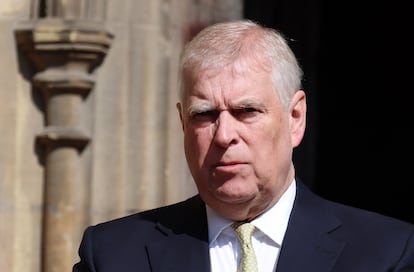

It is necessary to have studied the person in great depth to pronounce such a resounding verdict. When this correspondent asked the historian Andrew Lownie, just a week ago, what former Prince Andrew was like, his first reply was visceral: “He’s stupid.”
“He’s a very self-important fellow, who feels entitled to everything. His very sense of self derives from being a member of the royal family. I think deep down he’s a very insecure person, with little personality, whom people generally find very boring. But he’s been told all his life that he’s wonderful and he has been overprotected. He has no moral boundaries. And at this point, he’s incapable of understanding the problem he’s created,” explained Lownie, author of the most rigorous, informed, and incisive biography of Charles III’s brother. Entitled: The Rise and Fall of the House of York, is a 450-page indictment of Andrew Mountbatten-Windsor, who has turned into the most serious problem facing the British royal family in the modern era.
Former Prince Andrew was always considered Queen Elizabeth II’s favorite son. His service as a pilot in the Falklands War (April-June 1982) briefly made him a national hero. But when the time came to find him a public role, that’s when the problems began. “We have always had a problem with the younger members of the royal family, partly because they don’t share the Queen’s sensitivity to public opinion, and partly because they give the impression (fairly or unfairly) of possessing rights or privileges that in some cases are not justified by the tasks they perform,” Jonathan Sumption, a historian, lawyer, and former Supreme Court Justice, explained to EL PAÍS when the Epstein scandal began to signal the beginning of the end for the then Duke of York.
British public opinion was outraged by revelations portraying the Queen’s son as an irresponsible and spoiled partygoer who had been capable of sexually abusing the women his friend Epstein provided. The photograph of Andrew holding Virginia Giuffre, then a minor ensnared in the billionaire sex offender’s perverse network, by the waist spoke volumes. Giuffre took the then-prince to court and accused him of sexual abuse.
Andrew, in a display of arrogance that proved his undoing, attempted to defend himself with an interview on the BBC’s Newsnight with journalist Emily Maitlis. In it, he demonstrated with abysmal clarity just how out of touch with reality he was. His responses, filled with ludicrous arguments to deny his relationship with the woman, and delivered with an unbearable air of arrogance, caused a stir at Buckingham Palace and throughout British society. Dozens of companies and institutions began to sever ties with the philanthropic projects of the then Duke of York, and the Queen, reluctantly urged on by the heir to the throne, Charles, and by Prince William, decided to remove her favorite from public duties representing the royal family.
Because despite her undeniable institutional commitment, when it came to Andrew, Elizabeth II did not fail to show the dilemmas of her dual role as mother and queen: in 2011, just weeks after Giuffre publicly denounced that she had been forced to have sex with Andrew on three occasions, Elizabeth II awarded her son, who has always denied the accusation, the insignia of Knight Grand Cross of the Royal Victorian Order, the highest honor to which one can aspire for “personal service” to the crown and the second highest in the hierarchy of decorations.
“It was a bit like what happened to Margaret Thatcher. She turned a blind eye to a son who was useless, and supported both his ambition and his corrupt practices. I fear the queen sinned in the same way,” notes historian Lownie.
Andrew’s fondness for women and luxury quickly shaped his image. Charles III said of him that he was the one in the family who had “the looks of Robert Redford.” In the 1970s, the press nicknamed him “Randy Andy” after he was caught in the girls’ dormitory at Gordonstoun, the Scottish boarding school where he studied. Countless affairs have been attributed to him, with well-known names and even simultaneously, although several women have spoken to the press about his rude manners and childish behavior.
Another of his nicknames is “Air Miles Andy,” due to his excessive use of helicopters and private planes for travel. The National Audit Office (the independent spending regulator) condemned the more than €4,000 spent on a helicopter trip of just 80 kilometers for a lunch with Arab dignitaries. In 2011 and 2012, his travel bill approached half a million euros, even though in 2011 he had resigned as the UK’s trade envoy precisely because of the growing controversy surrounding his close ties to Epstein, who had already been convicted of sex crimes against a minor.
At that time, the royal family still hoped to control the scandal with a series of incremental punishments—withdrawal of titles, expulsion from the official residence where he lived—that would show apparent firmness and soothe public irritation.
But all the information that has emerged in Epstein’s files in connection with Andrew has shocked British society to the point of becoming the biggest crisis faced by the monarchy in recent decades.
Andrew and Sarah’s mutual aid society
Sarah Ferguson, whom he married in 1986 and divorced in 1992, is an integral and inseparable figure in Prince Andrew’s story. Until very recently, she continued to share royal residences with him. The now former Duchess of York possessed a social grace that her ex-husband lacked, but also a fondness for money and a compulsive tendency to spend it recklessly, which frequently caused problems for Buckingham Palace. She became “the greatest single threat to the monarchy of that era,” according to Robin Janvrin, then Queen Elizabeth II’s press secretary, before Epstein’s shadow began to loom.
Accustomed to falling and getting back up, there was a time in her later years when she played the role of ally to Charles III, trying to convince her ex-husband to avoid the public scrutiny that was only complicating matters for his brother. Her skill was even rewarded with another invitation to the family Christmas celebration at Sandringham.
The disclosure of her humiliating email to the American financier, sent in 2011 even though at that point he was already convicted of sex crimes, once again put the spotlight on the character with the strongest survival instinct in the complex world of the British royal family.
Her downfall, however, does not appear to be nearly as dramatic as that of her ex-husband, who never in his worst dreams imagined that one day he would leave home under arrest by the police.
Sign up for our weekly newsletter to get more English-language news coverage from EL PAÍS USA Edition
Tu suscripción se está usando en otro dispositivo
¿Quieres añadir otro usuario a tu suscripción?
Si continúas leyendo en este dispositivo, no se podrá leer en el otro.
FlechaTu suscripción se está usando en otro dispositivo y solo puedes acceder a EL PAÍS desde un dispositivo a la vez.
Si quieres compartir tu cuenta, cambia tu suscripción a la modalidad Premium, así podrás añadir otro usuario. Cada uno accederá con su propia cuenta de email, lo que os permitirá personalizar vuestra experiencia en EL PAÍS.
¿Tienes una suscripción de empresa? Accede aquí para contratar más cuentas.
En el caso de no saber quién está usando tu cuenta, te recomendamos cambiar tu contraseña aquí.
Si decides continuar compartiendo tu cuenta, este mensaje se mostrará en tu dispositivo y en el de la otra persona que está usando tu cuenta de forma indefinida, afectando a tu experiencia de lectura. Puedes consultar aquí los términos y condiciones de la suscripción digital.