The Jalisco New Generation Cartel, a criminal enterprise with a turbulent rise
The death of El Mencho raises questions about who will succeed him at the head of the powerful criminal organization, whose operations range from drug trafficking to extortion and money laundering
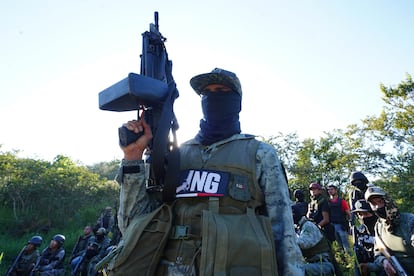

The Jalisco New Generation Cartel (CJNG) made its grand entrance onto the criminal scene with a macabre image: the public display of 35 corpses — bearing signs of torture — in the city of Boca del Río, Veracruz, in 2011. The criminal group of Nemesio “El Mencho” Oseguerra was then known as Los Matazetas (The Zetas Killers), as that was supposedly its purpose: to exterminate the Los Zetas cartel. Since Los Zetas had a reputation for being bloodthirsty, the CJNG — which in its early days was in alliance with the Sinaloa Cartel — mirrored their violence and pushed it into outright barbarism. El Mencho’s hitmen even strapped dynamite to their rivals’ bodies to make them explode while still alive.
Many things have changed on Mexico’s criminal map in the last decade. Los Zetas have lost influence, the CJNG broke its alliance with the Sinaloa Cartel, and El Mencho became the last remaining target on the government’s list of objectives after the fall, one by one, of the major leaders of the other drug cartels. On Sunday, El Mencho was killed in an operation by Mexican security forces, led by the Mexican Army and in coordination with the United States.
The feat has many dimensions, one of them symbolic. In the very heart of the capital, the CJNG orchestrated an attack in 2020 against Omar García Harfuch, who at the time was Mexico City’s secretary of security. Today, he holds that position at the federal level and leads President Claudia Sheinbaum’s security strategy against the cartels. The score has now been settled.
The downfall of Oseguera — also known as the Lord of the Roosters due to his interest in cockfighting — comes at a time of intense cooperation between Mexico and the U.S. On security matters. The Trump administration’s concerns over the fentanyl epidemic have aligned with the Sheinbaum government’s shift in its approach to fighting cartels, centered on intelligence and precision strikes.
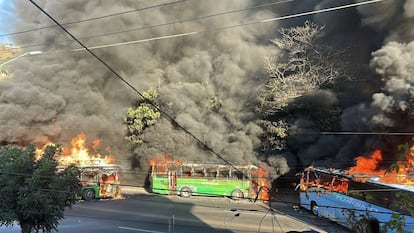
A source in Mexico’s National Palace told EL PAÍS that the operation to go after El Mencho had been postponed largely because the kingpin lived in densely populated areas of Jalisco, unlike other traffickers who retreated into the mountains to evade authorities. The risk of collateral damage forced an extremely meticulous planning process for the raid, which ultimately resulted in seven traffickers killed and three soldiers wounded — far less tragic than it could have been. In the hours that followed, vehicles were set on fire and highways were blocked in several states. It was the cartel baring its teeth.
Thefall of El Mencho raises questions about who will succeed him at the head of the Jalisco New Generation Cartel. Options within his inner circle are limited, as authorities have neutralized key figures in the cartel. The kingpin’s son, Rubén “El Menchito” Oseguera, has been serving a life sentence in the United States since 2020, convicted of drug trafficking and illegal weapons possession. One of El Mencho’s brothers, Antonio “Tony Montana” Oseguera, in charge of laundering the CJNG’s millions of dollars in revenue, was extradited to Washington in February of last year as part of the mass extraditions of drug lords initiated during the Trump era. Months later, Mexico sent another key figure in the Jalisco cartel’s criminal scheme to the U.S.: Abigael González Valencia, “El Cuini,” El Mencho’s brother-in-law and right-hand man. Another of El Mencho’s brothers, Abraham “Don Rodo” Oseguera, was captured in February and is in the hands of Mexican authorities.
Mencho’s wife — now his widow — Rosalinda González Valencia, “La Jefa,” has had better luck. Identified as part of the CJNG’s administrative structure, she was arrested but released by a judge in January last year. The Sheinbaum administration criticized the decision and used it as an example of corruption within the judiciary. It is possible that the leadership of the CJNG will be replaced by the González Valencia clan, who head the Los Cuinis cartel. The family, originally from Michoacán like Mencho, is made up of 18 brothers and sisters. La Jefa has a solid criminal record, predating her marriage to Oseguera, which positions her as a natural successor.
The CJNG cannot be understood without its alliance with Los Cuinis. The United States justice system included El Mencho and El Cuini in the same indictment in 2014. Court documents accuse both organizations of jointly trafficking cocaine, methamphetamine, and fentanyl into the United States, in a criminal enterprise that generates profits of at least $10 million annually. The indictment notes that the CJNG is responsible for “numerous acts of violence, including murders, assaults, kidnappings, assassinations and acts of torture” aimed at ensuring the cartel’s “prestige, reputation, and position,” instilling fear, expanding its empire, disciplining its members, and coercing public officials.

Under El Mencho’s command, the Jalisco cartel expanded across all of Mexico and took its operations abroad. The organization introduced several innovations that help explain its power. For example, it operates like a franchise: local criminal groups can “buy” the right to use the CJNG brand by paying a tribute to the cartel. Another feature is the forced recruitment of young people to bolster its ranks, who are lured in through fake job offers.
Financially, the CJNG has found an enormous source of income in timeshare fraud. Through networks of collusion with resorts and shell companies, El Mencho’s organization obtained at least $300 million in four years by scamming around 6,000 victims in the United States. Washington has launched a campaign to strangle the CJNG’s financial networks, blocking the accounts of individuals and companies that launder the cartel’s illicit assets.
Organized crime has transformed as it has expanded into new sources of revenue and stopped depending entirely on drug trafficking. Resembling a corporation — tellingly, the CJNG also calls itself La Empresa (“The Company”) — the Jalisco cartel may well continue operating without a leader as dominant as El Mencho. Security analysts have been predicting the end of the era of the drug lords. Oseguera is one of the last figures marking that transition. Oseguera is one of the last remaining kingpins in this changing landscape.
Sign up for our weekly newsletter to get more English-language news coverage from EL PAÍS USA Edition
Tu suscripción se está usando en otro dispositivo
¿Quieres añadir otro usuario a tu suscripción?
Si continúas leyendo en este dispositivo, no se podrá leer en el otro.
FlechaTu suscripción se está usando en otro dispositivo y solo puedes acceder a EL PAÍS desde un dispositivo a la vez.
Si quieres compartir tu cuenta, cambia tu suscripción a la modalidad Premium, así podrás añadir otro usuario. Cada uno accederá con su propia cuenta de email, lo que os permitirá personalizar vuestra experiencia en EL PAÍS.
¿Tienes una suscripción de empresa? Accede aquí para contratar más cuentas.
En el caso de no saber quién está usando tu cuenta, te recomendamos cambiar tu contraseña aquí.
Si decides continuar compartiendo tu cuenta, este mensaje se mostrará en tu dispositivo y en el de la otra persona que está usando tu cuenta de forma indefinida, afectando a tu experiencia de lectura. Puedes consultar aquí los términos y condiciones de la suscripción digital.