How El Mencho evaded justice over the course of the last decade
Failed operations, thwarted intelligence, and unprecedented firepower hampered the pursuit of the Jalisco New Generation Cartel leader until the operation in which he was killed
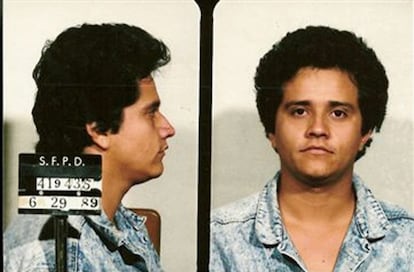

The capture of Nemesio Oseguera Cervantes, aka “El Mencho,” was a long-sought goal for Mexico, one that seemed impossible to achieve for over a decade. The leader of the Jalisco New Generation Cartel (CJNG) became the most elusive drug kingpin, he was also wanted by the United States, and yet he managed to evade military cordons, federal deployments and intelligence operations that, at various times, brought him within striking distance of his arrest. Finally, he was killed this Sunday in an operation that concludes one of the longest and most complex manhunts against a Mexican drug lord.
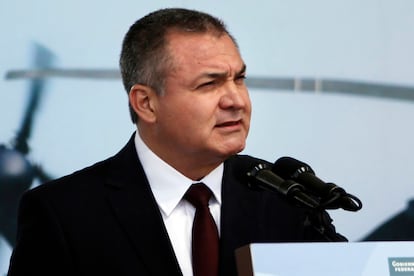
The first failed attempt to capture El Mencho was in 2012. According to an investigation by El Universal, the drug lord was allegedly arrested on August 27, 2012, in Zapopan, Jalisco, by members of the Mexican Navy, but had to be released hours later due to the intervention of the then-governor of the state, Emilio González Márquez. At the time, the information was disseminated by local and national media outlets that claimed to have confirmation from federal security officials, but it remained a rumor. It was neither corroborated nor denied by the authorities. The story gained traction due to a series of roadblocks and the burning of dozens of vehicles in the state capital, Guadalajara, and various municipalities operated by members of the CJNG. The violence spread to the state of Colima and was attributed to the cartel following the arrest of Oseguera Cervantes. The Federal Police, led at that time by Genaro García Luna, the security secretary under President Felipe Calderón and now convicted in the United States for collaborating with organized crime, ruled out any connection.
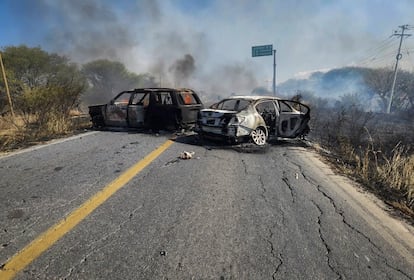
The second major attempt occurred on May 1, 2015, during Enrique Peña Nieto’s presidency, in what was then considered the largest federal deployment against the CJNG. Federal security forces from the Ministry of National Defense (Sedena), the Navy, the Federal Police, the Attorney General’s Office (PGR), and the then-Center for National Security and Investigation (Cisen) carried out Operation Jalisco. But the criminal group’s response was immediate. Roadblocks, burning vehicles, and armed attacks in various parts of western Mexico captured national and international attention. The episode of violence culminated in the downing of a military helicopter with a rocket launcher, an unprecedented event that resulted in the deaths of soldiers, demonstrating the cartel’s paramilitary capabilities. “There was a violent reaction from the criminal group to prevent the authorities from acting,” said Monte Alejandro Rubido, the National Security Commissioner, after the failed operation. El Mencho managed to escape.
That episode was a turning point. Oseguera Cervantes became an almost legendary figure within the security institutions. According to leaks from federal authorities, the difficulty in capturing him had much to do with his discipline: he eliminated electronic communications, minimized his movements, and operated through a territorial protection network that included hard-to-reach rural areas in Jalisco, Michoacán, and Colima.
During Andrés Manuel López Obrador’s six-year term in office, the security strategy prioritized containing violence over capturing leaders, but El Mencho remained on the list of high-value targets. During those years, the United States increased pressure with federal indictments and a multimillion-dollar reward that reached up to $15 million for information leading to his arrest. Even so, the CJNG’s combination of low profile and firepower kept the leader beyond the reach of the state.
For years, the authorities themselves acknowledged—albeit indirectly—the complexity of capturing Nemesio Oseguera Cervantes. After the failed 2015 operation, the then-Secretary of National Defense, Salvador Cienfuegos, warned that the Army could not act “irresponsibly [...] Putting the population at risk,” a reference to the violence that his arrest could unleash. Within the Security Cabinet, the message pointed in the same direction: the Secretary of Security, Alfonso Durazo, advocated avoiding “spectacles” and prioritizing the reduction of violence.
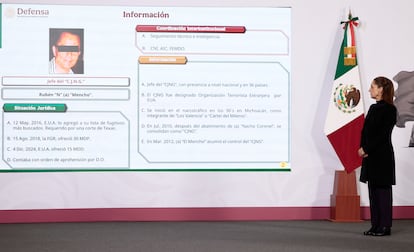
Another incident that highlighted El Mencho’s operational capabilities was the 2020 attack on Omar García Harfuch, then in charge of security in Mexico City, an attack attributed to the CJNG. The current Secretary of Security under President Claudia Sheinbaum described it as “the most violent group in the country,” a statement that offered a glimpse into what confronting the criminal organization and capturing its leader would entail. Until now. The search has ended.
Sign up for our weekly newsletter to get more English-language news coverage from EL PAÍS USA Edition
Tu suscripción se está usando en otro dispositivo
¿Quieres añadir otro usuario a tu suscripción?
Si continúas leyendo en este dispositivo, no se podrá leer en el otro.
FlechaTu suscripción se está usando en otro dispositivo y solo puedes acceder a EL PAÍS desde un dispositivo a la vez.
Si quieres compartir tu cuenta, cambia tu suscripción a la modalidad Premium, así podrás añadir otro usuario. Cada uno accederá con su propia cuenta de email, lo que os permitirá personalizar vuestra experiencia en EL PAÍS.
¿Tienes una suscripción de empresa? Accede aquí para contratar más cuentas.
En el caso de no saber quién está usando tu cuenta, te recomendamos cambiar tu contraseña aquí.
Si decides continuar compartiendo tu cuenta, este mensaje se mostrará en tu dispositivo y en el de la otra persona que está usando tu cuenta de forma indefinida, afectando a tu experiencia de lectura. Puedes consultar aquí los términos y condiciones de la suscripción digital.