Marielle Franco case: Brazão brothers convicted of ordering murder of Rio councilwoman
Brazil’s Supreme Court has reached a verdict on the most significant political killing of the decade, nearly eight years after the crime
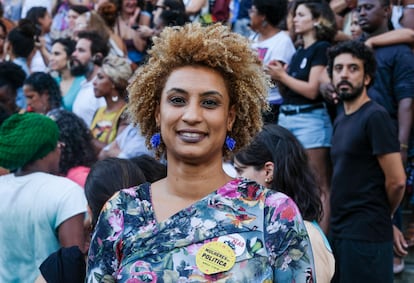

The outcry that echoed across Brazil for years — “Who ordered Marielle’s killing?” — now has a judicial answer. Two political strongmen from Rio de Janeiro known for defending the interests of paramilitary criminal groups, brothers Domingos and João Francisco “Chiquinho” Brazão, were convicted on Wednesday for ordering the murder of Marielle Franco, a 38‑year‑old left‑wing city councilor, in 2018.
The presiding judge said that it was a political crime in which misogyny and racism also played a role. With this ruling, both the gunmen and the masterminds behind the most significant political assassination in Brazil in the past decade have been held accountable. Political violence has claimed the lives of around 700 Brazilians — elected officials and activists — over the last 20 years, according to a recent academic report.
The Brazão brothers were unanimously sentenced to 76 years in prison each for two counts of murder (Franco and her driver), one attempted murder, and membership in an armed criminal organization. Both are veteran politicians with long careers in Rio marked by suspicions over their dangerous associations. The court also ordered them to pay seven million reais ($1.4 million) in compensation to the victims’ families.
Chiquinho, 64, served alongside the victim when both were city councilors; he with several terms behind him, she a newcomer. When he was arrested and formally charged with the murder in 2024, he was a federal congressman in Brasília and was forced to resign his seat. His brother Domingos, 60, was suspended from his position on Rio’s state audit court, though he continues to receive his hefty monthly salary of $10,000.
The Marielle case, which contains all the elements of a television thriller, has opened a window into the fetid underworld of Rio de Janeiro’s city and state politics — a realm where, for decades, organized crime has maintained close ties with politicians and security forces to conduct business, secure electoral strongholds, and guarantee impunity.
The now‑convicted brothers led a militia group — the term used in Rio for mafias made up of police officers moonlighting for criminal enterprises, specializing in extortion and real‑estate schemes. The confession of the hitman who pulled the trigger was crucial in identifying and punishing the masterminds. The judges said that most of his testimony was corroborated by documents and witness statements.
The court acquitted the then‑chief of Rio’s Civil Police, commissioner Rivaldo Barbosa, of the double murder due to lack of evidence. But he was sentenced to 18 years for obstruction of justice and corruption, as he was on the brothers’ payroll and later sabotaged the investigation from within — all to guarantee their impunity. Two other defendants were also convicted: one received 56 years for murder, the other nine years for belonging to a criminal organization. One judge underscored that “there is no perfect crime, only poorly investigated crimes — in this case, deliberately so.”
On the night of March 14, 2018, Marielle Franco was riding in a car through downtown Rio when another vehicle pulled up alongside. The assassin, a former military police officer, wielded a submachine gun and opened fire. Franco was shot four times in the head; her driver, Anderson Gomes, was hit three times in the back. Miraculously, Franco’s press secretary, who was seated beside her, survived.
The case was tried in the Supreme Court because one of the Brazão brothers was a federal congressman and therefore had privileged jurisdiction. Specifically, it was heard by the same chamber of the court that tried and convicted former president Jair Bolsonaro for leading a coup plot.
In a deeply personal and emotional opinion, Justice Cármen Lúcia Antunes Rocha highlighted the misogynistic dimension of the crime. She asked: “How many Marielles will Brazil still allow to be murdered?” She admitted that, the day after the execution that shocked the country, she could hardly have imagined that eight years later she would be judging those responsible.
When the Brazão brothers ordered Marielle Franco’s assassination, they had two objective, according to the judges: eliminating a political opponent who, as a member of the Socialism and Liberty Party (PSOL), stood in the way of their economic interests, and sending a message to anyone who dared to follow her example.
The judges highlighted other elements of this political killing: “Councilwoman Marielle was a Black, poor woman who dared to go against the interests of militiamen — white, wealthy men. That was the message. Their mistake was not anticipating the enormous repercussions,” said the case’s lead justice, the prominent Alexandre de Moraes.
Franco was a young, fierce councilor, unknown outside of Rio, where the political climate of 2018 propelled her into a symbol of the Brazilian left’s resistance to the far‑right Bolsonaro movement.
None of those involved in the crime imagined the national and international impact the murder of this Black councilwoman — raised in Rio’s Maré favela, a human‑rights and LGBTQ+ rights activist, mother of a daughter and married to another woman — would have. Brazil was in turmoil: the left was weakened, its charismatic leader Luiz Inácio Lula da Silva had just been imprisoned on corruption charges (which were later annulled), and the far right was surging toward electoral victory. The Marielle case became a powerful symbol of resistance.
Marielle Franco’s assassination is the most consequential political killing in Brazil in the past decade, but it is not exceptional — except for the fact that it reached trial and resulted in convictions. Her killers had initially considered murdering a male colleague from her party but abandoned the idea, convinced that the death of a poor Black councilwoman would go unnoticed.
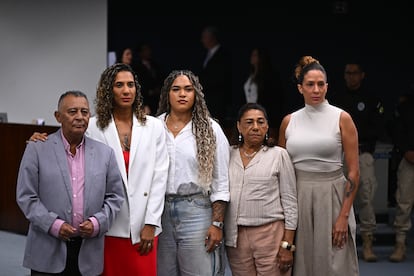
The shooting’s lone survivor and the victims’ families attended the trial from the front rows. Among them was Franco’s sister, Anielle Franco, whom President Lula appointed Minister of Racial Equality in 2023. The administration also increased resources to investigate the case.
Sign up for our weekly newsletter to get more English-language news coverage from EL PAÍS USA Edition
Tu suscripción se está usando en otro dispositivo
¿Quieres añadir otro usuario a tu suscripción?
Si continúas leyendo en este dispositivo, no se podrá leer en el otro.
FlechaTu suscripción se está usando en otro dispositivo y solo puedes acceder a EL PAÍS desde un dispositivo a la vez.
Si quieres compartir tu cuenta, cambia tu suscripción a la modalidad Premium, así podrás añadir otro usuario. Cada uno accederá con su propia cuenta de email, lo que os permitirá personalizar vuestra experiencia en EL PAÍS.
¿Tienes una suscripción de empresa? Accede aquí para contratar más cuentas.
En el caso de no saber quién está usando tu cuenta, te recomendamos cambiar tu contraseña aquí.
Si decides continuar compartiendo tu cuenta, este mensaje se mostrará en tu dispositivo y en el de la otra persona que está usando tu cuenta de forma indefinida, afectando a tu experiencia de lectura. Puedes consultar aquí los términos y condiciones de la suscripción digital.