In the cloud forest of Cali, birdsong becomes medicine
Birdwatching is emerging as an economic sector and a form of physical and mental therapy in Colombia, the country with the highest number of species in the world

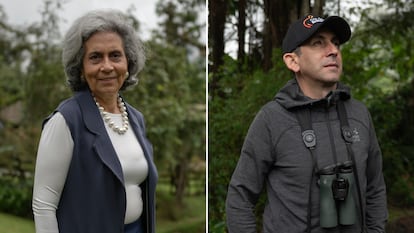
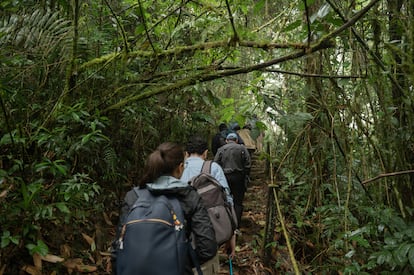
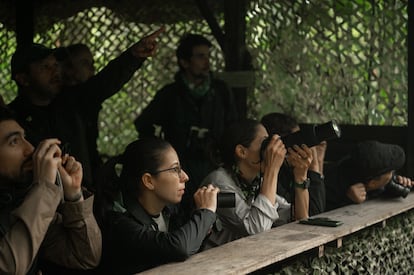
The only sound is the crunch of leaves under the boots of the birdwatchers. They’ve risen early to head to the cloud forest on the outskirts of Cali, Colombia’s third-largest city. Carlos Mario Wagner, founder of the Colombia Bird Fair, speaks with EL PAÍS on the way to Los Farallones National Park, which rests like a forested giant southwest of the capital of Valle del Cauca.
“I’ve loved birds since I was a child. People told me I was crazy because I could watch them for hours… But I persisted, and look how far we’ve come,” he says proudly. Colombia is a bird paradise: it has over 1,900 species, almost 20% of those found on the planet. “Valle del Cauca alone has more birds than all of North America combined; more than half of Colombia’s bird species are in this department,” Wagner explains before arriving at the farm where a spectacle of feathers, songs, and colors will take place.
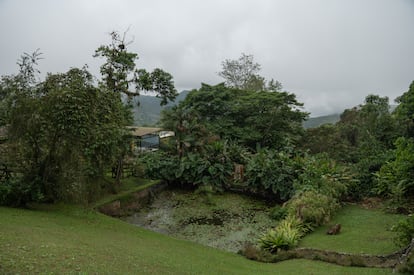
The road climbed from 900 to 2,000 meters above sea level in just 40 minutes, a steep ascent that transformed the warm climate into a mountain chill that demands at least a wool sweater. The mist hangs heavy, its density palpable. Nestled in the mountainside is the San Felipe farm, owned by Clara Cabarcas and her husband Carlos Calle, the first reserve in South America to offer birdwatching expeditions for the blind.
“We started this business four years ago. We went from cattle ranching to becoming a sanctuary dedicated to respecting nature,” says Cabarcas. “We have restored the birds’ habitat. Today, the land is 80% forest. In the last two years, we have planted 3,700 native trees.” After this introduction, the group accompanying this newspaper ventures into the forest.
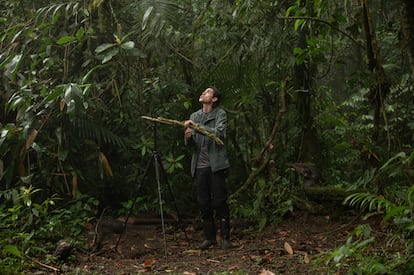
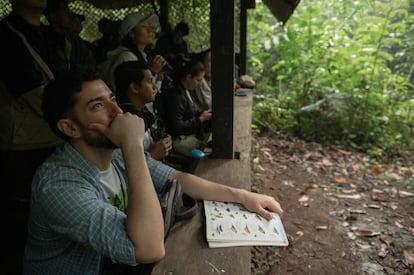
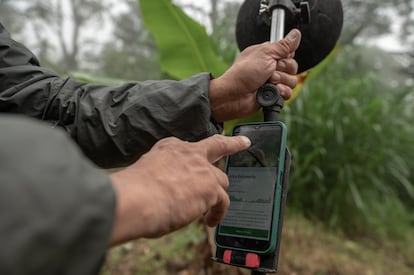
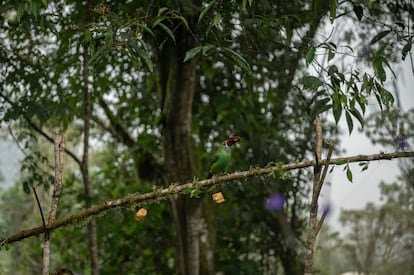
The city’s presence gradually fades away, and the silence of the trees suddenly transforms into a concert of birdsong. Blue, yellow, and white emerge in an open field that resembles a natural theater. In just over four hours, the group records 40 species. Wagner takes out his phone and notes each sighting on eBird, a platform developed by the Cornell Lab of Ornithology that has made field notebooks obsolete. Most are sightings of endemic birds, but the tree canopy also provides refuge for migratory birds. One of them is the honey buzzard, a species that flees the North American winter to forage in the tropics.
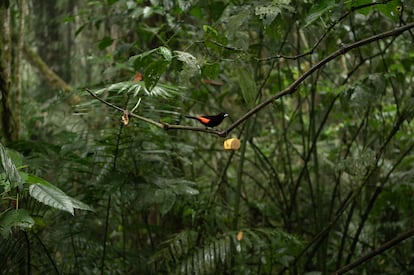
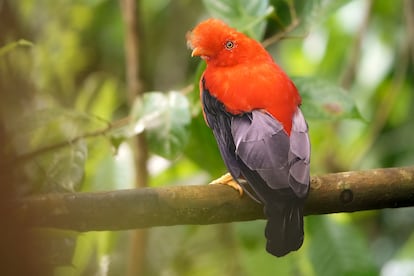
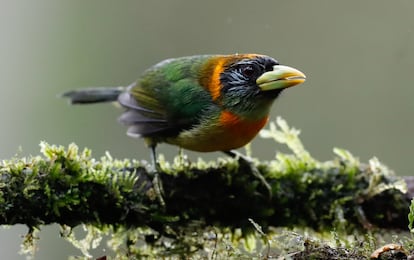
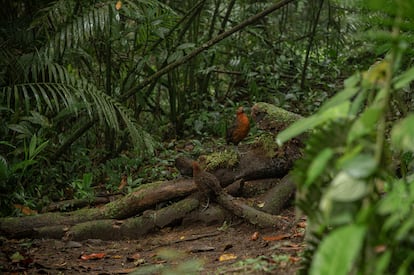
The crown jewel, however, has a local flavor. Binoculars are focused on the multicolored tanager and the red-winged tinamou, both endemic to the Colombian Andes. Both are considered threatened: “Their populations have declined significantly and they were in danger of extinction in this area,” explains Wagner, without taking his eyes off the branches. But the trend has changed. “In the last 20 years, the conservation of the cloud forest has halted the decline.” Tourists pay to see them in their natural habitat, a return on investment that has convinced local communities to protect them.
The visit takes place under the auspices of the 12th Colombia Bird Fair. Cali has become the undisputed capital of this market: the event closed with a record 7,000 attendees, and organizers estimate that each international tourist spent between $300 and $350 per day on expeditions lasting from 12 to 18 days. This is high-value tourism that injects money into rural economies. The fair, which offered 70% of its program free of charge, attracted visitors from 24 countries and secured Cali the joint hosting of the 2027 World Bird Fair and the South American Bird Fair, which they anticipate will bring in more than 2,000 international visitors.
The rigor of this growing industry has its own names, and ornithologist Steve L. Hilty, 80, is one of them. The author of the first bird guide to Colombia was named honorary president of the fair this year. His vision is as scientific as it is pragmatic. “Fairs are an excellent way to generate interest in wildlife and a magnificent opportunity to connect people with similar interests,” he says in a conversation with EL PAÍS. The zoologist understands that birdwatching is not just an academic exercise, but a social phenomenon. “I’m happy to see how many people are now interested in a world that used to be for a select few enthusiasts. Now, after so many years, it has become more accessible,” he says.
This year’s motto sums it up well: “Where there are birds, there is hope. Breathe, listen, and contemplate.” It is precisely there, in the act of listening, that economics and science open the door to a more intimate realm: that of the body. The forest demands more than just the eyes. Ascending over 1,000 meters, navigating the mist, and carrying photographic equipment along steep trails is demanding.
Mauricio Eraso Monzón knows this well. A surgeon and sports medicine specialist, he is one of the keynote speakers at the fair. For him, birdwatching is equivalent to a high-impact medical prescription: “Walking in the mountains to look for a bird directly combats a sedentary lifestyle,” he says. “It counteracts a significant risk factor for developing chronic diseases such as cardiovascular, metabolic, or mental illnesses,” he explains.
The benefits extend beyond the physical body and reach the brain, as a natural environment triggers profound neurobiological changes. “The immune system adjusts, and the autonomic nervous system slows the production of stress hormones,” the expert explains. Interestingly, the most powerful impact comes not through the eyes, but through the ears. Eraso is emphatic: the sounds of the wind, water, and birdsong have a modulating effect on human stress that surpasses the visual stimuli of nature.
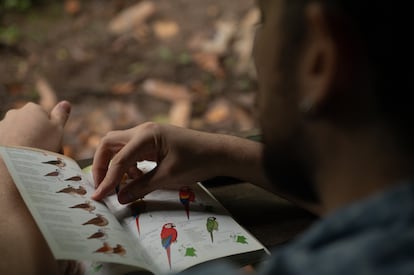
Listening heals. Juan David López, a psychologist, psychoanalyst, and nature photographer, has spent over a decade documenting this intersection between humankind and the ecosystem. For López, birdwatching goes far beyond a pastime to unwind: “It’s an anchor to life,” he tells this newspaper. From a clinical perspective, this activity facilitates a “release of vital energy” toward the environment. In people with depressive symptoms, birdwatching acts as a grounding force: “It compels them to practice mindfulness, demands impulse control, and, incidentally, forges new social bonds,” he notes. The patient stops focusing on their own emptiness and begins to register the life that pulsates in the branches.
Birds also offer powerful metaphors for processing grief. López recounts the case of a participant who came to the birdwatching session after experiencing a painful breakup, and who found in bird photography a perfect analogy for accepting the loss.
“He understood that the other person, like the animal he observed through his lens, is a free being who cannot be forcibly restrained,” he recounts. This understanding energized his grieving process and transformed it into personal growth. Both experts agree on a conclusion that directly challenges the state: with more than 1,900 species, Colombia is the most biodiverse natural pharmacy on the planet. However, the country views this potential almost exclusively as a tourism sector. “We need to take the leap, to do more research. These kinds of health-related findings can take up to 10 years to develop,” Eraso warns.
The challenge of research also extends to biology, and technology proves it. Merlin, another Cornell University development that functions like the song-identifying app Shazam for birds, has only recorded 65% of the species that inhabit the cloud forest. Artificial intelligence needs thousands of audio recordings to learn, and the area to be mapped is immense. The solution depends not only on academia but also on the public.
Daniel Arias Cruzatty, the Ecuadorian coordinator of eBird, defines it as a democratization of science: “We are doing participatory science, for and by everyone. Any ordinary person, simply by sending data, can contribute,” he explains. It is a collective but rigorous effort, complemented by the work of experts like Lilly Briggs from Canada, who is responsible for filtering this avalanche of information to guarantee its quality.
Data collection is, at its core, a race against the unfathomable. Hilty knows this better than anyone. At 80, he refuses to let his curiosity fade: “I’ve done a lot, but I’m not satisfied. I have a couple of pieces I want to publish. They’ve been sitting on my desk for years, and only now have I returned to them,” he says. For this expert, the country’s natural inventory is a bottomless pit. “What remains to be discovered is beyond words… That’s the thing about science: it never has to run out,” he declares. The mystery still dwells in the forest, and the only way to begin to unravel it is to return to the basics: venture into the mountains, be silent, listen, and be amazed.
Sign up for our weekly newsletter to get more English-language news coverage from EL PAÍS USA Edition
Tu suscripción se está usando en otro dispositivo
¿Quieres añadir otro usuario a tu suscripción?
Si continúas leyendo en este dispositivo, no se podrá leer en el otro.
FlechaTu suscripción se está usando en otro dispositivo y solo puedes acceder a EL PAÍS desde un dispositivo a la vez.
Si quieres compartir tu cuenta, cambia tu suscripción a la modalidad Premium, así podrás añadir otro usuario. Cada uno accederá con su propia cuenta de email, lo que os permitirá personalizar vuestra experiencia en EL PAÍS.
¿Tienes una suscripción de empresa? Accede aquí para contratar más cuentas.
En el caso de no saber quién está usando tu cuenta, te recomendamos cambiar tu contraseña aquí.
Si decides continuar compartiendo tu cuenta, este mensaje se mostrará en tu dispositivo y en el de la otra persona que está usando tu cuenta de forma indefinida, afectando a tu experiencia de lectura. Puedes consultar aquí los términos y condiciones de la suscripción digital.