Spain refuses to provide military support for US attack on Iran and distances itself from France, Germany and the UK
Washington has withdrawn its tanker planes from the Morón air base in Seville after being denied permission to use it in Operation Epic Fury

Spain is refusing to support the U.S. And Israeli military operation against Iran and has distanced itself from the position adopted by France, Germany, and the United Kingdom, which have shown themselves willing to undertake “proportionate defensive action” in response to Tehran’s attacks on the Persian Gulf countries and Cyprus. “Each country makes its own foreign policy decisions. Spain has a very clear position: Europe’s voice must be one of balance and moderation at this time, working towards de-escalation and a return to the negotiating table,” Foreign Minister José Manuel Albares said on Monday. “A logic of violence, as we are seeing, only leads to a spiral of violence, and unilateral military actions outside the United Nations Charter, outside any collective action, have no clear objective. Europe must defend international law, de-escalation, and negotiation,” he insisted.
The minister condemned Iran’s “absolutely unjustified” attacks against the Persian Gulf countries and, in particular, against Cyprus, an EU partner that currently holds the rotating presidency of the Union, to which he conveyed “full support and solidarity.” However, Spain has opted for a diplomatic response to these attacks: it has summoned the Iranian ambassador in Madrid, Reza Zabib, and conveyed its “rejection and condemnation” of Iranian actions, demanding their immediate cessation and reminding Tehran that they also endanger the 30,000 Spaniards in the region.
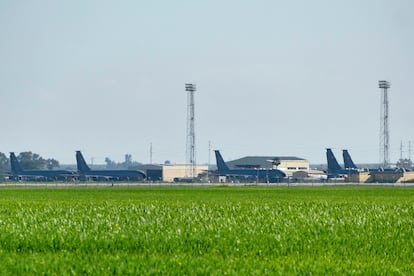
Spain’s refusal to provide military support for the attack on Iran has led the Pentagon to withdraw a dozen KC-135 tanker aircraft deployed at the bases in Morón de la Frontera (Seville) and, to a lesser extent, Rota (Cádiz) to supply fuel in the air to its fighter-bombers, as confirmed by Minister of Defense Margarita Robles. After “categorically” assuring that Spain has not provided any assistance to the attack on Iran, Robles explained that the cooperation agreement with Washington, which serves as an umbrella for the presence of U.S. Troops in Spain, “must operate within the framework of international law” and that what is currently taking place are unilateral actions, without the backing of a multilateral organization such as the UN, NATO, or the EU. “The bases will not provide support unless it is necessary from a humanitarian point of view. Until there is a resolution, the treaty does not apply,” she insisted.
Speaking to the press at the Spanish Air Force helicopter school at the Armilla base (Granada), Robles took it for granted that Washington was aware of Spain’s decision, which is why it moved its refueling aircraft from Morón to other bases in Germany and France over the weekend, as reported by El Independiente. “What is clear is that the tanker aircraft have not carried out and were not going to carry out any support operations [for the attack on Iran]. That is probably why the U.S. Army has taken the sovereign decision to move them to other bases,” she concluded.
This position is consistent with the fact that, as reported by EL PAÍS, two destroyers stationed at the Rota naval base in Cádiz, the USS Roosevelt and the USS Bulkeley, are deployed in the Eastern Mediterranean to reinforce Israel’s protection against ballistic missile attacks launched in retaliation by Iran. Unlike aircraft, ships can spend months away from their main base and receive orders while at sea, so Spain has no possibility of vetoing them.
Regarding the situation of the over 1,000 Spanish military personnel deployed in the region (almost 700 in Lebanon, 275 in Iraq, and 150 in Turkey), the minister explained that all are well and have adopted measures of “prevention, prudence, and safety.” The former, who are part of the United Nations mission in Lebanon (UNIFIL), spent the night in bunkers, she added, in view of the resumption of hostilities between Israel and the Shia militia Hezbollah, with an exchange of rockets and shells. Albares also expressed concern about the spread of the war to Lebanon, which in his view shows that “the unilateral action taken on Saturday has many ramifications and consequences that are difficult to predict.”
The head of Spanish diplomacy stressed that the safety of the 30,000 Spaniards in the region is his priority and promised support for those who have been stranded by the suspension of flights at airports with a high volume of international traffic, such as those in the United Arab Emirates, although he warned that the airspace of most of these countries is closed, so repatriation by air is not an option at this time. In any case, he stressed that the crisis unit activated by the Foreign Ministry will be operational 24 hours a day “for as long as this situation lasts, which looks set to be quite a while.”
The Spanish government’s refusal to allow the use of its bases comes after France, the United Kingdom, and Germany opened the door to launching “proportionate defensive action” against Iran. The leaders of the three European countries warned the Iranian regime to cease its “indiscriminate attacks” in the region and agreed to address this threat in coordination with the United States. “We will take steps to defend our interests and those of our allies in the region, potentially through enabling necessary and proportionate defensive action to destroy Iran’s capability to fire missiles and drones at their source,” said France’s Emmanuel Macron, Britain’s Keir Starmer, and Germany’s Friedrich Merz in a joint statement.
Sign up for our weekly newsletter to get more English-language news coverage from EL PAÍS USA Edition
Tu suscripción se está usando en otro dispositivo
¿Quieres añadir otro usuario a tu suscripción?
Si continúas leyendo en este dispositivo, no se podrá leer en el otro.
FlechaTu suscripción se está usando en otro dispositivo y solo puedes acceder a EL PAÍS desde un dispositivo a la vez.
Si quieres compartir tu cuenta, cambia tu suscripción a la modalidad Premium, así podrás añadir otro usuario. Cada uno accederá con su propia cuenta de email, lo que os permitirá personalizar vuestra experiencia en EL PAÍS.
¿Tienes una suscripción de empresa? Accede aquí para contratar más cuentas.
En el caso de no saber quién está usando tu cuenta, te recomendamos cambiar tu contraseña aquí.
Si decides continuar compartiendo tu cuenta, este mensaje se mostrará en tu dispositivo y en el de la otra persona que está usando tu cuenta de forma indefinida, afectando a tu experiencia de lectura. Puedes consultar aquí los términos y condiciones de la suscripción digital.