Under Kast, Chile begins its most conservative period since the dictatorship
The new president, an ally of far-right leaders worldwide, has promised an emergency government focused on law and order, and economic growth
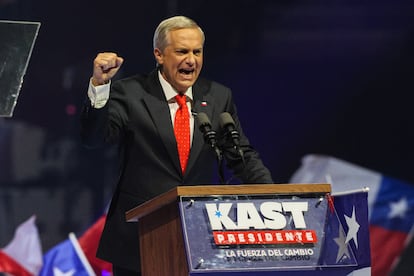

Chile is beginning a new political cycle. Thirty-six years after the end of the military dictatorship of Augusto Pinochet (1973-1990), a conservative president has arrived at La Moneda Palace the likes of which had not been seen in recent years. The right wing came to power twice during democracy with Sebastián Piñera, but the businessman was something of an oddity in conservative circles. With José Antonio Kast, the right wing that truly connects with Pinochet’s legacy is back. A 60-year-old lawyer, father of nine, member of the Schoenstatt Catholic movement, and founder of the Republican Party, Kast is promising an emergency government focused on controlling crime, curbing irregular immigration, and promoting economic growth. He will succeed Gabriel Boric, leader of a new generation of leftists who came to power in 2022 with the idea of burying neoliberalism in Chile. What emerged, however, was a mass of voters who, impatient and frightened by crime, are now giving a chance to the first president who has not broken with Pinochet, although in this campaign, on his third attempt, he opted for a more pragmatic approach, set aside his authoritarian nostalgia, and held back on his beliefs that are contrary to individual freedoms, such as abortion.
In Chile, there is talk of a shift in the political cycle because Kast has demonstrated that, 52 years after the 1973 coup against Salvador Allende, it is possible for a supporter of the dictatorship to lead the country again. He will do so for four years, until March 2030. His tenure begins after being elected in December with 58% of the vote, becoming, due to mandatory voting, the most voted-for president in Chilean history. He also comes to power with high public expectations: since 2005, citizens have not elected a president of the same political affiliation as their predecessor, in a kind of punishment of incumbent leaders. It is a demanding electorate that does not readily commit to political projects, largely due to the disaffection with the ruling class.
In the 2025 presidential elections, after Kast and Jeannette Jara, third place went to Franco Parisi, a populist who rejects politics and has revealed his intention to run for president for a fourth time in 2030. His party, the People’s Party, has become a significant force in the new Congress, and one of its members, Pamela Jiles, will likely become speaker of the Chamber of Deputies this Wednesday through an agreement with the left. There is a consensus that this is a powerful force in Chilean politics, having managed to connect with sectors of the population that neither the right nor the left had previously taken seriously: the middle and emerging segments of the population in regions outside of Santiago.
Kast and his circle don’t like being labeled far-right, but since his election in mid-December, he has made his preferences known internationally. His first visit was to Argentine President Javier Milei, with whom he posed for a photograph holding a chainsaw, a symbol of the dismantling of the state. He then visited Nayib Bukele’s El Salvador, touring its mega-prison, the Center for the Confinement of Terrorism (CECOT). “We want to ask for your collaboration on improving our prison system, on better understanding your criminal justice system, not necessarily by doing the same thing, but, according to our reality, by being able to refine it,” Kast told Bukele in late January in San Salvador.
He then embarked on a tour of Europe. He met with Prime Minister Giorgia Meloni in Italy and with Viktor Orbán in Hungary, both far-right figures. He was also in Belgium, where he was a speaker at the VII Transatlantic Summit, organized by the Political Network for Values, an ultraconservative organization that the Chilean led between 2022 and 2024. An ally of Santiago Abascal, the leader of Spain’s ultranationalist party VOX — they acknowledge being friends — Kast called in Europe to promote “family, truth and freedom” in the face of the “isms” of the left.
After breaking with Boric’s government and ending the transfer of power in a bilateral meeting last week—a relationship that was later repaired—Kast traveled to Miami to participate on Saturday in the Shield of the Americas summit at Donald Trump’s Florida resort. There, the Chilean president praised Trump’s operations in Venezuela and encouraged him to do the same in Cuba, commending his foreign policy. Brazilian President Luiz Inácio Lula da Silva was expected to attend Wednesday’s inauguration ceremony, but Lula canceled his trip to Chile due to the presence of Bolsonaro’s son, a close ally of Kast. No prominent left-wing president will be present at the ceremony.
The new Chilean government will seek $6 billion in fiscal cuts over 18 months, but Kast’s Finance Minister, Jorge Quiroz, has already issued a directive ordering a 3% across-the-board cut in public spending for all executive branches, even before the Kast administration has officially begun. Simultaneously, through various initiatives, the new government is seeking to distance itself from Boric and his generation. Along with announcing an audit of his entire tenure, the new government is looking to change its symbolic imagery. Starting this Wednesday, Chilean government employees will be required to adhere to a new dress code. For men: shirt, jacket, and tie. For women: sober and formal attire. Meanwhile, the Chilean left is bracing for a long night in the Kast government.
Sign up for our weekly newsletter to get more English-language news coverage from EL PAÍS USA Edition
Tu suscripción se está usando en otro dispositivo
¿Quieres añadir otro usuario a tu suscripción?
Si continúas leyendo en este dispositivo, no se podrá leer en el otro.
FlechaTu suscripción se está usando en otro dispositivo y solo puedes acceder a EL PAÍS desde un dispositivo a la vez.
Si quieres compartir tu cuenta, cambia tu suscripción a la modalidad Premium, así podrás añadir otro usuario. Cada uno accederá con su propia cuenta de email, lo que os permitirá personalizar vuestra experiencia en EL PAÍS.
¿Tienes una suscripción de empresa? Accede aquí para contratar más cuentas.
En el caso de no saber quién está usando tu cuenta, te recomendamos cambiar tu contraseña aquí.
Si decides continuar compartiendo tu cuenta, este mensaje se mostrará en tu dispositivo y en el de la otra persona que está usando tu cuenta de forma indefinida, afectando a tu experiencia de lectura. Puedes consultar aquí los términos y condiciones de la suscripción digital.