A 15-year-old teenager, missing since 1986, officially recognized as a victim of the Pinochet dictatorship
Luis Alberto Pino Soto, a high school student in Arica, in northern Chile, disappeared 40 years ago, on the eve of a national protest against the regime
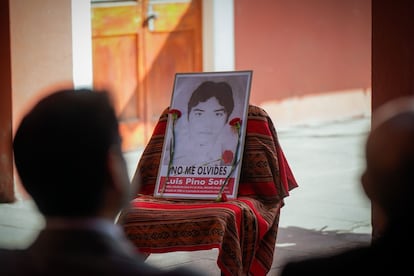

In September 2023, a notification arrived at the home of Luis Alberto Pino Soto’s parents. Luis had been missing for four decades, ever since he disappeared at age 15 during the dictatorship of Augusto Pinochet (1973–1990). The notice came from a court in Arica, in the far north of Chile, summoning him for failing to vote in the May elections for constitutional councilors, according to records from the Electoral Service (Servel). Under Chile’s compulsory voting law, anyone who does not vote must provide a justification; otherwise, they face sanctions.
The letter was not only chilling and a fresh source of pain for the family, which has carried an open wound since July 1, 1986, when they last saw Luis, but it also revealed, over time, an administrative error by the state that had persisted for years. When corrected, this mistake led to the teenager being officially recognized on Thursday as one of 1,469 disappeared persons in a ceremony in Arica. His name had not been included in the records of the Truth and Reconciliation Commission Report, known as the Rettig Report, initiated by Patricio Aylwin, the first president of Chile’s democratic transition, which identified victims of human rights violations.
Luis was the second of four siblings. He disappeared at 1:45 p.m. On July 1, 1986, when he left his home in the Santa Rosa neighborhood to fetch a notebook from the house of a classmate from Liceo A-1 Octavio Palma Pérez. That day, the atmosphere was tense, on the eve of a massive protest against Pinochet, called as part of a national strike on July 2 and 3 organized by the Assembly of Civil Society, which demanded the opening of electoral registers and free elections. The protest ended with brutal repression.
As the hours passed and Luis did not return, his parents, Víctor Pino and María Soto, began searching for him. That night, they went to the Carabineros de Chile (the Chilean national gendarmerie), which did not take the report because 48 hours had to pass before opening an investigation for a presumed disappearance. Two days later, the Investigations Police (PDI) accepted the case.
In the days that followed, the family received “threats, harassment, and institutional silence,” according to information from the Undersecretariat of Justice of the Gabriel Boric government. They explained that testimonies, which have not yet been judicially processed, reported the “possible transfer” of the student “in a military truck.”
His disappearance has been under investigation since 2024 by Judge Sergio Troncoso, following a complaint filed by the family through Francisco Bustos, together with human rights attorney Nelson Caucoto.
Luis Pino’s case experienced serious state irregularities, which explain why he can only now be included in the official list, despite previous attempts by his parents, Víctor and María, in 1990 and 1993. The commission initiated by Patricio Aylwin not only recognized as victims those persecuted for their political activism, but also accounted for “the indiscriminate repression” that occurred during the dictatorship, explains Bustos.
“There are people who may not have been politically active, but they can still be victims of the lack of judgment and of people who knew they were acting with impunity and had a ‘license’ to kill. In terms of international law, this is a widespread attack on the civilian population,” says Bustos.
When the court notice arrived at the student’s parents’ home in 2023, the organization Women, Memory, and Human Rights group of Arica sent letters to several state agencies requesting that the summons be canceled, that the family receive an apology, and that measures be taken to ensure that “a revictimizing situation” like this would not happen again. That same year, the Electoral Service explained to Chlie’s national TV station TVN that Pino remained on the voter registry because, when Chile introduced automatic registration and voluntary voting in 2012 — and restored compulsory voting in 2022 — his name was added to the rolls. At the time, he was not officially recorded in the Civil Registry as either missing or deceased, unlike today.
The case reached the National Plan for the Search of Detained-Disappeared Persons in 2024, a public policy initiative housed within the Ministry of Justice, led by Jaime Gajardo, and the Undersecretariat of Human Rights, headed by Daniela Quintanilla. The initiative was launched by Gabriel Boric on the eve of the 50th anniversary of the coup d’état that occurred on September 11, 1973. The team’s task is to reconstruct the trajectories of the 1,469 people who remain missing, from the moment of their detention to their final fate. In that work, researchers discovered that, in the commission that operated in 1990 and delivered its results in 1991, a human transcription error caused the secondary school student not to be included in the list of victims: his surname was written as “Pinto” instead of “Pino.”
The National Plan for the Search of Detained-Disappeared Persons, while clarifying this student’s case and officially acknowledging the error through a resolution on August 30, 2025, also investigated another case: that of Bernarda Vera, listed in the National Truth and Reconciliation Commission Report as a detained-disappeared person. However, an investigation carried out between 2024 and 2025 revealed inconsistencies and contradictions between that official version and multiple testimonies indicating that Vera, who had been sentenced to death by the dictatorship, may have clandestinely crossed the Andes into Argentina and now resides in Miramar, in the province of Buenos Aires. Since October, these findings have been in the hands of Chilean human rights judge Álvaro Mesa, who has opened a confidential investigation.
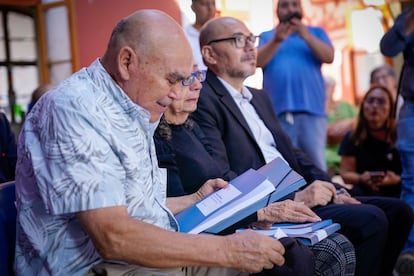
A four-decade odyssey
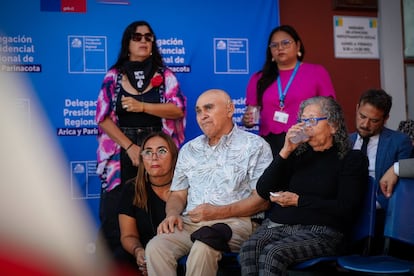
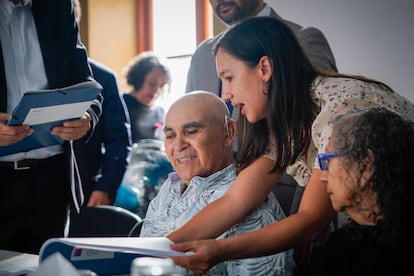
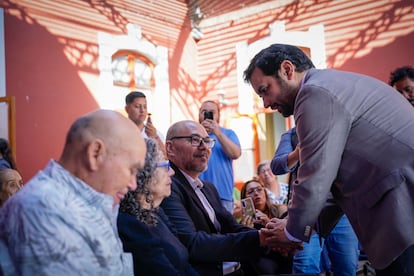
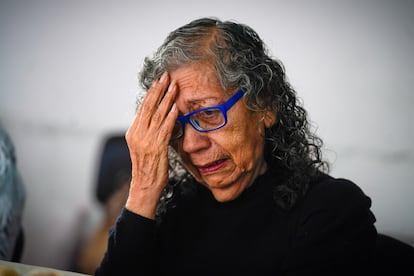
Forty years after their son’s disappearance, Víctor Pino and María Soto took part on Thursday in the reparations ceremony in Arica, led by Jaime Gajardo and Daniela Quintanilla. The minister of justice emphasized that, at the time of his disappearance, Pino “was practically a child.” “The state is correcting a profound mistake that was committed against Luis Alberto Pino Soto, his family, and the memory of the city of Arica, because although the relevant information had been submitted to the Truth and Reconciliation Commission, an administrative error prevented him from being recognized as a victim of the military dictatorship,” he said.
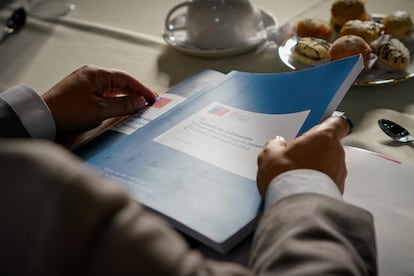
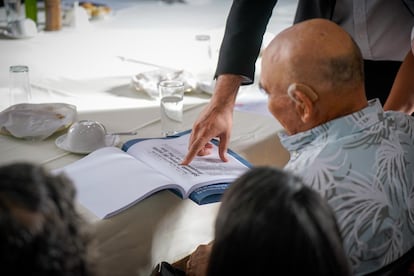
During the ceremony, the family was also given, for the first time, Luis’s case file, the folder with his victim designation, and the ruling issued on January 28 by the 19th Civil Court of Santiago, which ordered that he be included in the official list.
Attorney Francisco Bustos, who traveled from Santiago to Arica, told EL PAÍS that, finally, “the family of Luis Pino Soto, who has lived through a true odyssey, has been given justice.” “The family recounts that the school principal hid class books and denied that Luis had been a student. There were also judges who refused to meet with them [Luis’s parents] because they were associating with left-wing supporters in their search.So, if they suffered mistreatment and cruelty during the dictatorship, they were met with closed doors in the democratic era. That is why, even if belatedly, this act recognizes their persistence.”
According to the National Plan for the Search of Detained-Disappeared Persons, of the 1,469 people who remain missing in Chile, 219 were under the age of 21.
Sign up for our weekly newsletter to get more English-language news coverage from EL PAÍS USA Edition
Tu suscripción se está usando en otro dispositivo
¿Quieres añadir otro usuario a tu suscripción?
Si continúas leyendo en este dispositivo, no se podrá leer en el otro.
FlechaTu suscripción se está usando en otro dispositivo y solo puedes acceder a EL PAÍS desde un dispositivo a la vez.
Si quieres compartir tu cuenta, cambia tu suscripción a la modalidad Premium, así podrás añadir otro usuario. Cada uno accederá con su propia cuenta de email, lo que os permitirá personalizar vuestra experiencia en EL PAÍS.
¿Tienes una suscripción de empresa? Accede aquí para contratar más cuentas.
En el caso de no saber quién está usando tu cuenta, te recomendamos cambiar tu contraseña aquí.
Si decides continuar compartiendo tu cuenta, este mensaje se mostrará en tu dispositivo y en el de la otra persona que está usando tu cuenta de forma indefinida, afectando a tu experiencia de lectura. Puedes consultar aquí los términos y condiciones de la suscripción digital.