The front line basements where Ukraine specializes in electronic warfare
Under the Russian invasion, Kyiv has positioned itself at the forefront of the use and downing of drones like those now employed by Iran to respond to attacks by the US and Israel

Andrey Kibenok, 38, knew nothing about technology when he began serving in the Ukrainian army 11 years ago. Today, the conflict has taken a dramatic turn, and he runs a small workshop manufacturing anti-drone systems on the eastern front in the Donetsk region. Following the major invasion that began in February 2022, he became interested in the weaponry that would soon gain prominence: drones. Initially, around 2023, he disassembled and analyzed them piece by piece. Then, the following year, he became curious about how they could be shot down. And that’s what he’s been working on ever since.
Kibenok represents one of the thousands of links in the makeshift chain of almost homegrown weapons manufacturers who, alongside the defense industry with its cutting-edge technology, confront the invader. In 2015, he made a name for himself as a soldier thanks to his knowledge of the terrain and the Kremlin, he claims, even offered $25,000 for his head. Today, health problems prevent him from fighting on the front lines, but that hasn’t stopped him from adapting to his country’s evolving military needs.
In the new arms race, drones — cheap and effective — are gaining ground over artillery, missiles, and fighter jets. This has placed Kyiv in a privileged position. Its experience has been evident since Iran began defending itself against attacks from the United States and Israel with the same suicide drones that Moscow has been using to punish Ukraine for four years. This is quite a paradox after Donald Trump cut off the flow of U.S. Weaponry to Ukraine last year. Despite this, President Volodymyr Zelenskiy has announced that the first Ukrainian specialists will arrive in the region this week to assist in the fight against Tehran’s counteroffensive.
Every day, hundreds of drones are launched, ranging from the large, 3.5-meter Shahed drones to small civilian drones converted into attack weapons. The European Union itself knows that its defensive plan against the Kremlin depends heavily on the knowledge acquired by Kyiv. Even the United States, along with other Middle Eastern countries, has requested assistance from Ukraine and expressed interest in its drone interceptors.
In this former Soviet republic, companies like Wild Hornets, founded in 2023, have emerged, manufacturing reconnaissance and kamikaze drones as well as interceptors. One of its flagship products is the Sting drone, capable of shooting down Shaheds. SkyFall, the manufacturer of the well-known Vampire bomber drone, has also developed an interceptor weapon, the P1-Sun, which could soon begin exporting. But it is in the many garages and basements scattered near the front lines where thousands of soldiers, like Kibenok and his comrades in the 28th Brigade, study, design, manufacture, and test drones and systems to shoot them down every day.
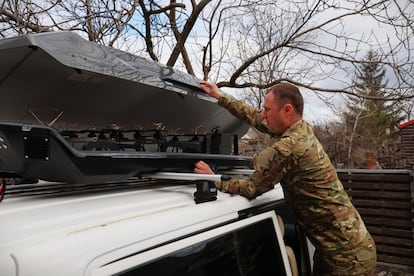
How does this technological leap happen? “Google,” Kibenok states definitively, referring to the origin of the low-cost, DIY solutions he works with. He drives the reporter to his lab in a van equipped with one of his anti-drone systems along the road from Kramatorsk to Sloviansk in Donetsk. The route often passes through tunnels constructed with netting to prevent the impact of drones with which the Russians systematically attack from about 15 kilometers away. This rudimentary defense system contrasts sharply with what the military officer demonstrates minutes later.
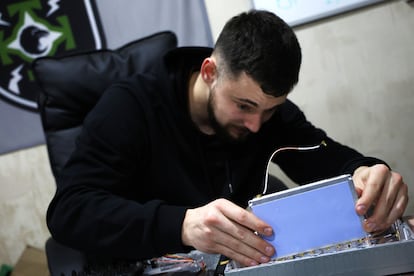
The workshop, where half a dozen men work, occupies several rooms in the basement of a house in the heart of the Russian-occupied zone. Several of them crouch down, illuminated by flexible lamps, working with cables, microchips, and precision tools. Next to them, Kibenok shows a Thule roof rack, the kind that attaches to cars to increase their cargo capacity. When opened, it reveals a series of antennas — “the smaller ones for high frequencies; the larger ones for low frequencies,” he explains — that make up a drone interception system.
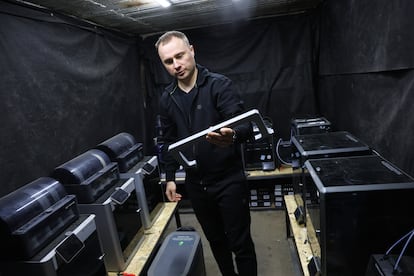
In another room, a repetitive hum can be heard. It emanates from a dozen 3D printers manufacturing plastic parts that, once assembled, will form the frame of the anti-drone system. The raw materials are different spools of plastic cable which, after about seven hours, are transformed into one of these parts. “This one already has 7,000 hours of work under its belt,” Kibenok explains, pointing to one of the machines.
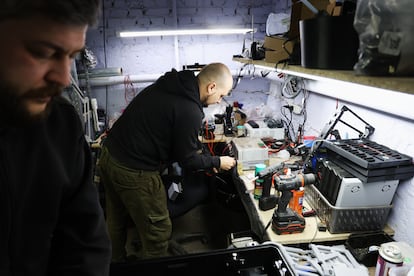
The early days were complicated, the workshop manager admits. But, in these two years, they have made progress with the models, the latest of which are capable of operating without causing interference and blocking nearby Wi-Fi or cell phones, or even the connections of tanks or other military vehicles.
The facilities are primarily financed by Kibenok himself, a cryptocurrency investor, along with some external donations. He asserts that his salary of approximately 50,000 hryvnias (around $1,150) wouldn’t be enough. “This house alone costs 75,000 hryvnias a month in rent,” he explains.
A few days ago, they received a donation of $15,000 from a German Catholic initiative, which had already sent them $10,000 in January. The most expensive of the systems they design costs 450,000 hryvnias (a little over $10,000). A businessman in the food sector in the Vinitsia region recently bought five anti-drone units from them to deliver to the army. Kibenok estimates that this workshop produces defense systems destined for some 30 brigades. Some gas stations in the Donbas region, one of the main theaters of conflict, are also already equipped with them.
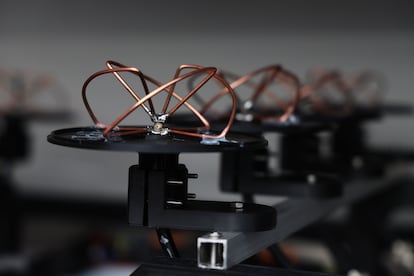
They are effective, he acknowledges, against the vast majority of FPV (First Person View) drones, but not against larger ones like the Iranian-made Shahed drones, which have a range of hundreds of miles and which Russia has also been manufacturing for months. In any case, the 57,000 Shahed drones launched toward Ukraine by Moscow, according to Zelenskiy’s estimates, have led Kyiv to also equip itself with specialists in intercepting this weaponry, which is currently causing particular concern among the Gulf countries.
Vaha, a 45-year-old engineer from the 93rd Brigade, estimates that around 10% of the drones Russia is using in attacks are guided by fiber optic cables thousands of meters long, meaning they don’t need a specific frequency to fly. This is also a new type of weaponry that both sides are researching and improving every day. Faced with them, this soldier concludes, “there’s no other option but to fire.”
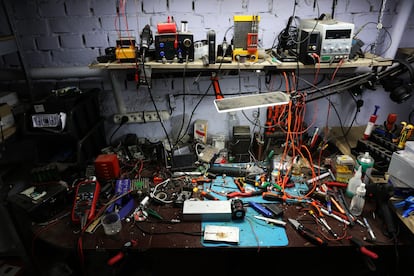
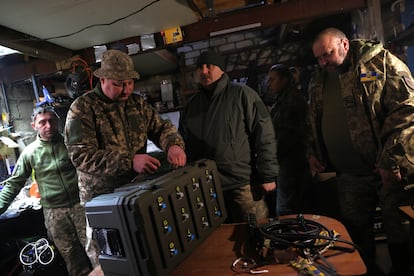
In any case, and despite the presidential announcement, the military personnel consulted on the ground in the Kramatorsk and Sloviansk area — the two largest cities in Donbas remaining under Ukrainian control — are reluctant to allow Kyiv to send a significant number of troops and equipment elsewhere, as this would reduce their defensive capabilities against the Russians. This is the view of Vaha, surrounded by other colleagues in the dilapidated facilities of a garage where they are demonstrating some of their progress in drone interception. He comments that Kyiv should only offer advice to other countries at this time because “we have other priorities here. It’s impossible to send people, although they could come here for training.”
Screen center
A short distance away, in another house converted into a barracks, is the command post of the 93rd Brigade’s battalion specializing in anti-drone operations, comprised of about 100 personnel. Half a dozen people monitor several screens displaying images of Druze drones, whose frequency has been intercepted with the help of comrades deployed with antennas in positions closest to the Russian lines.
A hulking 40-year-old soldier nicknamed Grizzly explains how the facilities work while a live feed shows a Russian drone flying over the besieged town of Druzkivka in the dead of night. Suddenly, alarms blare. One of his comrades’ positions has just been hit by a Russian drone.
There were no casualties, but the deputy commander, Roman, 34, immediately ordered soldiers on the ground to take extreme precautions and recommended they bury all equipment to prevent its destruction in the event of another attack. Despite the tense moments, they acknowledged that this was the daily reality due to the presence of hundreds of enemy drones in the area.
Shortly after, the commander arrives. Vladislav, a 27-year-old psychologist who enlisted in 2021 and is nicknamed Martin, is another who has become absorbed by the technological race that the Ukrainians have been forced into. “The main problem is dealing with the high number of drones coming from the Russian side against both military personnel and civilians,” he emphasizes, sitting at a desk.
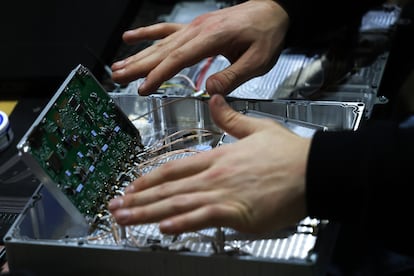
In his hands is the navigation system salvaged from a Shahed drone that didn’t explode, which will be reused in experimental drones. In a few minutes, he disassembles it with a screwdriver to show that the heart of the system is a small computer manufactured in the United States. In any case, Vladislav doesn’t believe Washington is complicit with Moscow, since these are components manufactured and sold on a civilian basis without state intervention. This young man is convinced that, in the future, “Ukraine will remain in Russia’s view,” which is why he’s certain he’ll never go back to studying psychology.
Sign up for our weekly newsletter to get more English-language news coverage from EL PAÍS USA Edition
Tu suscripción se está usando en otro dispositivo
¿Quieres añadir otro usuario a tu suscripción?
Si continúas leyendo en este dispositivo, no se podrá leer en el otro.
FlechaTu suscripción se está usando en otro dispositivo y solo puedes acceder a EL PAÍS desde un dispositivo a la vez.
Si quieres compartir tu cuenta, cambia tu suscripción a la modalidad Premium, así podrás añadir otro usuario. Cada uno accederá con su propia cuenta de email, lo que os permitirá personalizar vuestra experiencia en EL PAÍS.
¿Tienes una suscripción de empresa? Accede aquí para contratar más cuentas.
En el caso de no saber quién está usando tu cuenta, te recomendamos cambiar tu contraseña aquí.
Si decides continuar compartiendo tu cuenta, este mensaje se mostrará en tu dispositivo y en el de la otra persona que está usando tu cuenta de forma indefinida, afectando a tu experiencia de lectura. Puedes consultar aquí los términos y condiciones de la suscripción digital.