From tanks to robotic warfare: The transformation of the front lines in Ukraine
The battlefield has become a ‘transparent’ zone, populated by sensors and modern devices, where everything is visible and the intensive use of drones increases casualties
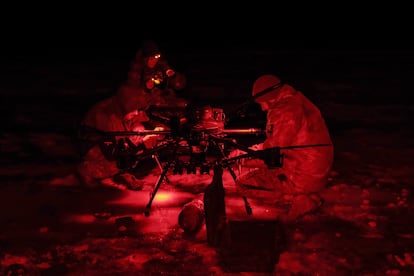

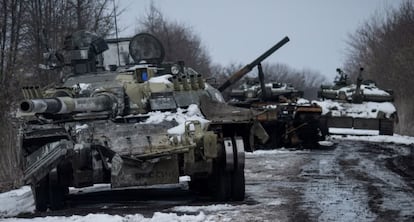
The initial stages of the full-scale invasion of Ukraine in February 2022 were marked by long columns of Russian tanks and armored vehicles that aimed to seize the country in a matter of days. The front line is now stalled, but the conflict has progressed rapidly in the last four years: toward the robotic warfare looming in 2026. The battlefield is riddled with sensors that render it transparent, maximizing the vulnerability of soldiers, and drones have become an omnipresent lethal weapon on land, sea, and, above all, in the air. In this modern form of warfare where armies compete for technological supremacy, the infantry soldier bears the brunt of the consequences.
Some of the key milestones of the conflict in Ukraine are linked to the weaponry that defined the battlefields. The Russian invasion was characterized by tanks, self-propelled artillery, and combat vehicles, reminiscent of 20th-century conflicts. Kyiv’s troops halted them with the help of Javelin man-portable anti-tank missiles, which became iconic. The Himars missile launchers subsequently boosted national morale and fueled the successful counter-offensive of summer 2022, which allowed Ukraine to recapture Kherson and other territories, also using armored vehicles and tanks.
The war of mobility gave way to positional warfare that autumn. And in the long and bloody Battle of Bakhmut, in early 2023, Mavic drones became the Ukrainians’ main reconnaissance tool. “Then they also started to be used to drop grenades into the trenches. That was something new,” explains Vladyslav Urubkov, head of the military department at the army aid organization Come Back Alive (CBA).
During the nine months of the offensive against Donetsk, “the use of FPV (First Person View) drones spread, and the Russians began using KAB glide bombs,” he continues. Urubkov served in the army in Donbas until the summer of that year and now travels back and forth to the front.
Following the failed counteroffensive of 2023 and the four-month blockade of U.S. Military aid, Ukraine began ramping up production of FPV drones. Urubkov continues his review of the war’s milestones at his organization’s headquarters, guarded by armed soldiers. “We had personnel problems, and in 2024 we failed to halt the Russian advance from Avdiivka to Pokrovsk. Drones began to be deployed more rapidly, and Russia followed suit. Both sides had electromagnetic warfare equipment, but the Russians’ was superior.”
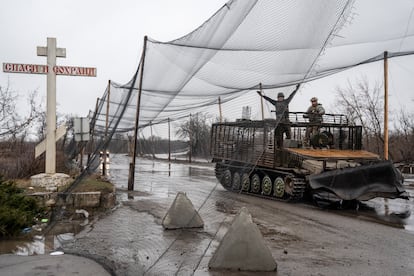
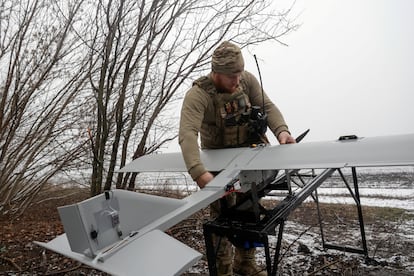
The Ukrainian offensive in Russia’s Kursk region in the summer of 2024 brought another technological innovation: Russia’s first fiber-optic drones, guided by cables and immune to electromagnetic warfare. “For now, the only protection against them is to install nets and shoot [at] them directly,” says Urubkov. To secure logistics, kilometers-long nets cover roads near the front, preventing drones from crashing into vehicles.
War has become a high-tech struggle. Drones have long dominated the battlefield. The race is now for numbers: “Whoever has the most will have the advantage on the front lines,” summarized one of the founders of DeepState, an organization that maps warfare from its inception, a few days ago at a meeting at the Kyiv Security Forum — held in a hotel parking lot to protect against bombing.
According to the head of the Armed Forces of Ukraine, Oleksandr Syrskyi, both sides use between 6,000 and 8,000 FPV drones daily. Drone operators are a priority target. Moscow has a feared elite unit in Ukraine, Rubicon.
In the air, at long range, Russia has a clear superiority with ballistic and cruise missiles, KAB bombs with ever-increasing range, Lancet kamikaze drones, and Shahed drones. They use them not only on the front lines, against logistical support, but also to destroy energy, military, and increasingly civilian infrastructure throughout the country. Early Sunday morning, Russia launched 50 missiles and nearly 300 attack drones of various types against the entire country.
Artillery remains essential, and tanks and other armored vehicles haven’t disappeared — the challenge now is adapting and protecting them from drones — but light vehicles like buggies and motorcycles are being used more and more. The Russians no longer attempt to break through the front lines, but instead employ infiltration tactics with small groups of soldiers.
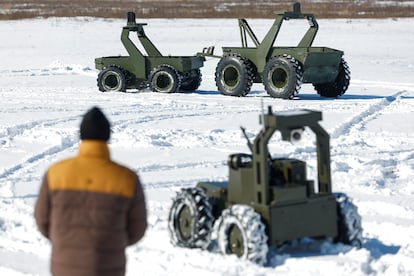
And then there are the ground robots. “Ukraine is ahead in development and application in this area,” explain Roman Pohorilyi and Ruslan Mykula of DeepState. They are key for logistics and for the evacuation of soldiers. According to the Ministry of Defense, ground drones carried out 7,000 missions in January alone.
In the lethal zone of the battlefield, soldiers previously feared artillery fire and mines above all else. They had to be vigilant against Mavic drones, which had a range of about 10 kilometers (6.2 miles), but were practically useless on rainy or foggy days.
That space, however, has now become an increasingly vast gray area, as the range of ubiquitous drones grows, exceeding 40 kilometers (25 miles) with fiber optics. There is no longer a clear dividing line between sides. Now they mingle in the air, on the ground, and underground.
Soldiers condemned to the trenches
Optical, thermal, radio frequency, acoustic, seismic, and GPS sensors, along with the signals emitted by cell phones. All these devices populate this modern battlefield and make it transparent. Everything is seen, everything is known in real time. And the kill chain, the sequence from the detection of a target to its destruction, is getting faster and faster.
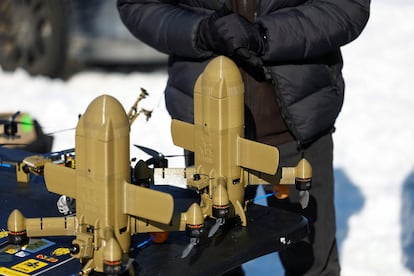
The one who bears the brunt of this frenetic and lethal technological development is the infantry soldier. The Ukrainian army attributes between 70% and 80% of its frontline casualties to drones. Andrii Yvanuk, codename Rezhyser (director), has served in the bloodiest parts of the conflict, such as Pokrovsk, in the 414th Independent Brigade of Unmanned Aerial Systems Attack, an innovative mobile reconnaissance unit. He has seen how the lives of these soldiers have worsened with each technological advance. “The main problems are logistics and rotation. Getting supplies (ammunition, water, food) to the position is like Russian roulette: you don’t know if you’ll reach it. And it’s safer to stay put than to rotate,” he explains.
“The main rule is to sit and hide,” Yvanuk continues. Before, there could be up to 10 soldiers in the same position, and they would be relieved every two or three days. Now, in some of the most difficult sectors of the front, there might be one or two at most, and they can spend weeks, even months, without leaving their trenches and underground bunkers. Psychologically, these are unbearable conditions.
“If they stick their heads out, they’ll get blown off,” says Yvanuk, an intelligence drone operator. In the cold, soldiers can be easily identified with thermal cameras. “Cooking and trying to keep warm is very dangerous. Even sitting on the ground, they can be identified because they heat the floor,” he explains. They can go days without being able to venture outside to do basic things: “Sometimes bottles of urine and bags of feces pile up.”
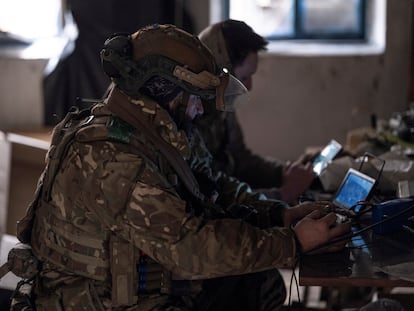
The infantry’s primary role is to hear and see the enemy, gather intelligence, and share it with drone and artillery units, which are the ones that carry out the attacks. But amid this ecosystem of chips, satellites, and cables, these soldiers remain essential: “Where we have infantry, it’s our territory,” Yvanuk states.
The year 2026 is the year of “Warfare 5.0,” as Yuri — who prefers not to give his last name — says. He leads a team at the Ukrainian Ministry of Defense dedicated to analyzing defense and security trends. “We are in a stage with more unmanned systems that is heading toward a phase with autonomous systems in different domains,” he states.
In a Kyiv café, the analyst offers a glimpse into the future of robotics, showing examples on his cell phone. One video shows a drone using machine learning and artificial intelligence systems that can resume its capture if the operator loses control due to electromagnetic warfare. Another video depicts an operation in which ground robots and drones surrounded an enemy position and captured the soldiers.
The search for solutions never stops, and technological superiority comes and goes: “One side develops interceptors. The other transforms drones. We are better at innovating, but in an autocratic regime like Russia it is easier to scale up,” Yuri explains.
There’s a certain euphoria in Ukraine today because they say the blocking of Starlink — Elon Musk’s satellite internet network — for Russian troops is having an effect on the front lines. Some attribute to this the fact that Kyiv has recovered, according to some estimates, about 200 square kilometers (77 square miles) of territory, mainly in Zaporizhzhia. Yuri, though, isn’t declaring victory over Starlink: “They’ll come up with something else.”
Tu suscripción se está usando en otro dispositivo
¿Quieres añadir otro usuario a tu suscripción?
Si continúas leyendo en este dispositivo, no se podrá leer en el otro.
FlechaTu suscripción se está usando en otro dispositivo y solo puedes acceder a EL PAÍS desde un dispositivo a la vez.
Si quieres compartir tu cuenta, cambia tu suscripción a la modalidad Premium, así podrás añadir otro usuario. Cada uno accederá con su propia cuenta de email, lo que os permitirá personalizar vuestra experiencia en EL PAÍS.
¿Tienes una suscripción de empresa? Accede aquí para contratar más cuentas.
En el caso de no saber quién está usando tu cuenta, te recomendamos cambiar tu contraseña aquí.
Si decides continuar compartiendo tu cuenta, este mensaje se mostrará en tu dispositivo y en el de la otra persona que está usando tu cuenta de forma indefinida, afectando a tu experiencia de lectura. Puedes consultar aquí los términos y condiciones de la suscripción digital.