War plunges Iranians into fear and uncertainty
The lack of shelters and the lines to buy food exacerbate the population’s suffering in the face of US-Israeli airstrikes
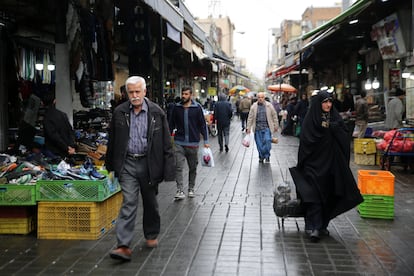
Nearly two weeks into the war, the accounts of Iranian citizens reveal anguish and unease. “In the first few days, I told my daughter that the noises were from the Chaharshanbé Suri festival (in Iran, the night of the last Wednesday of winter is celebrated with fireworks), but now she has nightmares every night,” explains a worried Simin, a resident of Tehran. “Elnaz [her daughter] is under a lot of stress; the slightest noise makes our hearts sink.” Simin, a tourism management specialist, previously worked at a travel agency, but has been unemployed for several months.
At the start of the war, many were relieved to hear the news of Ali Khamenei’s death. However, they acknowledge that the prolonged conflict and the lack of a clear solution are beginning to cause concern. Farid, a married accountant from Isfahan in central Iran, sums it up this way: “Our joy lasted only that night when we learned that Khamenei was dead; after that, little by little, the worries began.”
He is referring primarily to the daily hardships faced by the population. “For many people, the problem now is obtaining basic food items at high prices, the long lines to buy bread, and the constant uncertainty about which place was bombed last night and which will be attacked tonight,” Farid laments. He lost a friend during the January protests and says he still holds out hope. “I am prepared to endure the hardships and fight until this regime is gone,” he adds. Even so, not all Iranians seem capable of withstanding a prolonged war.
“During the Iran-Iraq War, sirens would wail before the bombings. I would take my children by the hand and go down to the basement, and then the siren would sound, indicating that the danger had passed,” recalls Shirin, a retired teacher living in the capital. “But now it’s very strange. We understand there’s been an attack because of the sound of the explosions, and then the neighbors take the elevator up to the roof to see where it’s landed,” she says.
Many citizens are discontented and shorn of hope due to the lack of an early warning system, the weakness of the air defenses, the lack of shelters, and the absence of information in the domestic media. Katayun, a fitness trainer, says: “At first, when Khamenei died, we were very happy, but now I feel abandoned. Some nights we take refuge in the bathroom because it has no windows.”
In these circumstances, children are the primary victims of the conflict. Teachers point to a decline in academic performance and the ineffectiveness of the Shad platform (the online education network for Iranian schools), which is not compatible with the internal intranet. “The children are exhausted from lack of sleep, and many don’t have access to Shad,” explains Setayesh, a primary school teacher. She adds that, in practice, “the platform is unreliable, and many students are also absent.”
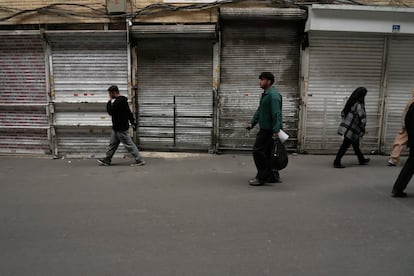
The Coordinating Council of Teachers’ Unions also mentions in its report on the situation in the capital that, despite the population’s need for hope and peace, “the city’s appearance has become strangely militarized.” “In the squares and at major intersections, vehicles used for repression and machine guns are on display,” it adds, pointing to the numerous checkpoints established by the regime to intimidate the population. “It seems that before we have to worry about the sky, we must fear the streets of our own city.”
Shirin also fears for her safety: “There are no military installations or sensitive sites near us, but there is a school just a block away.” Her son has asked her to move to his house because, he says, he has seen the Basij (a paramilitary force made up of volunteers) turn the area into a base.
The statements made Tuesday by Ahmad Reza Radan, head of Iran’s police and security forces, in which he threatened citizens, followed the same line. “If anyone takes to the streets responding to the enemy’s wishes, we will not consider them a protester, but an enemy,” he said. And he issued a direct threat against the protesters: “[With them] we will do the same as with the enemy; all our forces have their fingers on the trigger.”
Internet outages
Since the beginning of the conflict, the Iranian regime, under the pretext of security threats, has cut off general internet access. According to a statement made Tuesday by Fatemeh Mohajerani, the government spokesperson, access is only granted to individuals and institutions that disseminate the official version of events.
“We had been selling handcrafted Iranian-designed jewelry online for two years. Business was good, but with the constant internet outages and restrictions, our work has practically disappeared,” laments Samin, an entrepreneur who, along with her sister, set up a startup about three years ago. She adds that to connect to the internet they have to use a VPN, the price of which has risen sharply, and which only allows momentary access, often just for sending text messages.
Following the bombings of the past two nights, several large Iranian banks, such as Melli Bank and Sepah Bank, which pay the salaries of civil servants and military personnel, have ceased operations and ATM cards are no longer valid, further exacerbating the economic problems of the population.
With each passing day since the start of the war, the testimonies reflect a growing weariness, as well as a mixture of anxiety and discouragement. The initial hope for change is fading in the minds of many, giving way to the more immediate concerns of daily life. Under a sky clouded by the smoke and dust of the bombings, amid increasingly empty tables and lives marked by uncertainty, another silent war is being waged, one that barely registers in the calculations of political leaders.
Sign up for our weekly newsletter to get more English-language news coverage from EL PAÍS USA Edition
Tu suscripción se está usando en otro dispositivo
¿Quieres añadir otro usuario a tu suscripción?
Si continúas leyendo en este dispositivo, no se podrá leer en el otro.
FlechaTu suscripción se está usando en otro dispositivo y solo puedes acceder a EL PAÍS desde un dispositivo a la vez.
Si quieres compartir tu cuenta, cambia tu suscripción a la modalidad Premium, así podrás añadir otro usuario. Cada uno accederá con su propia cuenta de email, lo que os permitirá personalizar vuestra experiencia en EL PAÍS.
¿Tienes una suscripción de empresa? Accede aquí para contratar más cuentas.
En el caso de no saber quién está usando tu cuenta, te recomendamos cambiar tu contraseña aquí.
Si decides continuar compartiendo tu cuenta, este mensaje se mostrará en tu dispositivo y en el de la otra persona que está usando tu cuenta de forma indefinida, afectando a tu experiencia de lectura. Puedes consultar aquí los términos y condiciones de la suscripción digital.