The hidden history of Afro-Bolivians: From slavery in silver mines to fighting for power
UNESCO recently highlighted a series of 17th-century documents. These reveal that the trafficking of Africans to exploit Bolivia’s Cerro Rico was the origin of the Black community in the country

Cerro Rico (“Rich Mountain”) is located near the Bolivian city of Potosí. It once produced up to 80% of the silver of the Viceroyalty of Peru (1542-1824) and as much as 60% of global production during certain periods of the 17th and 18th centuries. But Indigenous labor was insufficient to extract the thousands of tons of ore flowing from the mountain. And so, the Spanish Crown’s solution was to bring enslaved Africans to the territory, using the transatlantic system that had been established by the Portuguese years earlier.
The rulers of the Spanish colony benefited from the fact that the new captives already had experience in gold mining. By 1630, some 5,000 Black people – primarily from Angola, the Congo and Guinea – were living in Potosí, part of present-day Bolivia.
A series of 17th-century public records, recently included by UNESCO in the Memory of the World Programme, document the inhumane conditions that these forced migrants were subjected to. These conditions included working in metal-smelting furnaces that operated 24 hours a day, seven days a week; being placed in shackles and stocks, which were used by slaveowners to restrict movement; sleeping in pallets lined with sheepskin that served as beds; and covering themselves with numerous blankets to mitigate the frigid Andean climate. Laboring at over 13,000 feet above sea level, the enslaved peoples were generally unaccustomed to such temperatures.
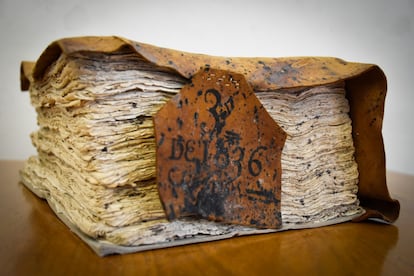
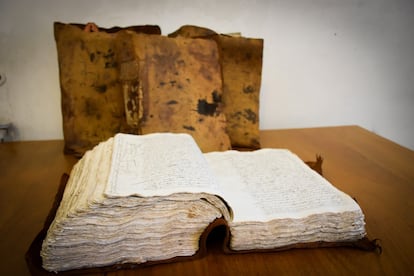
The series, which consists of 27 manuscripts, is entitled Public deeds about the African slavery trade between Buenos Aires and the Villa Imperial of Potosí (1635 – 1636). The documents are preserved in the former National Mint of Bolivia, in Potosí, which is now a museum. The mint was the institution that converted the silver produced during the colonial period into circulating currency.
The institution’s director, Luis Arancibia, highlights the multidisciplinary studies that can be conducted using these archival records: “They’re a primary source for analyzing trade routes, intermediary networks, notarial practices, historical demography, Afro-Bolivian studies and processes of forced migration.”
The history of the Afro-Bolivian nation – like that of other Black communities in the region – has a complex origin. And this group is a minority compared to that of neighboring countries: while there are some 30,000 Afro-Bolivians, there are, for example, 815,000 Afro-Ecuadorians. The history, however, remains just as ancient.
Juan Angola is a historian from La Paz, Bolivia. He’s of Angolan and Makonde descent. He describes the work of his ancestors in the furnaces where silver bars were smelted, and in the ore amalgamation plants: “There were up to 13 workers per furnace. They covered the windows with leather and had to work by candlelight. There was no difference between day and night. Shifts could last between 15 and 20 hours.” The prisoners received daily rations of bread and beef. On holidays, they were given fish.
Angola details the other major task performed by slaves in the Andean region: cleaning the ore in the mills. “Men and women used their feet to mix and stomp on the mixture of ground ore and mercury, damaging their toes. Many of them were left maimed by the metal.”
Mining production declined drastically in the final stage of the Spanish American colonies. And, by the 19th century, the Black population had migrated to the agricultural estates in the region north of La Paz, known as the Yungas. This region – a transition zone between the high Andes and the subtropical valleys – became the refuge and home of the Afro-Bolivian community.
The lush, green cloud forests are home to plantations that grow cassava, rice, bananas and coca leaves. For much of Bolivia’s history, this area was the exclusive property of large landholders. Wealthy landowners could own up to 30 enslaved people on each estate. And despite Bolivia’s independence in 1825, the situation of Indigenous and Black peoples – who made up the base of the social pyramid – didn’t change much. “The first constitution – [which was drafted by Simón Bolívar, in 1826] – already addressed the abolition of slavery. The article, however, was unclear: it left the matter to the discretion of the landowners. Clearly, the landowners didn’t want to lose their workforce, which [would have] cost them dearly […] There was no freedom with independence, only a change of leadership,” Angola explains.
Years later, in December of 1829, the Bolivian National Congress determined that, by law, enslaved Afro-descendants could purchase their freedom “at the same price as their last sale.” The attempt at total abolition only came in 1851, during the government of Manuel Isidoro Belzu, who was considered to be the first Bolivian president who had support from the masses.
It would be more than a decade before Black people achieved their freedom in the United States, and more than two decades in Brazil. However, the reality for Afro-Bolivians changed little after 1851: as they were released into freedom without economic support, entire Black families continued to do free work for landowners four days a week, as a form of payment to obtain small plots of land.
Access to citizenship and full freedom, for both Afro-Bolivians and the vast majority of Bolivians, came with the National Revolution of 1952. Among the changes that were enacted, the agrarian reform legally transformed Afro-Bolivians into small landowners with economic autonomy. But despite the law being passed, their cultural and social integration remained a pending issue. Bolivian society, which is predominantly Indigenous, tends to be distrustful of what it doesn’t know about, or doesn’t find similar to the dominant culture.
Juan Carlos Ballivián, a lawyer, activist and founder of the National Afro-Bolivian Council (CONAFRO), recalls his childhood in the 1980s, growing up in the Yungas region: “We lived together to protect ourselves from the racism and discrimination. We went to school together [and] we left home together, because racism was rampant and was practiced not only against us, but also against our parents.”
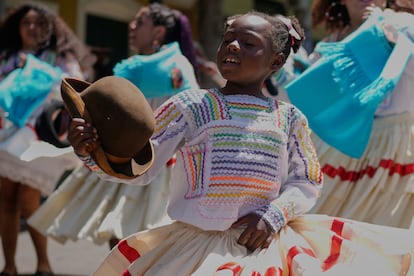
Dance – the Afro-Bolivian saya – was the primary tool for making their Black heritage visible in Bolivia. To the rhythm of drums and cuanchas (a type of rattle), the saya dance began to spread from the provinces to the big cities.
For Angola, however, it’s time for his community to move into the political sphere: “We must join forces to achieve our common goal: for Afro-Bolivians to be visible, because the state remains structurally racist, as does Bolivian society.”
The 2009 Constitution is the first to recognize the Afro-Bolivian nation as part of the country: they are mentioned in four articles. And branches of CONAFRO have been established in several cities, while members of the community have been elected to the Legislative Assembly, or have gained positions in other institutions. However, according to Angola, these have not always been spaces where Afro-Bolivians have attempted to advocate for their community.
He elaborates on his point: “The saya has undoubtedly become a kind of symbol for us. The other side of the coin is that it has overshadowed other efforts and contributions, such as our participation in the [Bolivian War of Independence, from 1809 until 1825]. A voice has been created through voices, drums and rhythms… but today, the demands are for spaces of power.”
Translated by Avik Jain Chatlani
Sign up for our weekly newsletter to get more English-language news coverage from EL PAÍS USA Edition
Tu suscripción se está usando en otro dispositivo
¿Quieres añadir otro usuario a tu suscripción?
Si continúas leyendo en este dispositivo, no se podrá leer en el otro.
FlechaTu suscripción se está usando en otro dispositivo y solo puedes acceder a EL PAÍS desde un dispositivo a la vez.
Si quieres compartir tu cuenta, cambia tu suscripción a la modalidad Premium, así podrás añadir otro usuario. Cada uno accederá con su propia cuenta de email, lo que os permitirá personalizar vuestra experiencia en EL PAÍS.
¿Tienes una suscripción de empresa? Accede aquí para contratar más cuentas.
En el caso de no saber quién está usando tu cuenta, te recomendamos cambiar tu contraseña aquí.
Si decides continuar compartiendo tu cuenta, este mensaje se mostrará en tu dispositivo y en el de la otra persona que está usando tu cuenta de forma indefinida, afectando a tu experiencia de lectura. Puedes consultar aquí los términos y condiciones de la suscripción digital.