The king of Spain takes another step: The ball is now in Mexico’s court
Felipe VI’s acknowledgment of ‘abuses’ during the colonization of the Americas awaits a response from Mexican President Claudia Sheinbaum
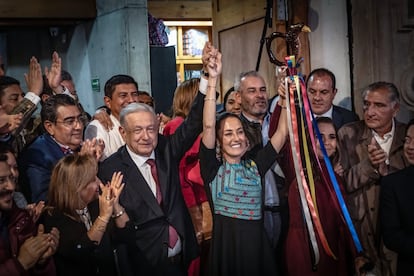

Culture is proving to be a crucial tool in repairing the strained diplomatic relations between Spain and Mexico, which soured in 2019 when the then newly elected Mexican president, Andrés Manuel López Obrador, demanded a gesture of reparation from the Spanish Crown for the excesses of colonization. The letter sent to the monarch at that time was private, but the matter was resolved publicly with a firm rejection from the Spanish government and a breakdown in relations that continues to this day.
Now, efforts to ease tensions are also being made publicly, and most of them are focused on the cultural sphere: the Guadalajara International Book Fair (FIL), the Princess of Asturias Awards, the Fitur tourism fair in Madrid, where Mexico is the guest country, and several exhibitions of pre-Hispanic art, such as the one that served as the backdrop for King Felipe VI’s acknowledgment of the “abuses” of the conquest of the Americas this Monday. Mexican President Claudia Sheinbaum has been viewing all of this as “steps” or “small steps” in the right direction, but will they be enough for the government that declared itself aggrieved by the Spanish monarch’s latest statements?
“It won’t be enough,” says Humberto Beck, a historian at the Colegio de México. The Mexican government will undoubtedly appreciate it, but will receive it “as a substitute for an official apology,” asserts this academic, a veteran analyst of current Mexican politics. “Making relations between the two countries contingent on this apology has been a mistake by the Mexican government,” he adds. “They have made this request for an apology a central issue that distracts from the deeper issues, which are reflection, a continuous process of memory and recognition on the part of both societies,” he says by phone.
In his opinion, the Mexican government has turned the Spanish monarch’s public apology and the concept of Hispanicity into a “fetish.” “This has been presented as if the problem were the Spanish state, and Mexico the aggrieved state, when it’s something that affects both,” he reflects. So no, Beck doesn’t believe the king’s words will close this matter. “They wanted a ceremony of redress, and the monarchy cannot do that because it would alienate a sector of Spanish politics that has put empire at the center.”
In 2019 it was López Obrador who privately requested this gesture from the Spanish monarchy, although a leak violently shifted the debate into the public sphere. The arrival of Claudia Sheinbaum to power in 2024 drove another nail into the coffin of relations that were privately struggling to repair themselves. The president did not invite Felipe VI to her inauguration, and once again the controversy obscured the path that had been clearing. In Mexico, the controversy found political traction among some sectors of the left and a strong rejection from the right, which saw no reason why Spain should apologize for events that occurred several centuries ago. Nor was President López Obrador’s proposal very popular among the many descendants of the Spanish Republican exiles in Mexico. Some, like the renowned historian and constitutional scholar Fernando Serrano Migallón, a son of exiles, considered the request inappropriate and an unnecessary barb, even though he, who could have obtained Spanish nationality, rejected it because he did not want to swear allegiance to the king as required by the process.
From that same republican perspective, the president of the Spanish Athenaeum of Mexico, Juan Luis Bonilla, told this newspaper that the king’s presence at the exhibition “Women in Indigenous Mexico,” currently on display at the National Archaeological Museum in Madrid, and his statements “demonstrate the Spanish government’s interest in maintaining a close relationship with Mexico, as it existed before López Obrador.” Bonilla also mentioned previous statements along the same lines, condemning the excesses of the Conquest, made by Foreign Minister José Manuel Albares and by Spain’s Prime Minister Pedro Sánchez himself. These, he said, are “gestures toward Mexico, attempting to resolve diplomatic conflicts that are hindering relations between the two countries,” a particularly sensitive issue among the descendants of the Spanish exiles.
With or without the king, the children and grandchildren of those Spanish Republicans seem to be saying, Mexico and Spain are sister nations and should behave as such. They are the ones who have kept alive that brotherhood which, since the end of the Spanish Civil War, has intertwined the destinies of both peoples, and they are the ones who have sought, even now, to ease this diplomatic crisis. This was the case with the Minister of Culture, Ernest Urtasun, when he met with his Mexican counterpart, Claudia Curiel, on the occasion of the Guadalajara International Book Fair in November 2024, with Spain as the guest country and the Republican exiles at the heart of the event. The Minister of Territorial Policy, Ángel Víctor Torres, also did so five months earlier, when he traveled to Mexico to acknowledge the role of those exiled Spaniards in democratic history. Since then, there have been numerous declarations and gestures of unequivocal intent to heal these open wounds. “Whether all of this is enough or not, Claudia Sheinbaum will have to say,” says Bonilla, but “Mexico requested an apology, that is, the assumption of responsibility for an event, and it seems to me that the king’s statements are clear in the sense that he has no responsibility for those events,” he affirms.
The monarch’s words were certainly not an official apology: “There was much abuse” and “ethical controversies” surrounding the conquest, he noted. He referred to the current perspective on what happened centuries ago, but framed it within a “context” that requires “objective and rigorous analysis.” But “obviously,” he emphasized, that “cannot make us proud.”
Historian Beck believes the Mexican government “needs to rethink what constitutes just reparations. If it involves the King assuming historical guilt, that’s not going to happen,” he ventures. He adds, “There needs to be a reevaluation of what historical memory means.”
Sign up for our weekly newsletter to get more English-language news coverage from EL PAÍS USA Edition
Tu suscripción se está usando en otro dispositivo
¿Quieres añadir otro usuario a tu suscripción?
Si continúas leyendo en este dispositivo, no se podrá leer en el otro.
FlechaTu suscripción se está usando en otro dispositivo y solo puedes acceder a EL PAÍS desde un dispositivo a la vez.
Si quieres compartir tu cuenta, cambia tu suscripción a la modalidad Premium, así podrás añadir otro usuario. Cada uno accederá con su propia cuenta de email, lo que os permitirá personalizar vuestra experiencia en EL PAÍS.
¿Tienes una suscripción de empresa? Accede aquí para contratar más cuentas.
En el caso de no saber quién está usando tu cuenta, te recomendamos cambiar tu contraseña aquí.
Si decides continuar compartiendo tu cuenta, este mensaje se mostrará en tu dispositivo y en el de la otra persona que está usando tu cuenta de forma indefinida, afectando a tu experiencia de lectura. Puedes consultar aquí los términos y condiciones de la suscripción digital.