Bukele alters Constitution to endorse life imprisonment in El Salvador
The government criticized a report by international legal experts that warns of crimes against humanity in the Central American country and lashed out at human rights organizations: ‘Go to hell’
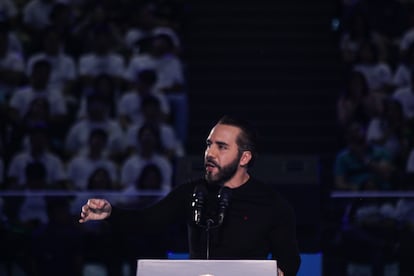
The Legislative Assembly of El Salvador, dominated by the ruling party Nuevas Ideas (NI), on Tuesday approved a constitutional reform sent by President Nayib Bukele that allows life sentences for “murderers, rapists and terrorists.”
“We’ll see who supports this reform and who dares to defend the Constitution’s continued prohibition against murderers and rapists remaining in prison,” the president had said. Bukele announced the new measure after the publication of a report by international legal experts accusing his government of committing crimes against humanity under the state of emergency that has been in place for the past four years.
“Imprisonment for debt, infamous imprisonment, proscriptive imprisonment, and all forms of torture are prohibited. Life imprisonment shall only be imposed on murderers, rapists, and terrorists,” states the reform to the second paragraph of Article 27 of the Constitution, approved in a plenary session by 59 pro-government deputies, their allies, and two from the opposition, without prior study or debate.
Justice and Security Minister Gustavo Villatoro arrived at the Bukele-controlled parliament on Tuesday to present the constitutional reforms and delivered a speech against the organizations that have denounced human rights violations under the current administration: “They started here talking about victims, about victims’ rights, and they created laws about victims’ rights only to end up with the story that the victim was the accused and the perpetrator was a law enforcement officer. Nothing could be more absurd. But their time has come. What we are doing is irreversible,” the minister said at a press conference in Congress.
Article 27 of the Salvadoran Constitution prohibits life sentences, considering that the prison system is organized with the “objective of correcting offenders, educating them and instilling work habits, seeking their rehabilitation and the prevention of crime.” Jurisprudence in El Salvador establishes a maximum sentence of 60 years for a convicted person, but in December 2025 the Attorney General’s Office announced that it had secured sentences of up to 1,000 years in prison for a group of gang members.
Minister Villatoro dedicated his entire speech in parliament to attacking human rights organizations. “Now we’re going to see these organizations defending, as always, violent criminals, rapists, murderers of men and women, terrorists, and representatives of criminal organizations: your vote doesn’t count because you have no sovereign legitimacy over this country. And I would like to tell you this as a citizen, but I have to respect the office I hold. I can simply tell you: Go to hell,” he said.
Following the publication of the report accusing El Salvador of crimes against humanity, the government launched a weekend-long social media campaign. Bukele, who rarely responds to journalistic reports, angrily wrote on his X account: “These ‘human rights’ organizations, which are receiving extensive coverage from many national and international media outlets [The Guardian, France 24, EL PAÍS, Open Society media, among others], and which are being picked up by thousands of local and foreign journalists, activists, and politicians, are demanding that the State of El Salvador release 100% of the gang members captured since the beginning of the State of Emergency.”
Sign up for our weekly newsletter to get more English-language news coverage from EL PAÍS USA Edition
Tu suscripción se está usando en otro dispositivo
¿Quieres añadir otro usuario a tu suscripción?
Si continúas leyendo en este dispositivo, no se podrá leer en el otro.
FlechaTu suscripción se está usando en otro dispositivo y solo puedes acceder a EL PAÍS desde un dispositivo a la vez.
Si quieres compartir tu cuenta, cambia tu suscripción a la modalidad Premium, así podrás añadir otro usuario. Cada uno accederá con su propia cuenta de email, lo que os permitirá personalizar vuestra experiencia en EL PAÍS.
¿Tienes una suscripción de empresa? Accede aquí para contratar más cuentas.
En el caso de no saber quién está usando tu cuenta, te recomendamos cambiar tu contraseña aquí.
Si decides continuar compartiendo tu cuenta, este mensaje se mostrará en tu dispositivo y en el de la otra persona que está usando tu cuenta de forma indefinida, afectando a tu experiencia de lectura. Puedes consultar aquí los términos y condiciones de la suscripción digital.