Salvadorans deported by Trump to Bukele’s mega‑prison fight against being forgotten
At least five prisoners remain cut off from all contact in Salvadoran jails, a year after the US president ordered their unprecedented expulsion as alleged gang members

On March 15, Herbert Sigarán turned 51. But no one celebrated at his home in Dallas. His wife, Karla, had asked him a few days earlier if he wanted at least a cake. He answered listlessly, but firmly. “No, no. I don’t want anything. All I want is to know about my son. It’s almost been a year since they took him.”
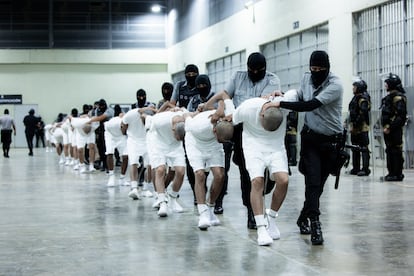
His son is Brandon Sigarán. On March 15, 2025, he was deported by the Trump administration to El Salvador along with more than 250 Venezuelans, who were all accused without evidence of being gang members. They were deported even though an emergency court order was issued while they were in the air. The situation became the first major scandal to erupt over the second Trump administration’s immigration policy. Once in the Central American country, the deportees were immediately detained in President Nayib Bukele’s maximum-security prison, known as the Terrorism Containment Center (CECOT). For weeks, nothing was heard from them, and Human Rights Watch said they had been forcibly disappeared.
In July, all the Venezuelans were transferred to Venezuela after a prisoner‑swap negotiation between Caracas and Washington. It seemed the story had come to an end. But not for everyone. Since then, the families of at least five Salvadorans have filed petitions, appeals, habeas corpus motions, and even the Inter‑American Court of Human Rights (IACHR) has ordered precautionary measures on their behalf. It has made no difference. The five Salvadorans who arrived in El Salvador on the same flights a year ago remain lost within Bukele’s prisons, without contact with their families or lawyers.
The Venezuelans have been able to rebuild their lives in Venezuela or in other countries. They could even return to the United States to clear their names, if they wished, according to a judge’s order. But none of them have any interest in revisiting the past; they are focused solely on the future: all those contacted declined to participate in this report.
Another Salvadoran who was deported with the Venezuelans was Kilmar Abrego García, who has become a symbol of the U.S. Government’s cruelty and contempt for the law. After a massive media and political campaign in June, he was returned to the United States and has since been fighting for his right to live in the country where he has built his life since the age of 13, the country where his children and his wife were born.
Meanwhile the five Salvadorans — Brandon Sigarán, William Martínez, José Osmín Santos, Irving Quintanilla, and Elmer Escobar González — remain effectively disappeared, according to Human Rights Watch, a year after being deported from the United States to El Salvador on the same flight as more than 250 Venezuelans.
“We haven’t had any new information. The lawyer Kelvi told us he was going to prepare some documents to send to the Attorney General’s Office in El Salvador, to different organizations, so they would listen to us. Because we literally know nothing,” says Karla Sigarán by phone from Texas, caught in a present that feels frozen by uncertainty.

Like the Sigarán family and others, Elmer Escobar’s family has exhausted all official and unofficial avenues to find him and speak with him. His uncle, Josue González, remembers when he first disappeared from the U.S. Immigration and Customs Enforcement (ICE) system. In mid-March, he says, the ICE search engine placed him in Guantánamo, Cuba, until one day his name vanished from the system. Weeks passed without any news of him until they recognized him in a video posted by President Bukele on X showing the arrival of deportees at CECOT. His fate was confirmed a few days later when, to mark the Salvadoran president’s visit to Washington, the White House published a list of some of the “cold-blooded criminals deported to El Salvador.” Elmer’s name was on the list, where he was described as a convicted sex offender.
Josué insists that’s a lie. Yes, his nephew — who arrived in the United States at age 13 and was a “Dreamer,” the term used to describe the beneficiaries of Deferred Action for Childhood Arrivals (DACA), a partial amnesty program from the Obama era for undocumented immigrants who entered the country as minors — was accused of sexual assault in September 2024, but according to Josué, the accusation was an extortion attempt. Although Elmer spent months in jail on a $250,000 bond he could not afford, the accuser maintained her allegation, and with no evidence to take the case to trial, the prosecutor offered what he presented as a quicker resolution: plead guilty to a substance‑abuse charge in exchange for release. Elmer accepted, but he never regained his freedom. As soon as he left the custody of the regular justice system, he was handed over to ICE.
Between April and the summer months, the families’ accounts all follow a near-identical pattern. Relatives, friends, and lawyers in El Salvador searched the country’s prisons trying to locate the missing men. They also went to the prosecutor’s offices and the Ministry of Public Security and Justice. Everywhere they encountered silence, and one by one, the lawyers who had initially agreed to help withdrew out of fear of possible reprisals from Bukele’s government.
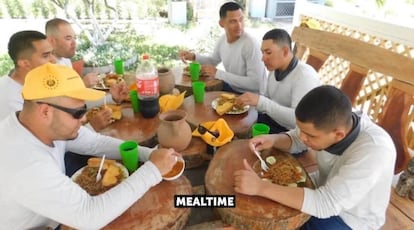
But the families held on, clinging to the faint hope that came from recognizing their sons, nephews, and brothers in another photo published by Bukele. This one showed Kilmar Abrego García having a snack with other inmates at the Santa Ana prison, a lower-security facility where prisoners are allowed out for a few hours to work — always under surveillance and without contact with civilians — painting schools or repairing streets. When Kilmar returned to the United States, he confirmed to William Martínez’s mother that he had been with him, first in CECOT and then in Santa Ana.
It was then that the families eventually realized that others were going through the same ordeal, and they created a group chat where they could share information and support one another. At that point, attorney Kelvi Zambrano, a Venezuelan lawyer based in the United States, entered the picture and took on their cases pro bono. With his help, they turned to international bodies and filed a request for precautionary measures before the Inter-American Commission on Human Rights.
By late November, they achieved what had previously seemed impossible: the Salvadoran government admitted that four of the missing men were in its prison system. Three were being held in Santa Ana. Only Brandon Sigarán remained inside CECOT. But that was all the information they received. Authorities did not disclose what the men were accused of or whether they had been sentenced. Nor were they allowed to contact their families or a lawyer. They were no longer “disappeared,” but their situation had barely changed.
Now, 12 months after the nightmare began, they have practically exhausted all available legal tools. Only one remains, says lawyer Zambrano. They will imminently file a petition with the IACHR “to determine the responsibility of the state of El Salvador in the human rights violations.”
Karla Sigarán is clinging to that last step because she has nothing left to hold on to. The past year has shattered the life she once had. Her husband is depressed and no longer leaves the house; her other son recently became a father, but even that has not eased the memory of the day his brother Brandon was arrested and he saw him for the last time; and she lost her office job a few months ago because, constantly distracted, she could no longer perform. The world has moved on, but they cannot — and do not want to — forget.
Sign up for our weekly newsletter to get more English-language news coverage from EL PAÍS USA Edition
Tu suscripción se está usando en otro dispositivo
¿Quieres añadir otro usuario a tu suscripción?
Si continúas leyendo en este dispositivo, no se podrá leer en el otro.
FlechaTu suscripción se está usando en otro dispositivo y solo puedes acceder a EL PAÍS desde un dispositivo a la vez.
Si quieres compartir tu cuenta, cambia tu suscripción a la modalidad Premium, así podrás añadir otro usuario. Cada uno accederá con su propia cuenta de email, lo que os permitirá personalizar vuestra experiencia en EL PAÍS.
¿Tienes una suscripción de empresa? Accede aquí para contratar más cuentas.
En el caso de no saber quién está usando tu cuenta, te recomendamos cambiar tu contraseña aquí.
Si decides continuar compartiendo tu cuenta, este mensaje se mostrará en tu dispositivo y en el de la otra persona que está usando tu cuenta de forma indefinida, afectando a tu experiencia de lectura. Puedes consultar aquí los términos y condiciones de la suscripción digital.