Iván Cepeda: ‘Our fight is not with Paloma or Abelardo, it is with Uribe’
Colombia’s left-wing presidential candidate defends the current government’s achievements but claims to be the only strategist in his campaign: ‘I am nobody’s copy or clone’
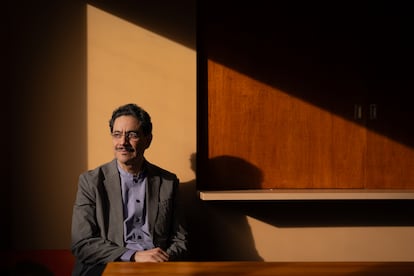
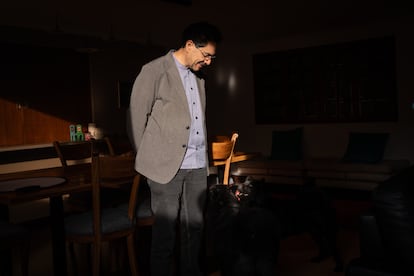
Iván Cepeda hopes to become president on May 31, without having to face a second round, but he is aware he shouldn’t celebrate before the event. He welcomes EL PAÍS into his bright apartment in an upper-class Bogotá neighborhood where his three chow chow dogs race around, one of them born on June 19, 2022, the same day that Gustavo Petro became president.
From his living room you can hear salsa coming from a conservatory next door. The 4 x 4 vehicles and bodyguards on the street flags up the presence of an important figure. But these elements are not there only for him. A few meters from his home, the far-right candidate Abelardo de La Espriella, who is polling second, has set up his campaign headquarters. “It’s wonderful,” Cepeda says drily. But he insists that he is not competing against De la Espriella. Nor against Paloma Valencia, whom he also considers to be far-right. “Our fight is with Uribe,” he says, referring to the former conservative president Alvaro Uribe Vélez, mentor to Valencia.
Cepeda claims to have run a no-frills campaign that has nothing to do with “spectacle politics.” He takes the criticism of his serious, non-viral style and turns it into a slogan: “I am who I am.” He does not intend to “adapt” and become “an easily digestible product” and promises not to give in to the politics of hatred.
Question. When was the last time you met President Petro?
Answer. I am very careful regarding my relationship with the president. I don’t want to betray his trust, or give details of our political activities, for various reasons. I am the candidate for the government’s party. Many people have tried to get me to run as the president’s endorsed candidate; I have never resorted to that. I see him frequently, we have conversations, but I am very respectful and treat these encounters confidentially.
Q. Does the president dictate or influence your campaign strategy?
A. My campaign has only one strategist and that is me. And I have a very simple strategy, which comes from my vision for the country and my experience. I do not receive instructions or ideas from the president on what needs to be done. I am nobody’s copy or clone. Not even Petro’s. One important component of my vision concerns our governance over these years. I have helped to shape that, but the vision I have now does not entirely coincide with it and is even critical of it.
Q. What would you do differently? How would you improve on Petro’s governance?
A. We are going to focus on the fight against widespread corruption. I believe deeply in an ethical revolution in Colombian society, because in Colombia it [corruption] has become systemic not just a sideline. Here we co-govern with corruption – not just this government, all governments. There are institutions in which all activities are deeply contaminated, at all levels of the state, in all branches of state power. So, if we want to solve some of the country’s essential problems, we have to tackle corruption. That has been lacking. It is a fight that we could have focused on more clearly.
Q. Your announcement that Aida Quilcué would be your running mate has drawn criticism because of her regional focus and inexperience. What does she bring to your campaign and what does her appointment mean?
A. There are decisions that come from my political convictions. In a country where 70 indigenous communities are being wiped out, we still have to spell out why an indigenous woman has been chosen as a running mate. That, in my opinion, is a symptom of how bad things are. Many people are dubious about how many additional votes it will get me, but that has not changed my decision. For me, the important thing is the significance, the transcendence and the symbolism.
Q. What is your strategy to win in the first round? Where will you look for the votes that your Historic Pact party lacks?
A. I don’t know how many it has and how many it lacks. What I can say, without being boastful, is that there is a segment of the country that has liked this government, its achievements, and wants more. Not only the militants in the Historic Pact, but very diverse sectors, whose support we are attracting. The significant vote we got in Congress indicates this. If I had been allowed to participate in the inter-party consultation [that chooses the presidential candidates; Cepeda had already participated in and won the internal consultation of the Historic Pact on October 26, 2025, and was therefore barred from participating again], we would surely have obtained a high number of votes. There is real support. Having said that, we do not blindly assume that we will win, closing ourselves off in our political universe. We are going to look for the necessary alliances. We are building them.
Q. Who is more difficult to defeat electorally, Paloma Valencia or the far-right Abelardo de la Espriella?
A. Paloma is also far-right. Let’s not pretend or dress it up as something else. Paloma is Uribe. She is trying to make out she is a centrist and deny what she stands for, but she always tends towards extremism. In both cases, we are facing the same vision. Our fight is clear; it is not with Paloma or Abelardo, it is with Uribe.
Q. Does it boost your campaign having the candidate of your political arch-enemy Uribe as a rival?
A. More than a boost, it is the political reality. In Colombia and in the world, there are two opposing ideologies, more polarized and extreme than in 2022. I represent a vision for the future, for the country and for the planet. Our vision is one that believes that the essential change in Colombian society, including on issues of security and violence, involves social change. Paloma’s vision is security filtered through the politics of hate, I am sorry to say. I do not want to ignore the fact that there are elements of the political center, but they have to make a decision on this profound contradiction.
Q. Many sectors, and not just on the right, consider it inconvenient to convene a Constituent Assembly, as Petro proposes. Why is it important to change the 1991 Constitution?
A. I am not a staunch supporter of the Constituent Assembly. It is a possibility, but as far as I am concerned what is required is a dialogue that concludes in a national agreement that can include constitutional reforms along the way. This is because there are unresolved problems that, structurally and historically, have accumulated and become more complex. They require a reformist, and in some cases revolutionary, policy in the best sense of that word. They require structural changes, and very profound transformations. We can discuss the mechanisms, but it is wrong to think that the mechanism takes precedence over the essence of the problem, which is to find agreement and consensus.
Q. This government has made very controversial decisions in terms of security, such as the aerial glyphosate fumigation of coca fields. If you came to power, would you do the same?
A. Our government is condemned and criticized whatever it does, because it is progressing with peace negotiations and because it is carrying out military actions. These have included methods that I not only dislike, but that trigger deep critical feelings within me, such as the bombings and the use of glyphosate. I wouldn’t want to do it, but I cannot guarantee how things will turn out. As a human rights defender, decisions of this magnitude bring with them problems of conscience. But when you assume the position of head of state, you must make decisions that can be profoundly contrary to what you want.
Q. You have been a successful negotiator for peace with the FARC but an unsuccessful negotiator with the ELN. What makes the difference between success and failure in negotiations?
A. I am more of the school of thought that when it comes to peace you never fail. The negotiations with the ELN gave us valuable experience which should not be wasted. Mistakes have been made, most likely. The ELN has to make decisions, and the country must demand that, obviously. But I believe that what was done during this government was valuable, and it will have to be picked up where we left off.
Q. Would you negotiate with the ELN again as president?
A. It is very likely, if certain conditions are met.
Q. This week you had your first clash in the Senate with Valencia over the deterioration of the health system. The opposition blames the government for the crisis. Has the intervention of the EPS [health promoting entities which are often private] aggravated the problem?
A. This intervention is due to a system that has been in crisis for some time, a crisis that has come to a head. The system was rife with corruption and created in such a way that the end result was inevitable. One example of mega-corruption in Colombia is the way in which health money has been stolen and continues to be stolen. This system that involves private companies acting as intermediaries has proven to be a resounding failure. Of course, reform is required, but it needs to be hammered out. What is on the table? A nationalized system? No, a mixed one, but there needs to be a willingness to establish that model through dialogue. We have to seek a process in which everyone contributes.
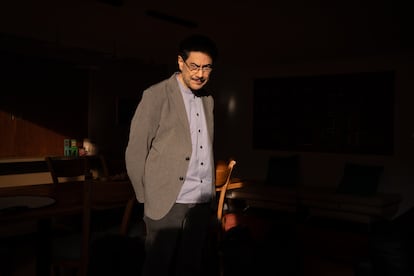
“I do not agree with the interventionist policies of the US”
Q. What do you think has changed in the relationship with the United States since Petro’s visit to Washington? How will you manage the agenda if you become president?
A. I believe that President Petro has established the path we must follow, in this matter and in others regarding international affairs. Generally speaking, he has become an international leader listened to on crucial issues such as climate change and the dangers of nuclear war. I will be guided by his behavior and attitude. A rupture of relations with the United States was all but expected, but the reality is that we have had a respectful, cooperative and fruitful dialogue. Now, we are facing an administration that has aspirations that are, in some cases, interventionist, and that seek to generate a type of hegemony in our hemisphere. In the face of an administration of this kind, we have emphasized the need to respect our sovereignty.
Q. Are you concerned about this interventionism in the elections? Do you believe you are considered a candidate the White House wants to see beaten?
A. Most likely. I demand respect for my aspirations, for the aspiration of the Historic Pact and for the millions of people who have placed their trust in us. It’s not that I think actions can be taken against me: they already have been. Figures on the extreme right, former President Uribe himself and close collaborators, have traveled to Washington and Florida to ask for an investigation. There is even a letter requesting it. I hope that does not come to anything.
Q. You have been criticized for your position on Venezuela which your critics equate with an acceptance of Chavismo.
A. My position has been critical regarding the violation of human rights and democratic principles while respecting the autonomy of the Venezuelan people to solve their own problems. We cannot break relations with Venezuela. I do not agree with policies of intervention: the United States committed an action that violates international law, regardless of what you think of Nicolás Maduro or the legitimacy of the Venezuelan government. My position is to facilitate a bloodless transition, to move towards democracy without bloodshed or rupture between our countries.
Q. Do you think Delcy Rodríguez is the right person to lead this process?
A. I couldn’t say.
Sign up for our weekly newsletter to get more English-language news coverage from EL PAÍS USA Edition
Tu suscripción se está usando en otro dispositivo
¿Quieres añadir otro usuario a tu suscripción?
Si continúas leyendo en este dispositivo, no se podrá leer en el otro.
FlechaTu suscripción se está usando en otro dispositivo y solo puedes acceder a EL PAÍS desde un dispositivo a la vez.
Si quieres compartir tu cuenta, cambia tu suscripción a la modalidad Premium, así podrás añadir otro usuario. Cada uno accederá con su propia cuenta de email, lo que os permitirá personalizar vuestra experiencia en EL PAÍS.
¿Tienes una suscripción de empresa? Accede aquí para contratar más cuentas.
En el caso de no saber quién está usando tu cuenta, te recomendamos cambiar tu contraseña aquí.
Si decides continuar compartiendo tu cuenta, este mensaje se mostrará en tu dispositivo y en el de la otra persona que está usando tu cuenta de forma indefinida, afectando a tu experiencia de lectura. Puedes consultar aquí los términos y condiciones de la suscripción digital.