Paloma Valencia: ‘I’m not going to distance myself from Uribe; I’m going to die a Uribe supporter’
The right-wing Colombian presidential candidate is looking for a running mate who thinks differently from her, without having to sacrifice the political principles of her mentor

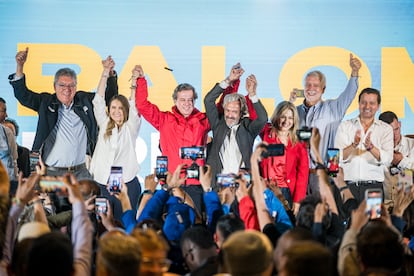
In the space of three days, Senator Paloma Valencia has become the candidate to beat in Colombia’s presidential elections in May. The Uribista leader won the center-right primary on Sunday, garnering more than 3.2 million votes, support that has focused media attention on her and the vice-presidential candidate she must announce by Friday. Although many of her allies expected her to choose Juan Daniel Oviedo, the runner-up in the primary with 1.2 million votes, he presented her with a difficult line to negotiate on Monday: that she back down on her criticism of the 2016 peace agreement with the FARC guerrillas and stop her attacks on the special tribunal it created (the JEP). Essentially, Oviedo demanded she abandon a central tenet of Uribismo —the movement created by former president Álvaro Uribe — that has stood for more than a decade.
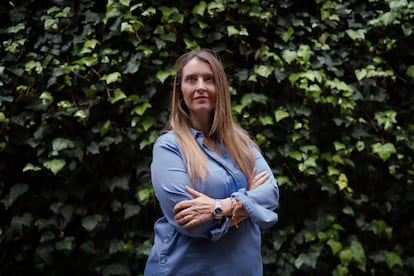
Valencia remains steadfast: although she wants to appeal to the centrist vote that Oviedo attracted, her rhetoric demonstrates that she has no intention of yielding and risking right-wing support. The candidate does not rule out, however, choosing someone with differing views as her running mate. “If, in a dialogue between different people, you seeks to come out the same, it destroys the meaning of difference,” she said in an interview with EL PAÍS on Wednesday morning. After the conversation, the candidate was due to meet with Oviedo for the third time since Sunday, and decide on Thursday whether to accept him as her running mate.
Question. You have repeatedly stated that you will not change who you are to decide on your vice-presidential running mate. What did Juan Daniel Oviedo ask of you that goes against your principles?
Answer. He has asked me, for example, to stop criticizing the JEP (the Special Jurisdiction for Peace). But I collected signatures to overturn the statutory law that created it; I presented a bill creating special trial chambers for the Armed Forces; I introduced the presumption of innocence for military personnel into the laws of the Havana Agreement. Not long ago, I filed a bill for the Constitutional Court to review the JEP’s rulings, as is done with any ruling in the Colombian legal system.
Q. Wasn’t this a topic of debate among the nine candidates in the Grand Consultation?
A. We have to ask Juan Daniel why this seems so important to him now; that’s what I’m wondering too. The country doesn’t need to look back. As Colombians, we have many wounds, many difficulties, and the only way we’ll be able to move forward is if we’re capable of thinking ahead. Our proposal is to enable us to look to the future together, despite our differences.
Q. Are you still discussing the JEP issue with Oviedo?
A. I’m no longer discussing policy issues with him; the question I asked him was that, after reading his interviews, I got the impression that he doesn’t want to be vice president. That’s fine, one can [provide] support without being on the ticket.
Q. Who are you making this decision with? Álvaro Uribe?
A. We’re talking to everyone. I like to talk, and listen; I ask everyone who calls me. Obviously, I discuss it with all the poll experts. I think it’s important to look at digital feedback to see how people feel about this or that ticket. Sometimes you intuitively believe one thing, and it turns out you’re not right. I’ve received hundreds of opinions.
Q. Is your strategy going forward to target the political center?
A. Walking among different people means remaining true to who you are, with your virtues, your flaws, with ideas that some people like and others don’t. And you have to seek out complementary, different people, people who bring diversity so that the national conversation remains vibrant. You have to be open to listening, but stand firm on your principles. If, in a dialogue between different people, you seek to come out the same, it destroys the meaning of difference.
Q. It is understood that at the moment you have two options with the selection of a running mate: target the centrist voter, or target the right-wing voter to prevent them from going over to Abelardo de la Espriella’s campaign.
A. My strategy is to have a different person. The consultation process represents that commitment to thinking about the future with people who are not the same as me.
Q. Do you plan to distance yourself from former president Uribe in the campaign to appeal to the centrist vote?
A. I’m not going to distance myself from Uribe; I’m going to die a Uribe supporter, and all of Colombia knows that. Anyone who says, “I’ll vote for Paloma when she stops being a Uribista” will never vote for me. I’m not a politician who follows the latest trends; I’m a politician with clear convictions. What do I offer? Transparency, my convictions, and the ability to engage in dialogue and reach understanding with sectors that aren’t like mine. I’ve been able to negotiate bills in the Santos, Duque, and Petro administrations. I’m clear about my convictions. Because of this, I can sit down and talk with anyone who has different convictions. One thing I’ve discovered over time is that when you look at the big picture, it’s very difficult to reach an agreement. But when you get down to the details, to the specifics, it’s very easy to find common ground.
Q. If you are going to die a Uribista, how would your presidency differ from Uribe’s?
A. I want to be a president that, years down the line, people still want to take pictures with and thank. That’s the stature of President Uribe, and that’s the stature I want to emulate. I want to be a president who gives Colombians back the right to live without fear, to travel down a road without worrying about being kidnapped. I want a country where freedom of enterprise is respected. I want a small, streamlined state, but with significant regional power, capable of solving Colombians’ problems. And I want a robust social policy that helps lift the poor out of poverty. Will my government be the same as Uribe’s? Well, no, because I’m not Uribe, and Colombia isn’t what it was in 2002.
Q. What mistakes did Uribe make during his years in government?
A. Many mistakes were made, but I don’t think the country’s conversation today should be about the past. But serious things happened: the crimes committed by members of the security forces, the extrajudicial killings. I also think there was a lack of interest in environmental issues, although it’s very easy to look back at that with today’s mindset. Uribe’s was a revolutionary government in terms of education, poverty reduction, and homicide reduction. Of course, there are things I would have liked to see developed further, but overall it was a revolutionary administration.
Q. The JEP has made progress in the investigations into extrajudicial killings...
A. The JEP has not conducted any investigations. It has simply taken over the investigations of the ordinary justice system, where they could have remained: at least those responsible would be in prison and not free as they are today.
Q. You are from Cauca, a department heavily affected by the conflict, as is the vice-presidential running mate of your opponent Iván Cepeda. What is your opinion of Aida Quilcué?
A. I love and admire her very much; I think she’s a very valuable woman. But however good the senator is, it doesn’t cover up the sins of [President Gustavo Petro’s] total peace process. I wouldn’t support a government that allows forced recruitment or that has allowed the municipalities of Cauca to register record highs in homicides.
Q. Have you spoken with Abelardo de la Espriella since Sunday?
A. No.
Q. Are you worried that the right wing will be divided going into the first round?
A. No, my main concern is finishing the consolidation of the political project we’re building. We were just chosen as candidates for a coalition, and we’ve only had a few days to focus on organizing ourselves to make it successful and elect the first female president of Colombia. We are convinced that the time for women has arrived, that this is the time for women to govern Colombia.
Q. And what do you think of the vice-presidential ticket chosen by De la Espriella, former minister José Manuel Restrepo? Could it steal votes from Uribismo?
A. He was Minister of Trade and Finance under President Duque and is an intelligent and capable man. I don’t think he identifies as a Uribe supporter; you’d have to ask him. I believe he appreciates President Uribe, but he doesn’t see himself in the Democratic Center party. I have always kept the lines of communication open with him, and always will.
Q. How do you assess the results of Sunday’s parliamentary elections?
A. They are impressive. We don’t have political machines, we’re not in government, we only have the strength of our convictions and political experience. We became the second-largest political force in this country, and it must be said: the Grand Consultation for Colombia overwhelmingly defeated the Senate vote of the Historical Pact.
Q. In a hypothetical government of yours, could you achieve majorities in Congress?
A. I haven’t entered into that discussion, but after three terms there, I know that we need to make members of Congress the protagonists of the transformation we want for Colombia. The political project we want to build has to inspire and motivate the people, and if there is popular support, the politicians will be on their side.
Q. How is your relationship with Senator María Fernanda Cabal?
A. We exchanged a couple of messages, but not much more.
Q. Is there still a possibility that she will join De la Espriella’s campaign?
A. You’d have to ask her.
Q. One gender-related issue that has been in the public debate is former president Andrés Pastrana and his relationship with Jeffrey Epstein and Ghislaine Maxwell. What is your opinion of the request from many female journalists to break a pact of silence on this matter?
A. President Pastrana is a completely honorable man. You can’t become a criminal just because you took a picture with someone who was incredibly popular worldwide and claim that crimes are transferred through friendship. There is no evidence of any wrongdoing against the president. Now, the Epstein case is a monstrosity similar to that of the FARC, but it would take about 200 Epsteins to equal the FARC’s level. The real pact of silence in this country concerns the tragedy of the children who were abused and turned into sex slaves by the FARC, and in this country, they put the abusers in Congress. That is a true pact of silence, and my fight against the JEP continues.
Q. In the lead-up to negotiations, how easily do you change your mind?
A. I don’t change my mind unless I’m proven wrong. I’m not closed off to the possibility that evidence might prove me wrong. If I make a decision and start seeing negative consequences, I have no problem correcting it. If I were [President Gustavo] Petro, I wouldn’t hesitate to admit I was wrong about the healthcare system and I would back down. I’m not stubborn in the face of evidence, and even the Amazon River recedes in winter.
Sign up for our weekly newsletter to get more English-language news coverage from EL PAÍS USA Edition
Tu suscripción se está usando en otro dispositivo
¿Quieres añadir otro usuario a tu suscripción?
Si continúas leyendo en este dispositivo, no se podrá leer en el otro.
FlechaTu suscripción se está usando en otro dispositivo y solo puedes acceder a EL PAÍS desde un dispositivo a la vez.
Si quieres compartir tu cuenta, cambia tu suscripción a la modalidad Premium, así podrás añadir otro usuario. Cada uno accederá con su propia cuenta de email, lo que os permitirá personalizar vuestra experiencia en EL PAÍS.
¿Tienes una suscripción de empresa? Accede aquí para contratar más cuentas.
En el caso de no saber quién está usando tu cuenta, te recomendamos cambiar tu contraseña aquí.
Si decides continuar compartiendo tu cuenta, este mensaje se mostrará en tu dispositivo y en el de la otra persona que está usando tu cuenta de forma indefinida, afectando a tu experiencia de lectura. Puedes consultar aquí los términos y condiciones de la suscripción digital.