Sarajevo ‘human safaris’ case in Italy continues with three people under investigation
The journalist who uncovered alleged organized trips to shoot civilians during the Bosnian war has published a book with new testimonies and details
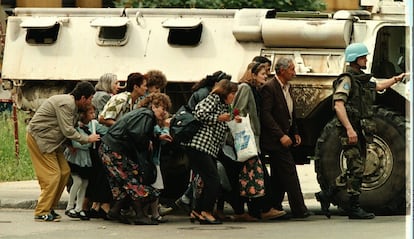

Four months have passed since an investigation into a chilling allegation from the Bosnian War in the 1990s came to light in Italy: weekend snipers from various European countries allegedly paid to go to the hills surrounding Sarajevo, besieged by Bosnian Serb troops, to shoot civilians there. A writer, Ezio Gavazzeni, had compiled information about this and handed it over to the Milan Public Prosecutor’s Office, which opened an investigation. It is a matter so appalling it borders on the unbelievable; it is also difficult to investigate, because 30 years have passed and it is based on a handful of testimonies. The fate of the case is uncertain, but some progress has been made: the Public Prosecutor’s Office has already registered three people as suspects, according to the Italian press.
The first suspect is an 80-year-old truck driver from San Vito al Tagliamento, a town in the Friuli region near the Slovenian border, whose house was searched by the Carabinieri. He was questioned by the prosecutor last month, but upon leaving, he told the media that he had nothing to do with it and that he only went to Bosnia in the 1990s for work, “not to hunt.” The other two suspects, according to media reports, are a man from central Italy who is an avid hunter and a businessman from Lombardy, the region of Milan.
The prosecution had alighted on them because in one way or another at some point they had spoken of having participated in these trips, even boasting about it at social gatherings, and they had been pointed out by people who heard them.
For his part, Gavazzeni published a 280-page book this week, I cecchini del weekend (The Weekend Snipers), in which he reveals new details of his investigation. Much of what he recounts had already been leaked, and some of the testimonies included were gathered after he filed his complaint and after the story broke in the media. These are people who had heard something or had some information at the time.
There is much hearsay evidence, though it coincides on several details, and it seems this was a topic that had been circulating for years in certain circles and among those who, for some reason, had a connection to the Bosnian War. One person — who claims to have informed the Carabinieri at the time — mentions organized excursions from Trieste in vehicles disguised as ambulances, ostensibly transporting medicine to the Balkan country. Once there, the weapons were handed over.
Testimony from a Spaniard
The book also includes the testimony of a Spanish citizen identified as Toni C., who wrote to the journalist: “My father had a millionaire friend who once went elephant hunting in Africa. The person who organized the safari, a Spaniard from Catalonia whose identity we don’t know, also organized trips to Yugoslavia to hunt human beings and offered him the opportunity to participate. […] It was something for the rich.” This is the only mention in the book of the possible participation of Spaniards in these expeditions. There are other similar accounts in Italy from people who confided at dinner parties that they had taken part in them.
According to the data he has collected, Gavazzeni maintains that the profile of those who went on these trips was that of people with money, often of far-right ideology, who found out about them through acquaintances in the world of hunting, weapons, and shooting ranges.
There are two other key testimonies in the book: one from someone identified as a former agent of the Italian secret service, who provides information and leads, and especially from a mercenary nicknamed “The Frenchman,” because he allegedly served as a paratrooper in the French army. He is one of the suspected participants in the “human safaris,” acting as a guide. He recounts that the groups usually consisted of three people, with two companions who also acted as bodyguards in a very dangerous and unstable war zone. In fact, he claims that some of these war tourists died during the trips.
This former mercenary claims that everything was organized by a Belgian agency, with a branch in London, which relied on a group in Milan. He even specifies the departure point for the excursion: Via Mecenate in Milan, in front of a warehouse belonging to an appliance company. From there, the groups went to Trieste airport and flew to Belgrade. Then, they traveled overland to the front lines. He indicates that these activities took place not only in Sarajevo, but also on occasion in Mostar, Tuzla, and Srebrenica.
This source is the only one who cites a figure: according to estimates he says he heard from someone else, 230 Italians went to Sarajevo between 1991 and 1995, along with French, Belgians, Swiss, and Austrians. He claims he went on nine occasions: six times from Italy, twice from Belgium, and once from France. “The practice for us was not to go more than 10 times; they kept changing us,” he recounts.
This alleged witness provides the most gruesome details of the story. He explains that they had their own jargon: they spoke of “archers” and “deer” to refer to the shooter and their victims. According to his account, the accompanying men’s job was also to count the people killed by each shooter in order to collect the corresponding fee, which was then paid to the agency, always in cash.
He also elaborates on a terrifying detail, if true, that has already come to light: the different prices depending on the target. He maintains that killing a child, the most expensive, cost 30 million lira (around $32,350) at the beginning of the war and between 90 and 100 million lira (between $90,140 and $99,385) by the end. The price then shifted to women, men, and the elderly. Furthermore, he claims that many snipers took the spent cartridges as souvenirs, marking them with different colors depending on the victim. “Blue or pink for boys or girls, red for men...” He lists.
The Frenchman describes seeing lawyers, doctors, a magistrate, and even “a very famous Italian businessman who still occasionally appears on television” during these trips, according to a witness. In the book, Gavazzeni gives him a name and asks if it is the person in question, to which he replies: “It could be.”
It is unknown whether The Frenchman will agree to testify before the prosecutor. So far, the most promising lead remains that of former Bosnian intelligence agent Edin Subasic, who has stated that he learned of this story after interrogating a prisoner and then reported it to the Italian secret service, SISMI, in March 1994. He reiterated this in statements to EL PAÍS. Subsequently, Italian security forces allegedly discovered the arrival route of these war tourists and intercepted them in Trieste. His testimony was later corroborated by Michael Giffoni, who was the second-in-command at the Italian diplomatic mission in Sarajevo during the war and later the country’s first ambassador to Kosovo. In a November interview, he stated that the “human safaris” did exist and confirmed the Bosnian ex-agent’s account. “Subasic isn’t making anything up,” he declared. The researchers hope that some official documentation will surface in Italy regarding these activities.
Sign up for our weekly newsletter to get more English-language news coverage from EL PAÍS USA Edition
Tu suscripción se está usando en otro dispositivo
¿Quieres añadir otro usuario a tu suscripción?
Si continúas leyendo en este dispositivo, no se podrá leer en el otro.
FlechaTu suscripción se está usando en otro dispositivo y solo puedes acceder a EL PAÍS desde un dispositivo a la vez.
Si quieres compartir tu cuenta, cambia tu suscripción a la modalidad Premium, así podrás añadir otro usuario. Cada uno accederá con su propia cuenta de email, lo que os permitirá personalizar vuestra experiencia en EL PAÍS.
¿Tienes una suscripción de empresa? Accede aquí para contratar más cuentas.
En el caso de no saber quién está usando tu cuenta, te recomendamos cambiar tu contraseña aquí.
Si decides continuar compartiendo tu cuenta, este mensaje se mostrará en tu dispositivo y en el de la otra persona que está usando tu cuenta de forma indefinida, afectando a tu experiencia de lectura. Puedes consultar aquí los términos y condiciones de la suscripción digital.