David Bowie and Iman’s daughter shares her painful story: An adolescence marked by drugs and psychiatric treatment
Lexi, the couple’s only child together, shared a video on Instagram in which she recounts how her life was shaped by her parents’ fame. ‘People projected onto me constantly expectations I didn’t understand, comparisons I could never live up to,’ she says


The name Alexandria Zahra Jones is not commonly seen in the media. Nor is Lexi, as she is affectionately called by those closest to her. She is the only daughter of one of the most popular couples of the 1990s: David Bowie and supermodel Iman. Her entire life has been marked by discretion; she has never been in the public eye and grew up far from the spotlight. She is now 25 years old and has decided to step forward to speak openly about what her adolescence was really like — a period marked by drugs, excess, and psychiatric treatments far away from her family.
Last Thursday, the artist shared her story in a video posted on her Instagram — where she has 231,000 followers — which has gone viral in the days since. “Some people know me as someone who writes a lot and some people know me as someone who makes music sometimes. Some know me personally. Some know me as all of the above. But there’s a part of me that most people don’t know. A set of experiences that shaped almost everything about who I am,” begins the video, which has received more than 16,300 likes.
“I spent a long time wondering if I was the problem or if the real problem is the way that the world responds to pain. And that’s so problematic. Pain is what landed me in treatment as an adolescent more than once. In those places, I met people who changed me,” she continues in the 20‑minute video with the playback sped up.
Lexi laments that her entire life has been defined by who her parents are, even though she grew up in a “normal” environment. “People assume that means having a perfect childhood and a protecte one and a magical one and parts of it were. I was loved, I was cared for, and I had opportunities most people never get, and I’m genuinely grateful for that and I always will be. But what people don’t understand is that life being extraordinary doesn’t make it emotionally simple,” she adds.
Over the years, Lexi explains, she realized that adults treated her differently: “So very early age, I started to feel like I existed as an idea, not Lexi the person, Lexi the daughter.’ People projected onto me constantly expectations I didn’t understand, comparisons I could never live up to. I didn’t just feel like I had to figure out who I was. I felt like I already was defined before I even got the chance to find out.”
Lexi acknowledges that some people approached her out of self-interest, which affected how she related to others: “I struggled to understand what a real relationship was supposed to feel like,” she says. “That does someting to your state of safety, and you start questioning every single interaction, every kindness, and every friendship.”
This happened when she was not yet 12 years old. “I thought my pain meant something was wrong with me specifically, that I was broken in a way that I shouldn’t be allowed to be broken in,” says Lexi.
The artist explains that she just wanted to be treated like a normal girl, like the rest of her classmates: “I didn’t want fame, I didn’t want attention, I didn’t want to be a public figure, and I still don’t. The spotlight never felt like warmth to me. [...] I was emotionally exhausted very young, and I didn’t understand why.”
From then on, her mental health “started collapsing”: “It was the result of years of confusion about my identity, expectations, and the feeling of being watched but not understood. That was my state before everything happened and before everyone knew something was wrong.”
By age 10, she was already in therapy. At 11, she began self-harming: “I didn’t know why I felt the way I felt. I just knew I was miserable. I felt stupid, incompetent, unworthy, useless, and unlovable. And having successful parents only made it worse,” she says. “I couldn’t understand how I came from people that were thriving in every single direction while I was failing at everything.”
She was also 11 when she suffered her first panic attack. Lexi began to feel depressed, and fail her subjects at school: “I developed bulimia at age 12.”
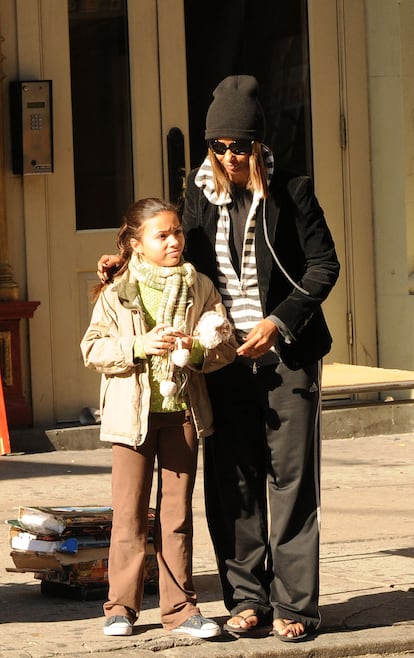
But things kept getting worse for her and those around her: “When my dad was diagnosed with cancer, I was at my breaking point. I was barely 14,” she says. “That’s when I turned to drugs and alcohol [...] Everyone around me was experimenting, but for me, it wasn’t about fun.”
She continues: “I wasn’t experimenting; I was escaping, escaping from my complicated mind [...] When the party ended for everyone else, I kept going and I drank and got high alone. [...] I felt free, free from being agreeable, free from being the well behaved version of myself. I broke out in defiance. I did everything I wasn’t supposed to do.”
The substances only made the tension escalate further: “My substance use got worse, and I became someone who lashed out. I was cruel to people who didn’t treat me the way I wanted to be treated. Part of me felt like I was trying to make up for all the times I felt like a doormat.”
Everything changed for Lexi one ordinary morning: “I had already gotten ready for school. My mom called me out to the living room. My dad, my godmother and my mom were all standing there. It felt like an intervention, and in some ways, it was. My dad read a letter he had written. I don’t really remember what it said, but I do remember the last line and it said: ‘I’m sorry, we have to do this.’”
After that, some men entered the house with the intention of taking her away “the easy way or the hard way.” “I felt stripped of any right to stay in my own life. They got me back into a black SUV and shoved me inside.”
In that moment, a new life began for Lexi — one far from her family.
She entered a wilderness therapy program, where she stayed for three months: “We could only communicate with people from the outside world through letters and only once a week.” She describes the experience as “dehumanizing”: they showered once a week, there were no mirrors, and no television. “I didn’t choose to be there,” she says. “Maybe some of us needed help [...] But places like that aren’t the answer, especially for kids and especially for kids like us. [...] I wasn’t physically abused [...] But still the mental and emotional manipulation I experienced is something I will not forget and I won’t pretend it didn’t happen.”
When that 90-day program ended, she was taken to another facility where she stayed for 13 months. “I kissed a girl in my house and the staff found out and they did not take that lightly,” says Lexi.
The artist explains she was dropped down to level one of the five-phase program, which was called “safety.” This meant she had to stay within five feet of staff at all times, she was watched while she slept, and she had to count out loud while using the bathroom. She was also placed on “communication block,” which meant she wasn’t allowed to speak to anyone for “a couple of weeks.” “The therapy was intense and it hurt. It was explosing and I was not ready,” she says.
Hundreds of miles away, Bowie was getting increasingly ill. “A few months into the program, my dad passed away. I was not there. I had the luxury of speaking to him two days before, on his birthday; I told him I loved him, and he said it back,” she recalls in the video.
What hurt her most was not being able to say goodbye to him and the media headlines claiming the whole family was there to bid him farewell: “The whole family was there, except for me,” she says. “Sometimes I have those moments where I wish things were to be different.”
At 16, Levi returned home, but was given a set of rules she had to follow: “I didn’t know who I was or what I needed. [...] I tested everything. I try to live fast to cram the years I’ve lost into the time I had left.”
It’s wasn’t long before Levi was taken to a new therapy program. “It felt like I was always being reshaped to fit somewhere I didn’t ask to be. [...] I went through things that no kid should have to go through. [...] This is not just a story about trauma; it’s a story about how I was shaped,” she says. “I also feel proud of how far I’ve come.”
Lexi has a released album, Xandri, and she also spends time painting and illustrating.
Sign up for our weekly newsletter to get more English-language news coverage from EL PAÍS USA Edition
Tu suscripción se está usando en otro dispositivo
¿Quieres añadir otro usuario a tu suscripción?
Si continúas leyendo en este dispositivo, no se podrá leer en el otro.
FlechaTu suscripción se está usando en otro dispositivo y solo puedes acceder a EL PAÍS desde un dispositivo a la vez.
Si quieres compartir tu cuenta, cambia tu suscripción a la modalidad Premium, así podrás añadir otro usuario. Cada uno accederá con su propia cuenta de email, lo que os permitirá personalizar vuestra experiencia en EL PAÍS.
¿Tienes una suscripción de empresa? Accede aquí para contratar más cuentas.
En el caso de no saber quién está usando tu cuenta, te recomendamos cambiar tu contraseña aquí.
Si decides continuar compartiendo tu cuenta, este mensaje se mostrará en tu dispositivo y en el de la otra persona que está usando tu cuenta de forma indefinida, afectando a tu experiencia de lectura. Puedes consultar aquí los términos y condiciones de la suscripción digital.