From Roberto to Leo: 35 years of friendship shape a Peruvian’s view of the Pope
Armando Lovera, a Peruvian biblical scholar based in Valladolid, talks to EL PAÍS about the pontiff who married him, baptized his daughters, and has never failed to reply to his messages despite his busy schedule
Every day, Leo XIV receives a ton of mail – letters, packages and postcards from all over the world. Since donning the white skullcap and the Piscatory Ring, the Pope must live up to the expectations of him as a man of peace in a world on the brink of war, and also respond in the most literal sense of the word.
Armando Jesús Lovera Vásquez feared that his “soul mate” would no longer reply to his messages once he became Pope, and that they would lose the daily routine they had cherished since the early 1990s when Robert Prevost was a forty-something priest who went unnoticed on the streets of Trujillo, a stately city north of Lima, Peru. At that time Lovera Vásquez was a member of the Augustinian Order’s training project.
But Roberto — as Robert Prevost was familiarly known by the religious community in Peru before he became Leo XIV—, was careful to maintain the personal touch. He replied to Lovera’s WhatsApp message on the same day he appeared on the balcony of St. Peter’s Basilica. He replied again when Lovera asked for his permission to write his biography. And to this day he continues to reply with the same familiarity of people who knew one another long before they became who they are today.
Lovera writes to the Pope several times a week from his home in Valladolid. Before the cardinals elected Prevost, he called him almost every day after work. And decades ago, when Prevost returned to the United States, they communicated by email.
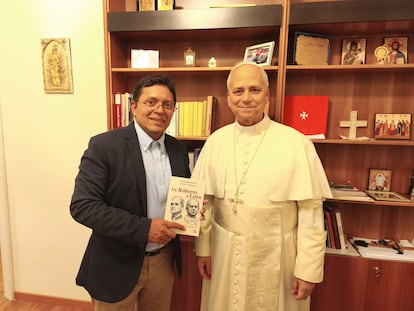
Lovera is getting used to calling Prevost the Holy Father, even though the last time he visited him at the Vatican, it was Leo XIV himself who asked his friend to call him Roberto. It was mid-October, and Lovera had gone to the Vatican to hand him a copy of his book, De Roberto a León (From Roberto to Leo), perhaps the most insightful of all the books written about the Pope. “You’re going to be famous,” the Pope told him with a smile. In May, he had given him his blessing with a concise message: “You are my friend. I trust you.”
Drawing from the 10 years they spent together in the Augustinian training school in the Santa María neighborhood of Trujillo, the book highlights the networks of solidarity they organized to “support the population most affected by the ‘Fujishock’ – the brutal economic adjustment enacted overnight by then-president Alberto Fujimori that caused prices to soar, destroyed wages, and left millions without the resources to survive.” Prevost and his colleagues invited the Augustinian students to try to perceive the presence of God in a reality in which democracy and respect for human rights were in danger.
On top of setting up soup kitchens in the poorest areas, teaching at the San Carlos and San Marcelo Seminary, and serving as judicial vicar of Trujillo, Prevost had an activist side to him that has often been overlooked. He organized the collection of signatures for the creation of the Truth and Reconciliation Commission, opposed the 1995 Amnesty Law that shielded military personnel who had committed crimes, and supported the creation of artistic expression by the Augustinians to raise awareness among the people.
One of these artistic expressions took the form of a musical group called Gloria Evaporada, in reference to the Gloria brand of milk cartons used to return the remains of a teacher and nine students murdered by the Colina paramilitary group in 1992. Armando Lovera named the band and was also the guitarist. “We sang protest songs very close to Liberation Theology. We performed in squares and schools. There were those who said we were defending terrorists. But there were also loyal military personnel who tolerated us,” he says. Prevost marched with every Augustinian who joined the cause. If he had been a public figure, he would undoubtedly have been accused of terrorism.
Lovera recalls two other incidents: the murder of popular leader María Elena Moyano, who was killed in a dynamite attack, and the capture of Shining Path leader Abimael Guzmán in 1992. “His [Prevost’s] birthday is September 14, and the capture was two days earlier. When the news came out, we couldn’t believe it. The faithful celebrated his birthday for a week. So the news came through while where they were singing to him in one neighborhood. We felt hopeful that things could change, but the terror continued,” he says.
One of the things that cemented the friendship was when Prevost, who was always busy, entrusted his father to Lovera. Louis Lanti Marius Prevost, known simply as Luigi, used to visit his son in Trujillo. He was an American war veteran who had fought in World War II. Lovera would take him around town on his motorbike and even take him to soccer games. More than once they talked about his participation in D-Day and the historic Normandy landings.
One of the photos that Lovera cherishes is of Prevost and himself behind the wheel in the mid-1990s, in Iquitos, the Amazonian capital of Loreto where he was born. One of the things that Leo XIV misses most about his previous life is driving. It is no coincidence that Prevost has traveled across Peru without a bodyguard or driver. “He finds it difficult not to be behind the wheel, but he has an electric car. He drives around, he has two horses, and continues to play tennis,” says Lovera.
On December 6, 2013, Prevost took a flight from Chicago to Trujillo to fulfill a promise: to marry Lovera and his fiancée in the parish of Monserrate. The place held significance for Lovera: Prevost had been parish priest there once, and it was where he and Lovera had met. Some time later, Prevost baptized the couple’s two daughters, and over a year ago he blessed their home in Valladolid. Peru hopes that the announcement made by the Episcopal Conference will materialize: that Leo XIV will return to the country at the end of the year. “He taught us to love one another as Peruvians. He could have been comfortable living in the United States, but he chose us. His love for the country is unquestionable,” says Lovera.
Sign up for our weekly newsletter to get more English-language news coverage from EL PAÍS USA Edition
Tu suscripción se está usando en otro dispositivo
¿Quieres añadir otro usuario a tu suscripción?
Si continúas leyendo en este dispositivo, no se podrá leer en el otro.
FlechaTu suscripción se está usando en otro dispositivo y solo puedes acceder a EL PAÍS desde un dispositivo a la vez.
Si quieres compartir tu cuenta, cambia tu suscripción a la modalidad Premium, así podrás añadir otro usuario. Cada uno accederá con su propia cuenta de email, lo que os permitirá personalizar vuestra experiencia en EL PAÍS.
¿Tienes una suscripción de empresa? Accede aquí para contratar más cuentas.
En el caso de no saber quién está usando tu cuenta, te recomendamos cambiar tu contraseña aquí.
Si decides continuar compartiendo tu cuenta, este mensaje se mostrará en tu dispositivo y en el de la otra persona que está usando tu cuenta de forma indefinida, afectando a tu experiencia de lectura. Puedes consultar aquí los términos y condiciones de la suscripción digital.