Nearly 2,000 African soldiers recruited by Russia are fighting in Ukraine
Hundreds of young people are being deceived with fake job offers or high salaries through emigration networks coordinated by Moscow
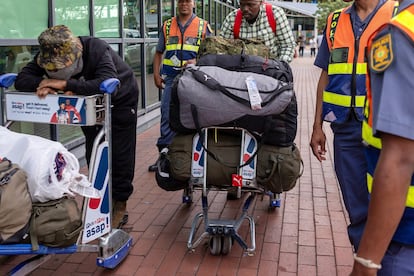

At least 1,780 young Africans from 36 countries are currently fighting in the Russian army in the war in Ukraine, Ukrainian Foreign Minister Andrii Sybiha reported on February 25. Many of them traveled to Russia to continue their studies or with the promise of a well-paid job, unaware that they would be forced into the war as “cannon fodder,” according to a report by the investigative organization Inpact, which revealed the existence of online recruitment networks coordinated by the Russian Federal Security Service (FSB). “This is not an isolated phenomenon, but a deliberate and organized strategy,” the report states. Ukrainian authorities confirmed last November that some 18,000 citizens from 128 countries are fighting in the Russian ranks.
Malick Diop, a 25-year-old Senegalese man, received a scholarship in 2023 to study at Lobachevsky University in Nizhny Novgorod. However, once in Russia, he was drafted into the army to work as a cook and sent to Luhansk, a Ukrainian city in the east of the country under Russian control since 2014. In April 2025, he was given a weapon and sent into combat, where he was captured by Kyiv’s troops, who accused him of being a mercenary. Similarly, Lamin Yatta, from Gambia, arrived in Belarus in 2023 on a student visa. After traveling to Russia in search of work, he was detained by Russian police for being in the country illegally. Forced to sign a contract with the army, he was sent to fight in Ukraine. In August 2024, he was declared killed in action.
Cases like these, published by the victims themselves or their families, are flooding social media and beginning to worry African governments. Inpact has documented a list of 1,417 citizens from 35 African countries recruited by Russia between 2023 and 2025, of whom 316 have died. According to the authors of the report, titled “The Business of Despair,” these figures could be the tip of the iceberg. The main countries of origin are Egypt, which contributed 361 soldiers, Cameroon (335), and Ghana (234). Other notable countries include Algeria, Gambia, Mali, Kenya, Nigeria, and South Africa.
“The average length of service for those who died in combat was just six months, revealing that the fate of many African recruits is to serve as cannon fodder on the front lines. Some 50 of them signed their contracts just one month before being killed,” the report states. Almost a third of the dead — 94 — were Cameroonian. A year ago, the Cameroonian government warned of the threat posed to its own army by the constant desertions of soldiers who were leaving for Russia to fight on the Ukrainian front, attracted by better pay.
According to the aforementioned research, the recruitment of young Africans has been increasing, rising from 177 in 2023 to 647 in 2025. While some enlist due to pro-Russian or anti-Western ideologies through the numerous channels deployed by Moscow, ranging from websites to Facebook profiles and Telegram groups, most are tempted by salaries and working conditions unattainable in their home countries or forced upon them once they are in Russia. “From the Africans’ perspective, recruitment is driven by a desire for social and geographical mobility, in a context marked by structural poverty, political instability, and recurring crises on the African continent,” Inpact asserts.
The offers vary, but they typically include an initial payment of up to €25,000 (around $30,000), a monthly salary of around €2,000 ($2,365), Russian citizenship after three to six months of service, and sometimes specialized training. “The promise of a fast-tracked visa, a good salary, and foreign citizenship is an attractive offer for young Africans seeking a way out of a continent that, in many cases, fails to provide opportunities for its young and growing population,” the report adds. Among the recruitment tactics identified are travel agencies managed by Kremlin intermediaries, influencers on the Russian government payroll, fake job offers, and clandestine emigration networks.
Growing unease
Concern is beginning to spread across Africa. In August 2024, a young Togolese man obtained a visa at the Russian Embassy in Benin and traveled to Moscow to continue his studies. Once there, he was forced to enlist, according to the Togolese government, and sent to Ukraine, where he was taken prisoner by the Ukrainian army. The Togolese Ministry of Education, which has identified about 20 similar cases, issued a statement warning its university students about these types of scams.
In December 2025, the Kenyan government dismantled a recruitment network and arrested five people, including a well-known radio presenter. A Kenyan intelligence report submitted to parliament recently claimed that 1,000 Kenyan citizens have joined the Russian army through a clandestine migration network involving civil servants and officials at Nairobi’s international airport.
On February 25, Ghana’s Foreign Minister Samuel Okudzeto traveled to Kyiv to ask Ukrainian President Volodymyr Zelenskiy for the release of two Ghanaian citizens captured during the war while fighting on the Russian side.
However, one of the most high-profile cases occurred in South Africa, where last November a recruitment network was exposed in which Duduzile Zuma-Sambudla, daughter of former president Jacob Zuma, was allegedly involved. The South African government then requested that Russian President Vladimir Putin facilitate the return of 17 South Africans who claim they signed contracts to work as security guards but found themselves fighting on the front lines, a request to which Moscow agreed.
Sign up for our weekly newsletter to get more English-language news coverage from EL PAÍS USA Edition
Tu suscripción se está usando en otro dispositivo
¿Quieres añadir otro usuario a tu suscripción?
Si continúas leyendo en este dispositivo, no se podrá leer en el otro.
FlechaTu suscripción se está usando en otro dispositivo y solo puedes acceder a EL PAÍS desde un dispositivo a la vez.
Si quieres compartir tu cuenta, cambia tu suscripción a la modalidad Premium, así podrás añadir otro usuario. Cada uno accederá con su propia cuenta de email, lo que os permitirá personalizar vuestra experiencia en EL PAÍS.
¿Tienes una suscripción de empresa? Accede aquí para contratar más cuentas.
En el caso de no saber quién está usando tu cuenta, te recomendamos cambiar tu contraseña aquí.
Si decides continuar compartiendo tu cuenta, este mensaje se mostrará en tu dispositivo y en el de la otra persona que está usando tu cuenta de forma indefinida, afectando a tu experiencia de lectura. Puedes consultar aquí los términos y condiciones de la suscripción digital.