45 years after Spain’s failed coup, reasonable doubts linger
Prime Minister Pedro Sánchez has announced that the government will release a trove of classified documents about 23-F ‘to settle a debt with citizens.’ Questions remain about the role played by former king Juan Carlos I, about the support shown by the army, and the extent of civilian involvement
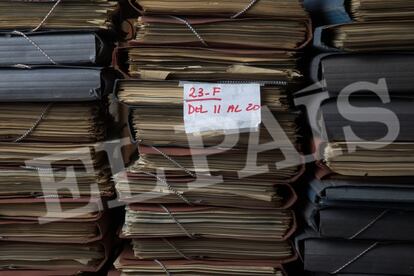

The story of February 23, 1981 (known in Spain as 23-F) is one of a failure with a happy ending. The system failed to prevent or stop the attempted coup, but the coup plotters did not achieve their objectives, and democracy continued its course. The documentation known to date, including the nearly 13,000 pages of the legal case to which this newspaper gained access on the 40th anniversary of the coup in 2021, provides an insider’s look at the protagonists’ perspectives and, at the same time, exposes things that were overlooked, both before and after. As a result, and despite the vast number of existing books, studies and documentaries about those hours when the country held its breath, reasonable doubts remain 45 years later.
Prime Minister Pedro Sánchez has announced that the government will release a trove of classified documents about 23-F “to settle a debt with citizens.” The socialist leader posted on X that “memory cannot be locked away. Democracies must know their past in order to build a freer future.” He also thanked the writer Javier Cercas, author of the award-winning The Anatomy of a Moment, a non-fiction narrative of 23-F, for paving the way by requesting the declassification of this information. The main opposition Popular Party (PP) was quick to describe the announcement as “a smokescreen.”
Julián Casanova, a renowned professor of contemporary history, cautions against excessive optimism regarding the release: “History doesn’t exist without documents, but documents are not absolute truth; a critical reading of the context and the source is necessary. Whoever classifies them decides what is kept and what is destroyed. No one should expect that all the documents or conversations generated around 23-F will be declassified, because some probably no longer exist. The CESID [predecessor of the national intelligence agency CNI] was then more focused on persecuting reds than on hunting down coup plotters because it was staffed by former Franco supporters, and that has repercussions. Those who classified or stored those documents were not lifelong democrats.”
The following is a reconstruction of what is known and what is not about the role played by former king Juan Carlos I, about the support shown by the army, and the extent of civilian involvement in the attempted coup.
Background and preparations
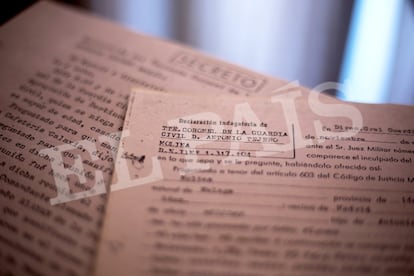
The saber-rattling was palpable and undeniable; the man who stormed into Congress, Lieutenant-Colonel Antonio Tejero, at 6:20 p.m. On February 23, 1981, had been released from prison in May 1980 after serving a seven-month sentence for “conspiracy to rebel” in connection with another coup attempt in 1978, known as Operation Galaxy. In the interrogations, the records of which EL PAÍS had access to, he revealed that since his release he had devoted himself to “maintaining contact” with officers who shared his “concern about the situation in Spain,” such as Lieutenant-General Milans del Bosch. In other words, he continued to conspire without anyone bothering him.
Tejero spoke with Milans del Bosch, and Milans in turn spoke with General Alfonso Armada. Because of these conversations, Tejero repeatedly insisted during his interrogations, he “assumed it was with His Majesty’s knowledge.” Armada had been with King Juan Carlos since 1955, having served as his tutor, and he blamed then-prime minister Adolfo Suárez for his dismissal as the monarch’s secretary. The King Emeritus states in his memoirs, published last December, that his father, Juan, dined with General Milans [whom he now describes as a “man famous for his bravery”] two months before the coup and that Milans told him: “Before I retire, I’m going to bring the tanks into the streets.”
Juan Carlos adds: “When my father told me this, I didn’t take it seriously, although I should have.” The former king asserts in his memoir that it was “very painful” for him to realize that “if Armada insisted so much” on being by his side that day, it was for one reason only: “To make people believe that I supported the coup.” Both Milans and Armada had participated in the Civil War with Franco and in the campaign in Russia with the Blue Division during World War II.
The truth is that the king had met with General Armada, whom the court ruling identifies as the main “beneficiary” of the 23-F operation, just weeks before the coup. According to the subsequent interrogations of Milans del Bosch, Armada told them that “the king was fed up with Suárez and was considering replacing him as prime minister. The king favored a civilian government, while the queen, it seemed, preferred a military one.”
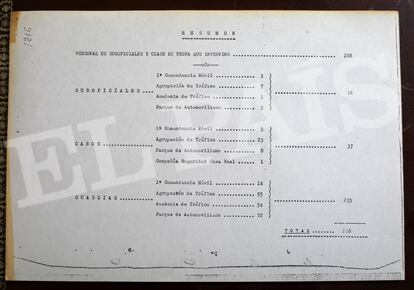
According to documents obtained by this newspaper, the coup plotters hesitated between occupying La Moncloa (the prime minister’s residence) or the Congress building, and opted for the lower house because it was “less complicated.” Tejero took “countless photographs” to study the building’s security measures. He explained that in December 1980 he had bought six 50-seater buses, as well as raincoats from the Rastro flea market, to transport 288 Civil Guards discreetly. He claimed that the purchase, “for about three million pesetas,” was financed with cash from an inheritance from his wife’s deceased aunt, and that “just in case it wasn’t enough,” he had requested four months’ salary in advance, “confident” that it would be repaid once the coup succeeded. He assured the lawyer he hired to handle the arrangements, for which he said he had forged his wife’s signature, that the buses were for a Basque family who wanted to invest “to avoid the revolutionary tax” levied by the terrorist group ETA.
No one should expect that all the documents or conversations generated around 23-F will be declassified, because some probably no longer existJulián Casanova, historian
The historian Nicolás Sesma and the researcher Carlos Fonseca, both of whom have written on the subject, agree that it would be of utmost importance for the declassified documents to include all the documentation produced by the CESID both before and after the coup. “If there is no documentation prior to the coup,” Fonseca states, “it would be extremely serious because it would mean the military intelligence service was unaware of anything. But at least there should be documentation from the period afterward, when they analyzed what went wrong and what accomplices they might have had within their ranks; they took statements from hundreds of witnesses, but the CESID was ultimately ruled out as part of the plot.”
Casanova insists that at that time, the intelligence services “were neither fully democratic nor did they operate with democratic methods of document classification,” so he believes that the material they generated about 23-F “sought, above all, to protect the top brass,” just as he believes that civilian involvement in the coup probably went far beyond what was stated in the court conviction.
The calls between Congress and the outside world
Lieutenant-Colonel Antonio Tejero stormed the Congress building on February 23, 1981, shortly after 6:00 p.m. And left under arrest at noon on February 24. During that time, telephone conversations took place both inside and outside the building, including with the royal palace of La Zarzuela, but only a few have been made public, all occurring after the state broadcaster TVE released the recorded message from King Juan Carlos condemning the coup, at 1:15 a.m.
Sesma and Fonseca believe that the most interesting aspect of this declassification would be the transcription of communications between Congress and the outside world, and especially with the Royal Palace. In his memoirs, Juan Carlos recounts a conversation between Sabino Fernández Campo, who had replaced Armada at his side, and Tejero in Congress, in which, according to his account, his secretary asked Tejero to stop speaking “in the name of the King” and to leave the Chamber. Tejero hung up.
“In 1994,” Fonseca states, “Julio Camuñas, who at the time of the coup was the government delegate to Telefónica and had previously been Undersecretary of Public Order, confirmed that Francisco Laína, the Director of State Security, had ordered him to tap some private telephones and those of Congress, but the tapes recording the conversations to and from the lower house were not included in the case file.” In his book, the researcher asserts that Laína’s second wife told him she had kept some of those recordings, but that she didn’t allow him to listen to them to respect her husband’s wishes. “I find it hard to believe,” Sesma agrees, “that those conversations weren’t recorded. Laína was very experienced, and it’s only logical that he would cover his tracks.”
Laína assured this newspaper in 2011 that they consulted three psychologists and finally agreed to cut off Tejero’s phone lines, but not completely, so that he would not feel isolated inside Congress, and that he urged the king’s secretary to get Juan Carlos to publicly condemn the coup as soon as possible, to which the royal secretary replied that the monarch wanted to speak to all the captains general first. At 1:15 a.m. On February 24, almost seven hours after Tejero stormed into parliament, TVE broadcast the king’s message.
Casanova would also like to see documents that “clearly” demonstrate that “as soon as Tejero stormed into Congress, King Juan Carlos said that this could not be allowed” in order to “clear up doubts about what happened until one in the morning.”
The calls between La Zarzuela and military leaders
When Defense Minister Alberto Oliart appeared before Congress in March 1981 to inform lawmakers of the progress of the investigation into the 23-F coup attempt, he asserted, as Fonseca recalls, that “94.4% of the armed forces were loyal to the government.” However, King Juan Carlos I himself paints a different picture in his memoirs: “I called each of the captains general individually. Of the 11, I estimate that half supported the rebellion, but they didn’t dare disobey.” According to Laína, the reason for the delay in the king’s message condemning the coup was that Juan Carlos I wanted to speak with all the captains general first. Both Sesma and Fonseca doubt that these conversations will be revealed once the 23-F documents are declassified.
Coalition government and party intrigues
In the interrogations to which this newspaper had access, Tejero explained that he felt betrayed by General Armada when the latter explained the coalition government he intended to impose after the coup. Among the names mentioned in these statements are those of Enrique Múgica, Jordi Solé Tura and Felipe González, who would later go on to become Spain’s longest-serving democratically elected prime minister under the Spanish Socialist Workers’ Party (PSOE), from 1982 to 1996.
The former king asserts in his memoirs that “political parties were also scheming in their pursuit of power.” There is at least one meeting that might emerge in the declassified documents: the one held in October 1980 between the socialists Enrique Múgica and Joan Reventós and General Armada, which lasted three and a half hours. The investigating judge asked Armada if, during that meeting, he “reached any agreement with members of the PSOE with a view to the eventual acceptance by said party or a faction thereof of a political formula such as the one he may have proposed as a consequence of the events of February 23.” The general replied that a government was never discussed.
The surrender
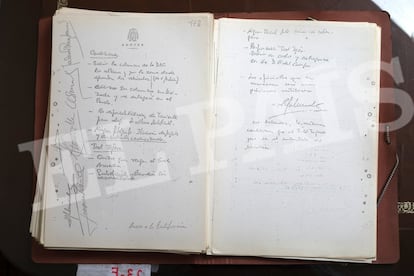
At 10:40 a.m. On February 24, Tejero telephoned the second-in-command of the Third Military Region to inform him that he was willing to surrender and that he wanted to see General Armada. The court documents include the piece of paper where his conditions for leaving the Congress building were noted: “No officers of rank below lieutenant. No photographers. Any officers who are sanctioned will be sent to military prisons.”
The investigation encompassed nearly 200 people, but only one civilian was convicted, and no one from the intelligence services was ever implicated. The courts acquitted Commander José Luis Cortina of the CESID even though, according to Tejero, Cortina had summoned him before February 23 to wish him luck and to inform him that the decrees that would come into effect once the coup concluded were already prepared.
Sign up for our weekly newsletter to get more English-language news coverage from EL PAÍS USA Edition
Tu suscripción se está usando en otro dispositivo
¿Quieres añadir otro usuario a tu suscripción?
Si continúas leyendo en este dispositivo, no se podrá leer en el otro.
FlechaTu suscripción se está usando en otro dispositivo y solo puedes acceder a EL PAÍS desde un dispositivo a la vez.
Si quieres compartir tu cuenta, cambia tu suscripción a la modalidad Premium, así podrás añadir otro usuario. Cada uno accederá con su propia cuenta de email, lo que os permitirá personalizar vuestra experiencia en EL PAÍS.
¿Tienes una suscripción de empresa? Accede aquí para contratar más cuentas.
En el caso de no saber quién está usando tu cuenta, te recomendamos cambiar tu contraseña aquí.
Si decides continuar compartiendo tu cuenta, este mensaje se mostrará en tu dispositivo y en el de la otra persona que está usando tu cuenta de forma indefinida, afectando a tu experiencia de lectura. Puedes consultar aquí los términos y condiciones de la suscripción digital.