Orson Welles’ love affair with Spain’s Castilla y León region
EL PAÍS takes a journey through Ávila, Soria, Segovia and Valladolid in search of the places that captivated the brilliant filmmaker in the year in which his most moving work, ‘Chimes at Midnight,’ turns six decades old
As emphatic as his own persona was Orson Welles’ response when, in 1960, he was asked which city he would choose to live in. “Ávila,” he said without hesitation. Seeing the journalist’s bewilderment, the filmmaker added the following explanation: “It’s in the center of Spain. The climate is awful, very hot in summer, very cold in winter. It’s a strange and tragic place. I don’t know why I feel something so special about it.”
This city could hardly reciprocate the compliment from the director, actor, and screenwriter who revolutionized cinema, theater, and radio to become one of the 20th century’s greatest geniuses. For, despite his words, he lived in the walled capital of the province of the same name for only a few months, the duration of the filming of what was, in his opinion, his finest work: Chimes at Midnight (1965), a film initially scorned by critics, but which ultimately came to be hailed as “moving, elegiac, and glorious.”
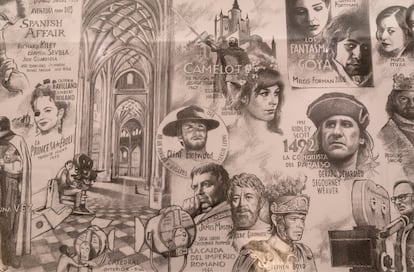
This year marks the 60th anniversary of Welles’ movie, which represented an unusual immersion into the Shakespearean universe by combining several tragedies by the English playwright (The Merry Wives of Windsor, Richard II, Henry IV, and Henry V) with a peculiar reinterpretation of the character of Falstaff. Filmed in various Spanish locations, Chimes at Midnight, along with other Welles titles, allows us to trace an emotional journey through the locations that fostered his love affair with the lands of Castilla y León.
The omnipresent wall
Ávila, of course, comes first. It is here that Welles shot the final scenes of the film, with his characteristic habit of filming shots and reverse shots in different locations and then fitting them together in the edit. This is the case in the coronation sequence, in which a dejected Falstaff is seen leaving for the Basilica of San Vicente in a jumble of images from other cities.
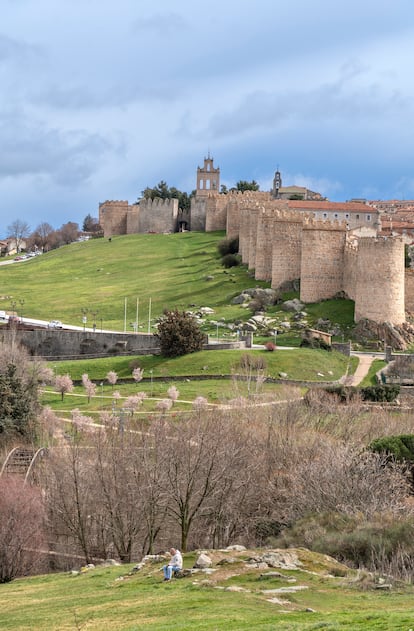
But it is the imposing city walls, especially as seen from the north, that are most frequently depicted. This 12th-century medieval construction has the distinction of being the only defensive fortification to have survived intact to the present day, and is the finest example of Romanesque military architecture in Spain. An impenetrable belt of 88 towers, 2,500 crenellations, and nine gates, it safeguards convents, churches, and palaces adorned with coats of arms, and is intertwined with what was the first Gothic cathedral in the country.
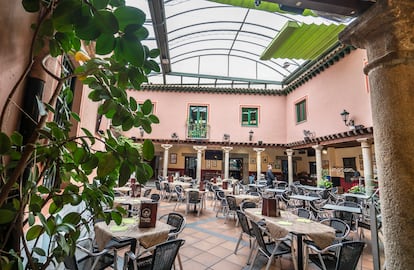
Following in Welles’ footsteps in the city of Santa Teresa involves visiting what is now the Posada de la Fruta restaurant, which was once the house where he stayed during the filming of Chimes at Midnight. Some even say he bought it. It also means enjoying a good ribeye steak at Mesón del Rastro, just as Welles did, who loved to wander through the narrow streets on winter mornings, enjoying what the people of Ávila call “days of sun and ice.”
Towns that were once London
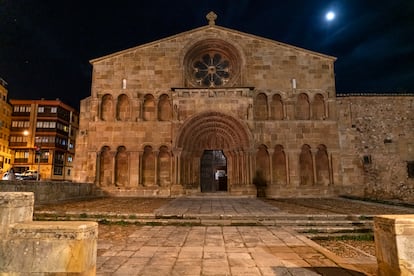
Soria is another of the provinces that served as a setting for Welles’ film. Especially the capital city, where the Romanesque church of Santo Domingo, with its monumental western façade, witnessed the funeral of Henry IV; and the town of Santa María de la Huerta, where Welles chose the refectory of its Cistercian monastery to frame the coronation of Henry V and his subsequent repudiation of Falstaff. Juan Pascual, the mayor of Soria, still remembers the imposing presence of the American director during filming. “Although I was barely 10 years old, I still retain the image of a huge man smoking one cigar after another,” he says.
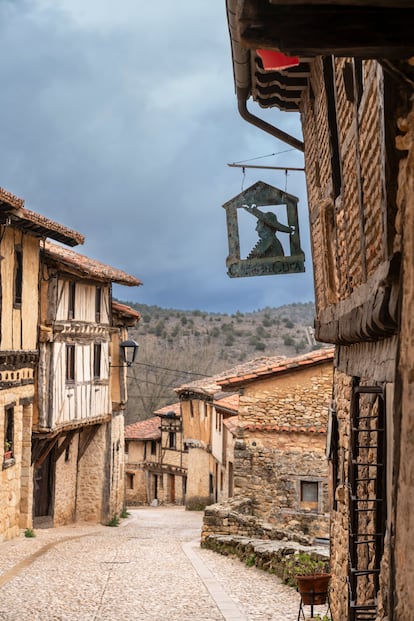
But no enclave in Soria had such a profound impact as the small village of Calatañazor, transformed, by the grace of cinema, into the gloomy medieval London of the Hundred Years’ War. The cobbled streets, the wooden arcades, the adobe houses, and the remnants of the fortress were perfectly suited to the course of this story, in which Falstaff was seen walking past the Church of Our Lady of the Castle, which had Romanesque origins in the 12th century and was renovated in the 16th. Today, visiting this beautiful village is like stepping into a time tunnel, hearing the crowds at ceremonies, the trot of horses in parades, or the clash of swords in battles.
From Macau to Snow White
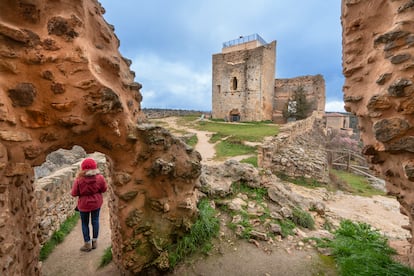
Pedraza, in Segovia province, also stood in for the English capital in Chimes at Midnight, aided by its perfectly preserved medieval town, perched atop a rocky outcrop and boasting a unique feature: underground power lines that enhance the charm of the streets and facilitate filming. The town walls, palaces, arcaded square, and imposing 13th-century castle completed the scenes filmed in this village, where at midday the restaurants exude the delicious aroma of roast suckling lamb.
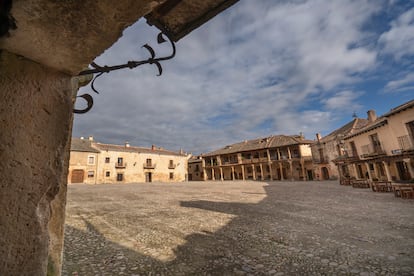
Perhaps it was this photogenic quality that led Welles to return a year later to film The Immortal Story, his personal adaptation of the story by Danish writer Karen Blixen. During filming, he transformed the Plaza del Álamo in Pedraza (as he also did with certain corners of Brihuega, in Guadalajara, and Chinchón, in Madrid) into the exotic Macau of the 19th century.
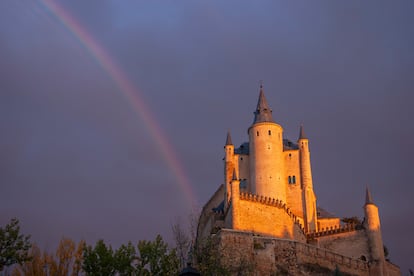
To continue the route through these landscapes touched by the magic wand of the man who, in 1938, terrified the United States with the radio version of The War of the Worlds, one must head to the city of Segovia. And a visit to the Alcázar is a must, whose imposing silhouette appears not only in Chimes at Midnight but also in another of his films: Mr. Arkadin (1955), the enigmatic story of a billionaire with a dark past. This former favorite residence of the Castilian monarchs served as inspiration for Disney (as the company confirmed in 2023) in designing Snow White’s castle, the one where the evil queen asked her mirror every day who was the fairest in the land.
Student chaos
The journey concludes in the city of Valladolid, which was precisely the setting for one of the most complicated scenes in Mr. Arkadin: a masked ball in the purest Venetian style that takes place in the College of San Gregorio, now the National Sculpture Museum. Up to 200 university students participated in the sequence, among them a young Miguel Delibes, the future novelist and editor receiving 10 pesetas and a ham sandwich in return.
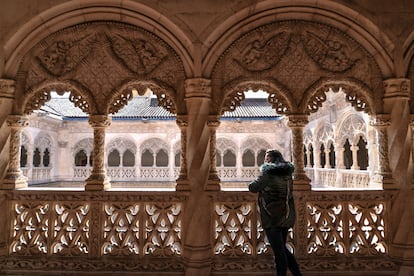
They say Welles was furious, unable to bring the unruly students to heel. And although the sequence, filmed in the courtyard, the cloister, and on the monumental staircase, was ultimately not included in the film (some say it was crushed by censorship), it’s always a good idea to discover this jewel of late Gothic architecture, which houses masterpieces such as Gregorio Fernández’s La Piedad, Juan de Juni’s Santo Entierro, and Pedro de Mena’s Magdalena Penitente.
Sign up for our weekly newsletter to get more English-language news coverage from EL PAÍS USA Edition
Tu suscripción se está usando en otro dispositivo
¿Quieres añadir otro usuario a tu suscripción?
Si continúas leyendo en este dispositivo, no se podrá leer en el otro.
FlechaTu suscripción se está usando en otro dispositivo y solo puedes acceder a EL PAÍS desde un dispositivo a la vez.
Si quieres compartir tu cuenta, cambia tu suscripción a la modalidad Premium, así podrás añadir otro usuario. Cada uno accederá con su propia cuenta de email, lo que os permitirá personalizar vuestra experiencia en EL PAÍS.
¿Tienes una suscripción de empresa? Accede aquí para contratar más cuentas.
En el caso de no saber quién está usando tu cuenta, te recomendamos cambiar tu contraseña aquí.
Si decides continuar compartiendo tu cuenta, este mensaje se mostrará en tu dispositivo y en el de la otra persona que está usando tu cuenta de forma indefinida, afectando a tu experiencia de lectura. Puedes consultar aquí los términos y condiciones de la suscripción digital.