Chapter 14: President of the Digital Dystopia
Trump has managed to dominate the new channels and media that define communication in the 21st century, spreading his message like wildfire
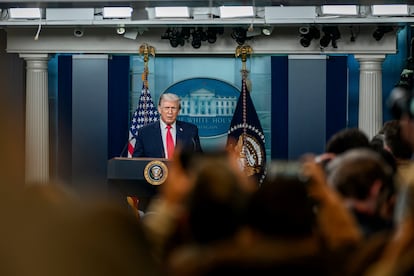

Donald Trump seems to have come back from the future. From that dystopian and bleak tomorrow toward which some seek to lead us, taking advantage of the growing polarization and the prevalence of emotions over rationality. From that digital realm characterized by the rise of social media, now made stronger and more chaotic by the explosion of generative artificial intelligence.
Ezra Klein recently discussed this on his podcast with the journalist and activist Masha Gessen. The United States has undergone a paradigm shift in the last year: “Biden felt fundamentally of another era, a politician of the past who was governing as a caretaker of the present. Trump is hypermodern […] a human being turned into a spectacle, a fully inhabited persona,” Klein states.
The current occupant of the White House lives for the show, as we analyzed in Chapter 2 of this series. But his impact goes even further. He has managed to master the new channels and media outlets that define communication in the 21st century. It’s unclear whether Trump has learned the codes and styles of digital communication, or if they simply suit his personality perfectly. What is certain is that they allow him to spread his message like wildfire; to keep his loyal base engaged; and to unsettle his opponents.
Next, we examine how communication is dominated by a digital logic that is visible in its content, its form, and its struggle to capture attention. Trump exemplifies many of the terms coined to define this new era: rage bait, enshittification, memeification, parasocial.. Many of the techniques the president employs work because of the way the world is today, but the world is becoming increasingly this way precisely because of the U.S. President’s own actions. It’s a vicious cycle, the chicken-or-the-egg dilemma.
Projection of authenticity
Last November, IAB Spain and Mazinn presented a study on how to connect with young audiences on social media. Of the 15 indicators under analysis, authenticity topped the ranking of essential elements for effectively engaging with audiences. “Being authentic is worth more than being cool,” the report succinctly summarized. In a world where distrust of institutions and experts has become fashionable, where excessive production is questioned, improvising in front of the cameras and saying politically incorrect things score points. And in this arena, almost no politician surpasses Trump. To emphasize this, he frequently mocks his predecessor: “Isn’t it nice to have a president who can go off teleprompter?” He joked a few days ago during an event.
Audiovisual culture
More than 9 out of 10 people worldwide use the internet to watch videos, according to Meltwater’s 2025 Digital Trends Report. Over the past decade, audiovisual culture has solidified its dominance. Some social media users have even abandoned platforms like X or Facebook because of their excessive text. Now, Instagram, TikTok, and YouTube reign supreme, with their short videos and images that fill almost the entire screen. Trump is well aware of this shift. It’s evident on the White House’s social media accounts and his own, but it goes even further. In his speeches and public appearances, he frequently uses high-impact audiovisual material to convey his message simply and directly. Trump knows that, despite deepfakes, a picture is still worth a thousand words.
On the one-year mark in office, President Donald J. Trump spoke to the press for nearly two hours.
— The White House (@WhiteHouse) January 20, 2026
And brought the receipts. Pic.twitter.com/wuMKeNBcd2
Simple language
A constant battle for attention is being waged on social media, and citizens are increasingly overwhelmed by the sheer volume of content. In the 2024 Digital News Report, 43% of Americans said they felt “burned out” by the vast amount of news available. Given this, simplicity is essential for conveying messages quickly. The president is unbeatable in this arena. His use of plain, everyday language also allows him to connect with broader segments of society, who perceive him as more approachable and authentic. This has been the case since his first campaign. In 2015, a report by The Boston Globe concluded that he was the Republican who spoke in the simplest way. Furthermore, his use of hyperbole is a hook to capture the listener’s attention and evoke emotions: building a “big, beautiful” wall can be more memorable than just a wall. But Trump’s simplicity doesn’t necessarily translate into a pursuit of clarity that would allow citizens to better understand the overall institutional language. That’s not part of the media circus, and he doesn’t care. That’s why he shut down the federal plain language website.

Permanent presence
In 2025, the Cambridge Dictionary selected “parasocial” as its word of the year. This academic term, which has been around for decades, has gained popularity due to the rise of social media, describing the one-sided psychological connection a person develops with a public figure, experiencing the familiarity and friendship found in a real-life relationship. Trump has built a strong parasocial bond with a significant percentage of American society, particularly with his most loyal supporters. He cultivates this relationship through a constant presence in traditional media and on social networks. According to The New York Times, in the first year of his second term, he made more than 250 media appearances, more than twice the slightly over 100 he made in 2017 and the fewer than 100 Joe Biden made in 2021.

Enshittification
Cory Doctorow popularized this term in 2022 on his blog. It refers to the process many social media platforms go through: first, they are good for their users and attract them; then they exploit those users for the benefit of corporate clients who generate revenue for them, then they eventually turn their backs on these clients as well to concentrate the greatest profits for themselves. Along the way, the content shared on these apps deteriorates significantly. This gives rise to another meaning of the word: the proliferation of fake news, deepfakes, low-quality content and so on. The American Dialect Society chose it as its word of the year in 2023, and Trump seems to be embracing the concept in its entirety. Politically, one could say he has done the same with some of the Latino voters who supported him and who have since seen their acquaintances violently deported by ICE. From a communications standpoint, he also contributes to the decline of online discourse.

Rage bait
“Rage bait” was chosen by Oxford as the word of the year in 2025. It refers to online content promoted by algorithms and deliberately designed to generate anger or outrage through provocation or offense that triggers a reaction, thus increasing engagement. Trump is also a specialist in provoking his rivals so that his issues dominate the agenda, if only because of the anger they generate. But he doesn’t limit himself to social media; he also uses all types of communication.
To learn more about this topic
Books:
- Cory Doctorow: Enshittification: Why Everything Suddenly Got Worse and What to Do About It
- Kiannah Frost: The Power of Parasocial Interaction: Exploring the Psychology, Media, and Technology Behind Celebrities, Influencers, and Our Unseen Relationships
Articles:
- Michael M. Grynbaum and Stuart A. Thompson: 329 Days of Trump, Trump, Trump, Trump, Trump, Trump, Trump
- Matt Viser: For presidential hopefuls, simpler language resonates
- Kate Hasset: Study Finds Trump Has The Vocabulary Of An 8-Year-Old Child
Videos:
- The Ezra Klein Show: Venezuela, Renee Good and Trump’s ‘Assault on Hope’
- Offline with Jon Favreu: Why Are Trump & Joe Rogan So Popular With Young Men?
Tu suscripción se está usando en otro dispositivo
¿Quieres añadir otro usuario a tu suscripción?
Si continúas leyendo en este dispositivo, no se podrá leer en el otro.
FlechaTu suscripción se está usando en otro dispositivo y solo puedes acceder a EL PAÍS desde un dispositivo a la vez.
Si quieres compartir tu cuenta, cambia tu suscripción a la modalidad Premium, así podrás añadir otro usuario. Cada uno accederá con su propia cuenta de email, lo que os permitirá personalizar vuestra experiencia en EL PAÍS.
¿Tienes una suscripción de empresa? Accede aquí para contratar más cuentas.
En el caso de no saber quién está usando tu cuenta, te recomendamos cambiar tu contraseña aquí.
Si decides continuar compartiendo tu cuenta, este mensaje se mostrará en tu dispositivo y en el de la otra persona que está usando tu cuenta de forma indefinida, afectando a tu experiencia de lectura. Puedes consultar aquí los términos y condiciones de la suscripción digital.