US House of Representatives passes election law requiring proof of citizenship to vote
The SAVE America Act would make voting more difficult for millions of women who adopted their husband’s last name, since it no longer matches the one on their birth certificate
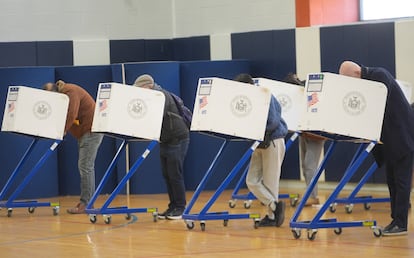

The House of Representatives approved on Wednesday a new electoral law that introduces significant changes to voting regulations. The so‑called Safeguard American Voter Eligibility (SAVE) America Act passed with 218 votes in favor and 213 against in the lower chamber, with unanimous support from Republicans and one Democrat vote, cast by Texas Representative Henry Cuellar.
With nine months to go before the midterm elections, which will determine the composition of both houses of Congress, the new law, supported by President Donald Trump, would require U.S. Citizens to present a passport or birth certificate to register to vote. In a message on Truth Social, Trump called on Republicans to support the act, arguing: “America’s Elections are Rigged, Stolen, and a Laughingstock all over the World. We are either going to fix them, or we won’t have a Country any longer.”
Although Republicans also hold a majority in the Senate, the bill is unlikely to pass in the upper house, where it would require at least seven Democratic votes to reach the necessary 60.
Democratic lawmakers and civil rights organizations are denouncing the new requirements, saying they disproportionately affect women, rural voters, and low-income families.
“The SAVE America Act is voter suppression, plain and simple. It will make it harder and more expensive for American citizens — especially women,” said Teresa Leger Fernandez, a Democratic representative from New Mexico who chairs the Democratic Women’s Caucus. Several of its members gathered to warn that the regulation will impact nearly 70 million women who no longer use the same last name that appears on their birth certificates because they adopted their husbands’ surname when they married.
Leger Fernández pointed out that women have registered and voted at higher rates than men in every presidential election since 1980 and stressed that Latina women may be more affected because many use two surnames and both do not always appear on official documents.
“If your current name doesn’t match the name on your birth certificate or citizenship papers, you could be blocked from registering to vote,” said Ohio Representative Emilia Sykes, who added that the difficulty increases for women over 65, because the older the certificates are, the harder they are to obtain.
Republicans have touted the law as a way to combat voter fraud by preventing non-U.S. Citizens from voting. “Americans need an ID to drive, to open a bank account, to buy cold medicine, to file for government assistance,” said Republican House Speaker Mike Johnson, in a statement. “So why would voting be any different from that?”
Foreigners who are not naturalized do not have the right to vote under the Constitution, and the reality is that fraud is minimal. “In my state of Ohio, where we have some of the strictest voter-ID laws, we have seen what happens,” said Sykes. “The amount of voter fraud is sustained, but the amount of voter engagement decreases, and particularly amongst people of color, young folks, the disabled and guess what, women.”
A passport, a luxury
Critics argue that requiring a passport as proof of citizenship further hinders the right to vote because only half of all Americans have one. Vermont Representative Becca Balint believes this requirement disproportionately affects economically vulnerable groups: “It punishes Americans who don’t have a passport,” she said. “Those [who have passports] are often wealthier people, people with more means.”
Balint argued that LGBTQ+ individuals will also face difficulties exercising their right to vote if the name on their birth certificate does not match the name they registered to vote. According to a study by the Brennan Center, a democracy advocacy organization, approximately 21 million Americans would have difficulty obtaining a birth certificate.
Voter registration would have to be done in person under the proposed legislation, eliminating the possibility of doing it online as is currently allowed. This would affect rural communities and residents of the most remote areas, who would have to travel for hours to reach an office where they can register. Likewise, mail‑in voting, which is widely used, would be restricted — though not eliminated, as Trump had wanted. In addition to tightening the requirements for registration, voters would also have to present a photo ID at the polls, excluding some forms that had previously been accepted, such as student IDs issued by universities or tribal IDs that do not have an expiration date — most of them do not.
Republicans argue that ensuring voter identity strengthens the country’s democracy, but critics contend that it would actually hinder the right to vote for the most vulnerable sectors of society. “[It will] disproportionately impact communities of color, seniors, women, young people, rural voters, and low-income families, making disparities in accessing the ballot even worse,” the League of United Latin American Citizens (LULAC) said in a message on social media. “It hits Latinos first and hardest. Hyphenated names, two last names, accent marks; our names tell our stories, but in databases they trigger ‘mismatches.’”
The Center for American Progress, a Washington think tank, points out that Republicans will be most affected by the new legislation because conservative women are more likely to change their last name upon marriage. Furthermore, it argues that “high rates of passport ownership are overwhelmingly concentrated in blue states, while low rates are concentrated in red states.”
If passed, the new legislation would affect the midterm elections to be held in November, when voters will elect all members of the House of Representatives and one-third of the Senate. Republicans hold a majority in both chambers, but President Trump’s declining popularity, primarily due to his administration’s aggressive immigration policies, threatens their hold on power. Trump has consistently claimed that there was fraud in the 2020 election, which he lost to Democrat Joe Biden, and has sought ways to change election regulations. Last week, Trump expressed his desire to nationalize elections, which are currently managed by the states, as mandated by the Constitution.
Sign up for our weekly newsletter to get more English-language news coverage from EL PAÍS USA Edition
Tu suscripción se está usando en otro dispositivo
¿Quieres añadir otro usuario a tu suscripción?
Si continúas leyendo en este dispositivo, no se podrá leer en el otro.
FlechaTu suscripción se está usando en otro dispositivo y solo puedes acceder a EL PAÍS desde un dispositivo a la vez.
Si quieres compartir tu cuenta, cambia tu suscripción a la modalidad Premium, así podrás añadir otro usuario. Cada uno accederá con su propia cuenta de email, lo que os permitirá personalizar vuestra experiencia en EL PAÍS.
¿Tienes una suscripción de empresa? Accede aquí para contratar más cuentas.
En el caso de no saber quién está usando tu cuenta, te recomendamos cambiar tu contraseña aquí.
Si decides continuar compartiendo tu cuenta, este mensaje se mostrará en tu dispositivo y en el de la otra persona que está usando tu cuenta de forma indefinida, afectando a tu experiencia de lectura. Puedes consultar aquí los términos y condiciones de la suscripción digital.