With State of the Union address, Trump returns to a Congress he needs after the tariff ruling
The US president will review his administration’s priorities at the Capitol on Tuesday. He has already warned that it will be a long speech and that he hasn’t rehearsed it much


The State of the Union address, an annual Washington political tradition in which the city pauses to listen to the president outline his administration’s priorities, is also a speech about the state of other things. In this case, when Donald Trump addresses a joint session of the House and Senate on Tuesday at 9:00 p.m., it will be an examination of the state of his relationship with Congress. Following the Supreme Court’s decision last Friday striking down a significant portion of his tariffs, the president needs the backing of Congress to impose the global 10% (later 15%) tariff with which he intends to circumvent the high court’s setback.
It won’t be easy: the first State of the Union address of his second administration comes at a difficult time for Trump, whose popularity has been at rock bottom for months, and while he’s still weighing up the possibility of military intervention in Iran. But above all, it coincides, as is also customary, with the midterm elections, scheduled for November. The law Trump wants to rely on to maintain his faith in tariffs (“the most beautiful word in the dictionary” for the White House occupant) allows him to impose them unilaterally for 150 days. And when those five months are up, he needs congressional approval.
That moment will arrive at the end of July, when all members of the House and a third of the Senate will be in the middle of their reelection campaigns. Defending unpopular taxes that would hurt their voters’ wallets doesn’t seem like the best campaign argument for Republicans torn between loyalty to their leader and their own electoral expediency.
The Supreme Court’s ruling will also influence the staging of the State of the Union address, a ceremony in which this year the presences (the president usually sends a message through the citizens he chooses to invite) will be as important as the absences: some Democrats have called for a rally near the Capitol to boycott the speech, but the snowstorm battering the East Coast is jeopardizing the initiative. The nine Supreme Court justices will be present, as tradition dictates, despite the insults that Trump has hurled at six of them since last Friday.
It will be interesting to see how the U.S. President and Supreme Court Chief Justice John Roberts, who wrote the opinion that struck down the tariffs, interact. Last year, when Trump had just returned to power for his second term and addressed Congress in what was technically not a State of the Union address, the Republican approached Roberts and said, “Thank you again. I won’t forget it.”
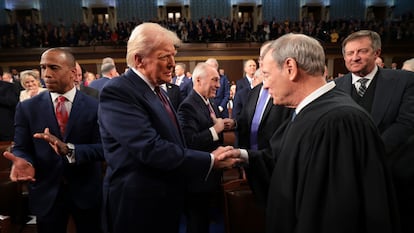
It was assumed that the reason for this expression of gratitude lay in the 2024 ruling that expanded the immunity of the President of the United States while in office (he said he was referring to the fact that the judge administered his oath of office). That ruling was written by Roberts for a case examining the decisions Trump made in the months leading up to the storming of the Capitol. At the time, Trump was the Republican nominee, and the decision paved his way to the White House.
On Tuesday, from the rostrum of the House of Representatives—the same place where then-Speaker Nancy Pelosi theatrically tore up the pages of Trump’s 2020 State of the Union address—Trump, flanked this time by Vice President J.D. Vance and House Speaker Mike Johnson, will review the rest of his agenda: from foreign policy to the economy, marked by tariffs but also by his inability to curb inflation or the high cost of living; and from the up-and-down funding of the Department of Homeland Security, on which Democrats and Republicans still cannot agree, which has forced a partial government shutdown, to the management of the southern border and the White House’s brutal immigration policy.
Trump has already warned that it will be a long speech (knowing his tendency for verbosity, Washington is preparing for the longest State of the Union address in history), and that he hasn’t rehearsed it much. It’s also safe to assume that he will go off-script more than once and pepper his speech with exaggerations, half-truths and outright lies.
At the end, as is also tradition, he will receive a Democratic response, which on this occasion will be two. The newly elected governor of Virginia, Abigail Spanberger, will respond in English. Senator Alex Padilla (California), who was arrested for interrupting a press conference by Secretary of Homeland Security Kirsti Noem, will respond in Spanish.
Sign up for our weekly newsletter to get more English-language news coverage from EL PAÍS USA Edition
Tu suscripción se está usando en otro dispositivo
¿Quieres añadir otro usuario a tu suscripción?
Si continúas leyendo en este dispositivo, no se podrá leer en el otro.
FlechaTu suscripción se está usando en otro dispositivo y solo puedes acceder a EL PAÍS desde un dispositivo a la vez.
Si quieres compartir tu cuenta, cambia tu suscripción a la modalidad Premium, así podrás añadir otro usuario. Cada uno accederá con su propia cuenta de email, lo que os permitirá personalizar vuestra experiencia en EL PAÍS.
¿Tienes una suscripción de empresa? Accede aquí para contratar más cuentas.
En el caso de no saber quién está usando tu cuenta, te recomendamos cambiar tu contraseña aquí.
Si decides continuar compartiendo tu cuenta, este mensaje se mostrará en tu dispositivo y en el de la otra persona que está usando tu cuenta de forma indefinida, afectando a tu experiencia de lectura. Puedes consultar aquí los términos y condiciones de la suscripción digital.