From killing her dog to labeling ICE victims in Minneapolis as ‘terrorists’: Kristi Noem’s most controversial moments
The career of the recently dismissed DHS secretary was marked by criticism of her lack of sensitivity

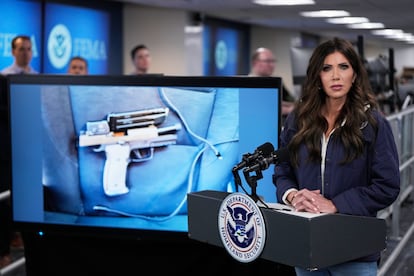
This Thursday marked the end of Kristi Noem’s tenure as Secretary of the U.S. Department of Homeland Security (DHS), following her dismissal by U.S. President Donald Trump. The news had been rumored for days, especially after Noem’s appearances this week before the Senate Judiciary Committee. As the top official responsible for the Trump administration’s immigration crackdown, Noem was questioned by lawmakers — especially Democrats, but also some Republicans — over abuses in immigration raids and, in particular, the killing of two U.S. Citizens, Renee Good and Alex Pretti, during operations in Minneapolis last January. Noem defended the actions of federal agents and refused to retract her labeling of the victims as “domestic terrorists.” She was also questioned over a controversial DHS advertising contract worth around $220 million, in which she featured prominently.
Her performance at the hearing, according to national media, triggered calls from people close to President Trump demanding her removal. It was the final straw, but Noem — a former congresswoman and governor of South Dakota, a vast Midwestern state — has a long record of moments that have drawn deep criticism for her lack of sensitivity.
As governor beginning in 2019, she gained notoriety for resisting public‑health restrictions during the COVID‑19 pandemic, going against federal recommendations from the Biden administration. As a result, she was considered a potential vice-presidential candidate for Donald Trump in the 2024 presidential campaign. However, in August 2024, her autobiography No Going Back was published, and her chances of becoming vice president evaporated amid the fallout from her first major controversy.
In the book, Noem recounted that years earlier she had shot and killed her 14‑month‑old hunting dog named Cricket. According to her own account, the animal was “untrainable,” which led her to consider it dangerous and “less than useless” as a hunting dog. So she decided to take it to a gravel pit and put it down with a single shot.
The confession, published in the book, triggered an immediate public reaction and bipartisan criticism, especially from animal‑rights advocates and political figures who questioned her judgment and sensitivity. Noem defended the decision by saying that on farms one sometimes has to make “tough decisions.” Even so, the episode damaged her image, and the label of “dog killer” has followed her ever since.
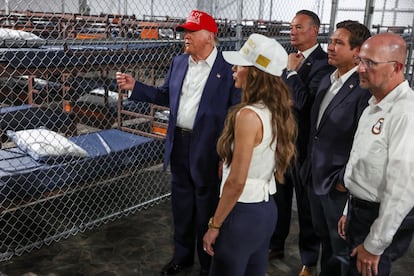
But the bad publicity was not enough to dissuade Donald Trump from including her in his cabinet once he won the presidential election in November 2024. He appointed her secretary of Homeland Security, which is responsible for the country’s borders and the enforcement of immigration policy — one of the most important posts for an administration that came into office promising to carry out the largest deportation operation in history.
It didn’t take long for her to make headlines in her new role. On her first day leading the DHS — which oversees agencies like Immigration and Customs Enforcement (ICE), Customs and Border Protection (CBP), U.S. Citizenship and Immigration Services (USCIS), the Transportation Security Administration (TSA), the Federal Emergency Management Agency (FEMA), and the Coast Guard — she took to the stage to address her entire team for the first time, in front of the cameras. As she walked to the podium, however, she chose to have the country song Hot Mama by Trace Adkins play in the background — a track about lingerie, sexual attraction, and turning “this room into a sauna.” The audience fell into an awkward silence, and criticism over the inappropriate musical choice poured in.
The rollout of Trump’s aggressive immigration offensive, however, quickly overshadowed that moment. In the first months of the Republican’s second administration, Noem became a familiar face and one of the main symbols of the aesthetic promoted by Trumpism, appearing frequently in the media and holding press conferences to announce operations and immigration measures.
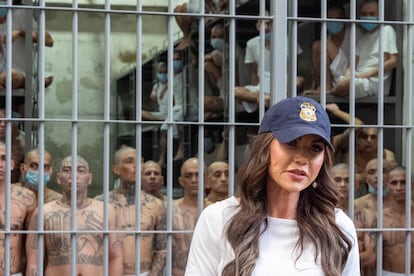
At the end of March last year, her visit to Nayib Bukele’s maximum-security prison in El Salvador produced what is perhaps the most iconic image of her time at DHS. Just 10 days earlier, the United States had sent more than 200 Venezuelans to that prison — the Terrorism Confinement Center (CECOT) — without due process, accusing them without evidence of belonging to the Tren de Aragua gang under the 1798 Alien Enemies Act, which labeled them part of a supposed invading army
It was the administration’s first major immigration scandal, marked by blatant disregard for legal norms and by its cruelty. In the midst of this storm, Noem toured CECOT with Salvadoran authorities and posed for the cameras in front of the massive communal cells, where the shaved and tattooed members of Salvadoran gangs held there by Bukele served as a backdrop.
Amid her work at the department, rumors began circulating about a possible extramarital relationship between Noem and Corey Lewandowski, a close adviser to Trump who had worked with Noem during her time as governor. Lewandowski was brought into the department as an unpaid temporary adviser for up to 130 days a year, although current and former officials have questioned how that time was counted and the real extent of his influence within the agency.
During her congressional appearances this week, Noem refused to answer Democratic lawmakers’ questions about the nature of her relationship with her adviser, including whether they had engaged in “sexual relations” during her time at DHS. Both have publicly denied having an intimate relationship, but various media outlets have reported on these allegations for months.
The climax of her repeated controversies, however, came on January 7. Just hours after Renee Good was killed in Minneapolis by gunfire from an immigration agent, Noem spoke at a press conference from the border, where she had planned to highlight the sharp drop in illegal border crossings. But the journalists present asked her about the incident that had just occurred thousands of miles to the north incident.
Despite the limited information available, Noem did not hesitate to label Good — a 37‑year‑old poet and mother of three, whose identity had not yet been made public — as a “domestic terrorist” who had tried to kill immigration agents with her car. The videos that flooded the internet, and others that emerged later, along with information about Good, completely contradicted Noem’s version of events.
A few weeks later, the script would repeat itself almost word for word after the killing of Alex Pretti, a 37‑year‑old nurse who had been peacefully observing immigration raids in Minneapolis, at the hands of other federal agents. Pretti was armed, and Noem seized on that fact to label him once again as a “domestic terrorist” who wanted to kill the officers. Once again, video of the incident showed that Noem’s account was false: Pretti had merely stepped between the agents and a woman they had assaulted, before being attacked by the officers, disarmed, and shot 10 times while lying defenseless on the ground. Despite the evidence and the scandal caused by the killings, Noem has not retracted her statements.
Even so, Secretary Noem had managed to hold on, and although rumors of her dismissal began gaining traction in early February, President Trump had repeatedly expressed confidence in her. But there was one thing that, according to several reports, Trump could not accept — and that became her final undoing: a $220‑million advertising campaign in which the secretary herself was the star.
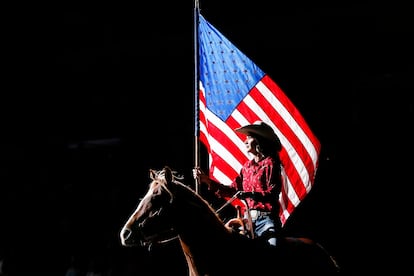
The ad shows Noem, wearing a cowboy hat and on horseback, emerging from a wooded clearing in the Black Hills of South Dakota, the state where she served as governor. The montage continues with images of DHS agents and federal officers, intercut with shots of Trump walking as the agents salute him.
“You cross the border illegally, we’ll find you,” Noem says. “Break our laws, we’ll punish you. Harm American citizens, there will be consequences,” she adds — paradoxically, given that none of the agents who killed Good and Pretti under her command have so far faced legal consequences, nor are there any signs that they will.
Senator John Kennedy, Republican from Louisiana, questioned Noem about the ad on Tuesday and suggested that the video promoted Noem rather than the president. She responded that Trump had approved the advertising campaign, although he later denied it. “The president tasked me with getting the message out to the country, and to other countries where we were seeing the invasion come from,” Noem said. On Thursday, her tenure came to an end.
Sign up for our weekly newsletter to get more English-language news coverage from EL PAÍS USA Edition
Tu suscripción se está usando en otro dispositivo
¿Quieres añadir otro usuario a tu suscripción?
Si continúas leyendo en este dispositivo, no se podrá leer en el otro.
FlechaTu suscripción se está usando en otro dispositivo y solo puedes acceder a EL PAÍS desde un dispositivo a la vez.
Si quieres compartir tu cuenta, cambia tu suscripción a la modalidad Premium, así podrás añadir otro usuario. Cada uno accederá con su propia cuenta de email, lo que os permitirá personalizar vuestra experiencia en EL PAÍS.
¿Tienes una suscripción de empresa? Accede aquí para contratar más cuentas.
En el caso de no saber quién está usando tu cuenta, te recomendamos cambiar tu contraseña aquí.
Si decides continuar compartiendo tu cuenta, este mensaje se mostrará en tu dispositivo y en el de la otra persona que está usando tu cuenta de forma indefinida, afectando a tu experiencia de lectura. Puedes consultar aquí los términos y condiciones de la suscripción digital.