Ta-Nehisi Coates, writer: ‘Obama never understood how deep-seated racism is in the country that elected him’
The author, a voice of racial consciousness in the United States, speaks of his 2024 book ‘The Message’ and how language can make violence presentable


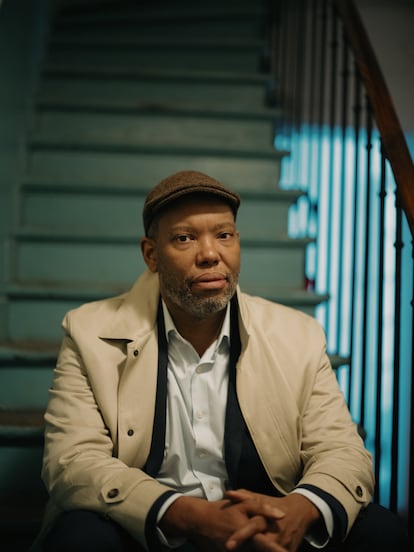
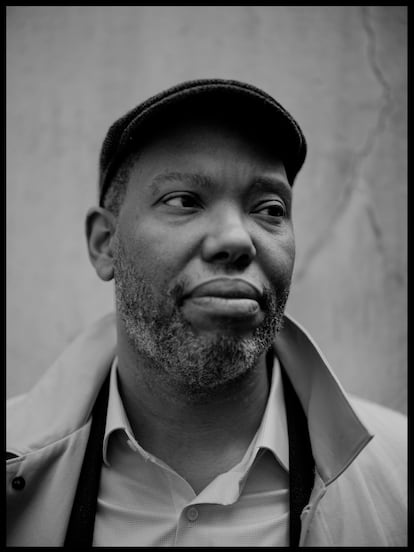
Ta-Nehisi Coates was a voice of conscience during the Obama era. The writer and journalist never bought into the reigning narrative of those years; he was critical of the U.S. President and cast doubt on the myth of racial progress, serving reminders of how the wounds of segregation had yet to heal. In 2015, Between the World and Me turned him into a literary phenomenon and thought leader.
Today, his place is perhaps less indisputable: he is no longer seen as a civic oracle, but rather as an uncomfortable and controversial voice. His journalism has also made a shift: he went from being a star writer at The Atlantic to joining Vanity Fair at the end of 2025.
In The Message (2024), Coates returns to his preferred mode: on‑the‑ground reporting and contrarian reflection as a way of challenging official narratives when they start to sound hollow. The book brings together three journeys (Dakar, South Carolina, and Palestine), all threaded by the same question: who decides which story gets told, who is left out of the frame, and how language makes violence presentable even when it is undeniable.
On his first trip to Africa, he confronts the continent he imagined as a child. In the southern U.S. States, censorship of Between the World and Me leads him to the roots of segregation. And on a 10-day trip to Palestine that took place shortly before the October 7, 2023 attacks and the brutal Israeli response, he observes up close the machinery of genocide and the gulf between what happens on the ground and the version circulating in the United States.
The Spanish edition, translated by Paula Zumalacárregui, arrives at a time when many of Coates’s insights into the culture wars — dismissed at the time as alarmist — now read as strikingly prescient. Coates spoke to EL PAÍS in a café tucked away in a quiet corner of Montmartre, in Paris, where he has spent long stretches over the past three years, far from the “exaggerated capitalism” of U.S. Society and immersed in what he calls “the city of all diasporas.”
Question. The book brings together your trips to three very different places. It’s not an obvious mix of destinations. What do they have in common?
Answer. My intention was to approach each place with the same question: what stories do we tell in order to understand our identity? In Senegal, I analyzed the narrative of the Black diaspora. In South Carolina, I observed how the issue of race was taught to my country’s youth. In Palestine, I focused on the story that hides domination and occupation. This led me to conclude that many people who subscribe to my ideology underestimate the power of culture, while those who criticize us have understood it very well. Art is political and can promote change, if one knows how to tell the story with precision and beauty.
Q. In the first pages, you write about how as a child, you discovered “something old, something ineffable, which marked all of humanity, stretching from Stratford upon Avon to the Streets.” That concept of shared humanity might today sound a bit naive. What does it mean to you?
A. I discovered that the characters from Macbeth and lyrics from the literature of my youth, which was hip-hop, have a lot in common. That this feeling of desperation was human. I saw it in Macbeth and when Biggie [the Notorious B.I.G.] Raps “I’m ready to die.” That’s not coming from a specifically Black pathology, but rather a sense that one is being beaten down by the world. In the United States, Black people are presented as an exception, as if we weren’t all human, and that makes you believe that your experience is unique. That’s a lie: our experience is a window onto common identity. Everyone looks out from their own window, but we are all living in the same building.
Q. You didn’t go to Africa until 2022. Why did you wait so long?
A. Because Africa carries a heavy weight. For a Black American, it can’t be a simple trip you take on your time off, because it is where all the myths are projected. You grow up thinking that everyone in the diaspora shares a bond that stems from colonization and slavery. To get there and not see that is a terrifying thought. And what if you don’t have anything in common with the place? Then who are you? Does your identity no longer have any foundations? I felt that the second I arrived. That moment when the plane descends, you take in the landscape and say, “Oh shit.” The myths are over. The stories are over. Now we’ll see what the truth is.
Q. Speaking of the power of stories, you write in the book that the “redeemers of this age look out and see their kingdom besieged by trans Barbies, Muslim mutants.” Why are these adversaries so obsessed with representation?
A. Because there is a sector of the United States whose identity is purely negative: it is not defined by what it is, but rather, what it isn’t. To exist, they need an enemy. They need a permanent war, something against which to measure oneself, for their life to make sense. For a long time, they used Black people in that role. But for many reasons, it’s getting harder to turn Black people into an automatic target for that war. That’s why they widened the battlefield, looking for other bodies, other identities, other minorities to put in the place of “other.” Ultimately, anyone can take the role of the Black person.
Q. We’re seeing a shift in the African American imaginary — from the racist stereotypes of the mammy and the sambo to Black Panther, which infuses representation with pride and power. You’ve taken part in that shift by writing some of the Black superhero’s comics.
A. I see it as important. It means that we aren’t your pets just because we are Black. That’s why I worked on the Black Panther comics. I actually did it because I love the comics, but also because sometimes, these new representations can have a bigger impact than a theoretical argument.
Q. What happened with the Black Superman you were working on with J.J. Abrams?
A. I wrote several versions of the script. In the end, they didn’t want it. They told me it was too woke, whatever that means. The ironic thing is that I wasn’t the one that proposed a Black Superman: they asked me to do it. It’s strange when they invite you to do something, and then they accuse you of being the woke one. But it’s fine, I’ll keep writing books.
Q. It’s symptomatic of a step back in pop culture: since Trump’s victory, studios and streaming platforms don’t want as many Black, LGBTQ+ or other minority characters.
A. The thing is, we should never count on them or trust them. If you can get money out of them while it lasts, do it. But these studios aren’t committed to any political will for change. If anything, their will is to keep things exactly as they are.
Q. Given the crisis in the United States, what is a country learning that, in barely a year, has gone from saying “he wouldn’t dare” to witnessing a pre‑fascist drift?
A. I hope we learn that we are capable of the very worst, that the United States is not morally unique and that we are capable of anything, no matter how terrible. It’s the end of the myth of U.S. Exceptionalism, that made us think that things that happened in other places could never happen here.
Q. What potential for resistance do you see? Will the American people wake up, like we’ve seen in the first major protests against ICE?
A. I don’t know. People are fighting and resisting, and it’s beautiful to see, but I don’t know what the result will be.
Q. You don’t sound very optimistic.
A. In the United States it’s very hard to limit the power of the institutions that are supposedly responsible for guaranteeing public safety. And it’s also a question of will: the other side is often more decisive and consistent. I don’t know if the mid-term elections are going to change anything.
Q. Regarding the censorship of your book Between the World and Me in places like Colorado, Tennessee and South Carolina, you write that you felt plucked from the present and pulled back to a time of lynchings and book burning. Is that where we are now?
A. Well, they’re killing people in the streets. I don’t like to say I told you so, but I saw this coming years ago, and they said I was being too alarmist. But it’s consistent with what the United States is as a country. If you accept that white supremacy lies in the bones of our country — and that doesn’t mean that it has to be like that forever, but it is a very powerful historical force — denying it is like when an alcoholic says they’re not one anymore because they haven’t had a drink in months.
Q. A decade after Barack Obama left the White House, how has your opinion evolved regarding his two terms?
A. My judgement is harsher. I think he never understood the country that elected him president. Particularly, how deep-seated racism is. He sees a lot of white people like he saw his grandparents: as good people. And of course, many are. But there is also a very aggressive segment who is open to doing anything to preserve the hierarchy and white supremacy. And those people don’t just disappear.
Q. I remember your interview with Obama in 2016. You told him that because of his mixed-race and cosmopolitan background, his personal experience of racism was different from that of most Black people.
A. It’s completely different. For example, I doubt that he imagined in 2026, a U.S. President would share a drawing of him and his wife with the bodies of apes. He wouldn’t have believed it in 2016. But some of us have always known that could happen.
Q. Back then, he said that moderation was a survival strategy, that if he was more aggressive in racial or social matters, a furious backlash could make the country ungovernable.
A. What they didn’t understand was that kind of reaction will always catch up with you, whether you’re moderate or radical. They hate you for what you are, and there’s no way out of that. You can be the most impeccable, middle-class, most “American” Black person and they will still hate you. And that hate is key to understanding what has happened during the last decade. There wouldn’t have been Trump without Obama. The fact that he was Black was what had the greatest impact, even if they try to hide it with explanations that are economic, or about the working class.
Q. What did you learn on your trip to Palestine?
A. I learned that the United States finances and actively supports a system of apartheid. That this occupation is in large part, our own. And it irritates me that they try to skate over that fact with words, with euphemisms. It angers me that people who call themselves liberal and defenders of equality lie like that. That caused a rupture between me and my profession. I was trained as a journalist in the general press and I believed in its tools. But when you see colleagues cooking up that story, you’re no longer debating ideas, but rather a method based in a lack of honesty. I think a lot about this story: in 2015, a correspondent from The New York Times in Jerusalem lived in a house that had belonged to a Palestinian woman who had been expelled. One day, they invited her to come back, took photos of her in the house, wrote an article about it and told her thanks and goodbye. Dude, you live in that woman’s fucking house. That’s astonishing.
Q. You talk about how your peers, many of whom were also your friends, described Zionism as a noble enterprise, but they never acknowledged the impacts on its victims. Perhaps because they had never been victims of anything.
A. The system is sustained by a certain degree of inhumanity: the victim always has to be almost an animal for you. That’s what the colonial gaze, which continues to this day, is based on.
Q. What is striking is that the ravages of Zionism have been known in the West for decades. Was there a deliberate blindness?
A. Yes. It was hard for many people to accept it, because support for Israel is profoundly incompatible with what the United States claims to be. Although perhaps, in reality, it is quite coherent with what we are…
Q. The same could be said for Europe.
A. Of course. I focus on the United States because it is my personal shame, but the contradiction is shared: proclaiming oneself a bastion of freedom and democracy and, at the same time, supporting something like what is happening in Israel, going around the world deposing governments…
Q. You cite a quote from Menachem Begin, a Zionist militia leader who later became an Israeli prime minister: “The Jews are not Zulus. You will not flog the Jews in their homeland.” What does that quote tell us?
A. That Zionism is born of nationalism and European colonialism, with the same ideology and racism. And it reveals something else: that, as he said, the category of “Black” as a position of submission can be applied to anyone. You don’t need Black people to produce an other to treat as an inferior. Being Black, in that sense, is something fabricated, something that is built.
Q. At the end of the book, you suggest a controversial idea: the conceptual parenthesis between Zionism and pan-Africanism.
A. There is a temptation in all nationalisms: the impulse to look for legitimacy in a past era, in a golden age that makes us special. And that element can also be present in pan-Africanism. But there are other ways of understanding that connection. For example, feeling connected not to an ancient greatness, but rather to having been turned into the lowest of humanity, to have been reduced in the world order. That doesn’t mean that there is a special pain that is essential to what we are: that is an idea I reject. It is a pain that comes from a historical situation. As always, many try to erase shame — of the Holocaust, of slavery — through stories based on an ancient greatness.
Q. Even so, their effects have been radically different.
A. Of course there are differences. In reality, African Americans are very American, even in a foundational sense. Now, German Jews are also as German as anyone else. You can’t understand Germany without them. And even so, they were exterminated. And I think that there’s a warning in that…
Q. In 2014, you wrote “The Case For Reparations,” an essay in The Atlantic that argued how the United States must repair, through policy and economic compensation, the damage caused to African Americans by slavery and decades of discrimination. Do you still believe that?
A. Yes, and even in a much wider sense. I connect the damage that the United States has made in the world, to the damage done by the entire West. I think about Congo and what Belgium did to it; what France extracted from Haiti; what happened in Iran and Guatemala… The West has caused so much pain, everywhere. Slavery and Jim Crow laws occupy a singular position, but they are not the only cases of exploitation in history. If opening that door implies other claims, open it. Europe, for example, is now experiencing migration as a threat. Let’s remember what the European powers’ policies were in the countries from which those migrants now come. We all know that they were not limited to handing out food and curing diseases. Europe was built on plunder. Let’s not forget that those who are arriving today are part of that history.
Sign up for our weekly newsletter to get more English-language news coverage from EL PAÍS USA Edition
Tu suscripción se está usando en otro dispositivo
¿Quieres añadir otro usuario a tu suscripción?
Si continúas leyendo en este dispositivo, no se podrá leer en el otro.
FlechaTu suscripción se está usando en otro dispositivo y solo puedes acceder a EL PAÍS desde un dispositivo a la vez.
Si quieres compartir tu cuenta, cambia tu suscripción a la modalidad Premium, así podrás añadir otro usuario. Cada uno accederá con su propia cuenta de email, lo que os permitirá personalizar vuestra experiencia en EL PAÍS.
¿Tienes una suscripción de empresa? Accede aquí para contratar más cuentas.
En el caso de no saber quién está usando tu cuenta, te recomendamos cambiar tu contraseña aquí.
Si decides continuar compartiendo tu cuenta, este mensaje se mostrará en tu dispositivo y en el de la otra persona que está usando tu cuenta de forma indefinida, afectando a tu experiencia de lectura. Puedes consultar aquí los términos y condiciones de la suscripción digital.