The United States is banking on its energy dominance to cushion the impact of the Iran war
Leading the gas market gives Trump an even greater strategic advantage than oil
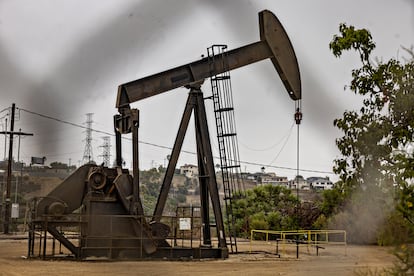

Behind the unexpected conflicts initiated by Donald Trump lies a strategic foundation that he summed up at the start of his term with “drill, baby, drill” — a reference to the controversial fracking technique for energy extraction — and that later took shape under the banner of “energy dominance.” Through his agreements with Saudi Arabia, Trump has managed to keep oil prices in a comfortable zone: high enough to be profitable for U.S. Producers, yet still affordable for consumers. But his real strength lies in the gas market, where the United States maintains a dominant position.
In the past, other U.S. Leaders have avoided entering conflicts in the Gulf region because of the steep price their citizens ultimately paid in the form of higher fuel costs. Although the United States produces oil, its benchmark price is set internationally, and a global rise in crude prices reaches U.S. Gas stations. But Trump — who appears to be better advised on oil matters than in other areas — saw that the slack in the oil market allowed him to intervene without paying such a high cost. As long as the war does not extend beyond a month, Saudi Arabia’s capacity to pump oil through pipelines is high, and Trump’s mere suggestion of escorting oil tankers has kept the price of a barrel below $80.
Two days before the start of the bombing campaign against Iran, the White House published an article highlighting the energy dominance Trump had achieved in his first year in office. The main achievement, the massive export of liquefied natural gas (LNG), is directly linked to the conflict in the Middle East. The White House states that “in 2025, the United States set a historic new record by exporting more than 100 million metric tons of liquefied natural gas (LNG) in a single year — the first country ever to achieve this milestone.” The statement predicts that exports will grow and that the U.S. Will meet the new demand thanks to the easing of restrictions on drilling.
This global control over LNG, with the U.S. As the leading producer, gives Washingtin a new lever of power with which to instrumentalize its economic war. Qatar’s LNG company will halt its activity for at least four weeks, which means removing 20% of its production from the market. With Russia under sanctions, there are not many gas suppliers left from whom to buy to replace Qatari supply. So the first option will be the United States. In this case, the benchmark index for gas prices in the country, the US Henry Hub, is insulated from external fluctuations, meaning the domestic spillover effect is very limited.
Dominating the gas market gives the United States an even greater strategic advantage than oil. Gas has been considered a “transition energy” by the European Union, which relies on this resource to generate electricity, with particularly high dependence in countries such as Germany. “Since the start of the war in Ukraine, the role of the United States has been increasing. And the conflict places it as the arbiter of global energy,” says Javier Moret, an independent energy markets consultant with 25 years of experience in the LNG market.
Selling energy at higher prices would help Washington reduce its trade deficit with other countries after the fallout from the Supreme Court’s decision on Trump’s tariffs. It won’t change the lives of ordinary citizens, but it will be a major MAGA victory heading into the midterm elections. It would also help offset the high financial cost of the war, which is expected to wipe out the supposed federal spending savings made by the Department of Government Efficiency (DOGE).
Antonio Fonfría, professor of economics at Complutense University, points out that the 12-day war of 2025, following attacks on Iran, cost Israel $750 million per day. Based on this recent conflict, Fonfría estimates that the current conflict will cost around $1 billion per day. The largest portion of the budget is consumed by aircraft carriers, which, including air operations, spend between $6.5 and $8 million per day, according to calculations by the strategic consultancy SP STRATUM. The consultancy firm believes that, depending on the intensity of Operation Epic Fury, the expenditure will range between $280 and $832 million per day. Military sources provide other figures that provide a more detailed picture of the costs involved: $4 million per missile; €240,000 ($278,000) per hour of F-35 use; or €100 million ($116 million) for each F-15 shot down.
Until now, China sourced 13.5% of its oil from Iran and 4% from Venezuela. With both supplies disrupted, the country has lost one‑fifth of its oil imports. This situation illustrates how the United States can pressure China by limiting access to key energy sources, especially at a time when analysts say Beijing has been gaining ground in the economic war. In fact, if China needed gas immediately, the supply it would most likely find on the market would be of U.S. Origin. Part of it could come from Russia and, like other Asian countries, it also has the option of burning more coal.
As Moret points out, in the current geopolitical landscape, Russia is one of the few countries with the capacity to increase its gas production, given its several pipelines that connect it directly to China. With its weakened economy, higher gas prices and increased demand from Asia would provide a much-needed boost to Moscow’s finances. Furthermore, Russia also benefits if the U.S. And Europe deplete their stockpiles to reinforce their position on the Ukrainian front.
By contrast, one of the countries in the worst situation is Japan, Moret explains, because it has no pipeline connections; it has no coal; and it faces problems with its nuclear capacity. In the end, the greatest damage falls on one of Washington’s closest ally. South Korea is also in a very difficult position.
Despite Europe’s heavy dependence on gas, the disruption is occurring in spring, when renewable energy output is typically strongest. With reservoirs full and the months bringing stronger winds and longer daylight hours, renewable generation can supply as much power as the grid can absorb.
Sign up for our weekly newsletter to get more English-language news coverage from EL PAÍS USA Edition
Tu suscripción se está usando en otro dispositivo
¿Quieres añadir otro usuario a tu suscripción?
Si continúas leyendo en este dispositivo, no se podrá leer en el otro.
FlechaTu suscripción se está usando en otro dispositivo y solo puedes acceder a EL PAÍS desde un dispositivo a la vez.
Si quieres compartir tu cuenta, cambia tu suscripción a la modalidad Premium, así podrás añadir otro usuario. Cada uno accederá con su propia cuenta de email, lo que os permitirá personalizar vuestra experiencia en EL PAÍS.
¿Tienes una suscripción de empresa? Accede aquí para contratar más cuentas.
En el caso de no saber quién está usando tu cuenta, te recomendamos cambiar tu contraseña aquí.
Si decides continuar compartiendo tu cuenta, este mensaje se mostrará en tu dispositivo y en el de la otra persona que está usando tu cuenta de forma indefinida, afectando a tu experiencia de lectura. Puedes consultar aquí los términos y condiciones de la suscripción digital.