The Gámez-Cuéllar mariachi family: the case that made Republicans raise their voices against Trump’s immigration policy
Politicians from both parties are taking credit for the release of the Mexican migrants, who had legally requested asylum and become well-known members of their community through their music
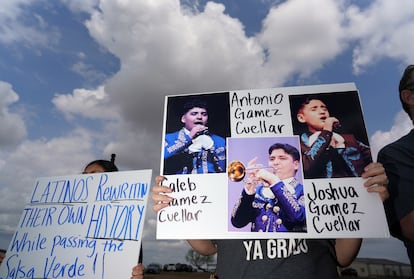

The detention and subsequent release of three brothers — all promising mariachi musicians — and their parents by ICE in Texas has newly exposed the cracks in Trump’s immigration policy. After becoming a national topic of conversation over the weekend, the case of the Gámez-Cuéllar family, originally from San Luis Potosí, Mexico, has shown that Latino voices within the Republican Party are now willing to more openly question the federal government’s persecution of migrants.
On Monday, the young musicians—Antonio, 18, Caleb, 14, and Joshua, 12—were released after calls and visits from members of Congress from both parties. Joaquín Castro, the Democratic representative from San Antonio who has recently taken up the cause of minors detained by ICE, went to the Dilley Family Detention Center, already known for its appalling conditions, along with several other House colleagues. Shortly afterward, the two younger boys, along with their father, Luis Antonio, and their mother, Emma, were freed.
The Gámez-Cuéllar family has been released. We are taking them now to reunite with their son Antonio.
— Joaquin Castro (@JoaquinCastrotx) March 9, 2026
When I returned to the Dilley trailer prison today, I brought my colleagues in Congress to meet with the children and families and to bear witness to their stories.
We are… pic.twitter.com/cmSkkVY1Oz
Around the same time, the older brother, Antonio, was released from the Raymondville detention center, where he had been held since reaching the age of majority. This release, however, was quickly claimed by Republican Representative Monica de la Cruz of South Texas. In a statement, she asserted that it was the result of her “direct advocacy with the White House” and the Department of Homeland Security (DHS). The family told The New York Times that they had never been in contact with her or her team and that Antonio’s release was delayed until he could have his picture taken with De La Cruz. The congresswoman has not responded to these allegations.
The case has struck a chord and taken place at a crucial moment. Mariachis embody the local culture of South Texas, for some even more so than the classic cowboy figure. In the Rio Grande Valley, on the southeastern edge of the border with Mexico, where 90% of the population is Latino, nationally renowned mariachi programs coexist with football teams in high schools. It’s no surprise that their arrest sparked a swift reaction from the Texas mariachi community. Musicians and educators began sharing videos on social media of the brothers performing songs at school competitions and concerts, while calling for their release. “Listen to these young men. They are not criminals,” wrote educator and mariachi Anthony Medrano on Facebook, one of the first to share their story.
Although the five members of the Gámez-Cuellar family were arrested by immigration agents on February 25, their case only gained public attention after several members of Congress and local politicians cited it to call for restraint in the Trump administration’s crackdown on migrants. Even Latino Republicans, such as De La Cruz, who had largely remained silent in the face of the raids by masked immigration agents, issued clear statements rejecting the persecution of people who are far from being the “criminals” the administration claims to be prioritizing. These calls come after the region’s Latino electorate, traditionally Democratic but which in recent years had begun to support Republicans for the first time in history, turned out in large numbers to participate in the Texas primaries on March 3, motivated largely, according to polls and analysts, by their rejection of the aggressive implementation of immigration policy.
The Gámez-Cuéllar case illustrates how a mission supposedly aimed at arresting and deporting “the worst of the worst” has been distorted. Instead, the family, none of whom have criminal records, were detained when they went to what was supposed to be a routine appointment with ICE in the border city of Edinburg. Agents arrested all five family members after the appointment. The parents, Luis Antonio Gámez and Emma Guadalupe Cuéllar, and their two younger children were taken to the Dilley Family Detention Center. Antonio, who had just turned 18, was separated from the rest of the family and sent to the El Valle facility in Raymondville, more than 300 km (186 miles) away.
The family arrived in the United States in May 2023 after fleeing Mexico. Originally from San Luis Potosí, the Gámez-Cuéllar family left the country after the father, also a mariachi musician, was kidnapped and beaten by members of organized crime, according to his testimony. The conflict began when his band refused to play songs associated with Santa Muerte, a popular religious figure sometimes linked to criminal groups. After the attack, the family decided to emigrate and entered the country through the CBP One asylum appointment system. They passed the initial “credible fear” assessment and had been attending immigration hearings and checks for nearly two years while their case remained open. They had no active deportation orders.
As their process progressed, the three brothers quickly became involved in the Rio Grande Valley music scene. Antonio and Caleb were members of the prestigious Mariachi Oro of McAllen High School, one of the most renowned school programs in the country, which had visited the Capitol the previous summer. In addition, the youngest, Joshua, participated in the mariachi program at Travis Middle School. Their performances at concerts, competitions, and school events had made them well-known figures within the South Texas mariachi community.
The partisan battle to gain credit for the family’s release demonstrates how central it is to local politicians to be perceived as fighting for the migrants who are part of their communities. This is especially true because the region is a hotly contested battleground in the lead-up to the November midterms, in which the entire House of Representatives is up for election and Texas’s Senate seat is also at stake.
Sign up for our weekly newsletter to get more English-language news coverage from EL PAÍS USA Edition
Tu suscripción se está usando en otro dispositivo
¿Quieres añadir otro usuario a tu suscripción?
Si continúas leyendo en este dispositivo, no se podrá leer en el otro.
FlechaTu suscripción se está usando en otro dispositivo y solo puedes acceder a EL PAÍS desde un dispositivo a la vez.
Si quieres compartir tu cuenta, cambia tu suscripción a la modalidad Premium, así podrás añadir otro usuario. Cada uno accederá con su propia cuenta de email, lo que os permitirá personalizar vuestra experiencia en EL PAÍS.
¿Tienes una suscripción de empresa? Accede aquí para contratar más cuentas.
En el caso de no saber quién está usando tu cuenta, te recomendamos cambiar tu contraseña aquí.
Si decides continuar compartiendo tu cuenta, este mensaje se mostrará en tu dispositivo y en el de la otra persona que está usando tu cuenta de forma indefinida, afectando a tu experiencia de lectura. Puedes consultar aquí los términos y condiciones de la suscripción digital.