Judge orders pause on construction of ICE migrant detention center in Maryland
The court ruling halts the conversion of massive warehouse in Williamsport for 14 days as a state lawsuit proceeds
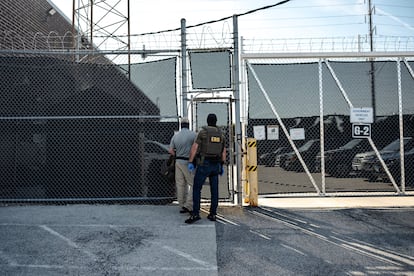

In a decision that deals a temporary blow to the Trump administration’s plans to expand immigration detention, a federal judge ssued a temporary restraining order on the construction of an Immigration and Customs Enforcement (ICE) detention center in Maryland. The measure suspends for up to 14 days construction work to convert a huge warehouse in Williamsport, Washington County, into a facility capable of housing up to 1,500 people, while the court evaluates a lawsuit filed by the state against the Department of Homeland Security (DHS) and ICE for alleged violations of environmental laws.
The order was issued Wednesday by U.S. District Judge Brendan A. Hurson. Maryland Attorney General Anthony Brown had requested the emergency pause on the grounds that the federal government moved forward with the project without conducting the required environmental review or allowing public comment. Maryland, governed by the Democrat Wes Moore, filed the lawsuit in February with the goal of halting construction of the center.
In his decision, Hurson concluded that the state demonstrated that federal agencies likely failed to comply with applicable environmental law. “The State has shown that Defendants likely failed to comply with their obligations under (the National Environmental Policy Act),” the judge wrote. He added that “the defendants do not appear to have taken a ‘hard look’ at the potential environmental consequences of their plans for the Williamsport Warehouse.”
The dispute centers on an industrial warehouse measuring more than 800,000 square feet (about 74,000 square meters) located in an industrial park near Hagerstown. The federal government purchased the property in mid-January for more than $100 million with the goal of converting it into a detention center for people in immigration custody.
According to court documents, the project envisions transforming the building—originally designed for commercial use—into a center that could simultaneously house 1,500 detainees. The property is located on more than 50 acres outside Williamsport, a town of just over 2,000 residents.
Brown argues that the project is being pushed through too quickly as part of the federal government’s immigration crackdown. “Federal immigration authorities are barreling past their legal obligations in an effort to build an immigration detention facility as quickly as they can,” the attorney general said. “Once construction begins, the damage to Maryland’s waterways, protected species, and communities cannot be undone.”
The lawsuit also warns that the development of the center could cause sediment runoff and pollution into Semple Run Creek, which flows into Conococheague Creek and then the Potomac River. In addition, the state argues that the existing infrastructure—especially the water and sewer systems—is not prepared for a facility of this size. According to the lawsuit, the lack of upgrades could lead to “sewage backups and overflows creating public health hazards and environmental harm.”
Brown hailed the court order as an initial victory for the state. “Though temporary, this ruling stops the construction of this massive immigration detention center while our lawsuit continues to play out in court,” the official said. “We will not let DHS and ICE rush through the proper legal process in their haste to ramp up deportations.”
The Department of Homeland Security criticized the decision. In a statement, a spokesperson said, “Let’s be honest about this. This isn’t about the environment. It’s about trying to stop President Trump from making America safe again.” Federal officials maintain that the new facility will meet current detention standards and argue that the project would generate economic benefits for the region, including more than 1,000 jobs and tens of millions of dollars in tax revenue.
The Maryland facility is part of a broader federal government strategy to expand immigration detention capacity across the country by converting large industrial warehouses into detention centers. Similar projects have been identified in states such as Arizona, Georgia, Michigan, New Jersey, Pennsylvania, and Texas.
Currently, there are around 220 facilities used to detain immigrants in the United States. In 2026 alone, ICE has spent more than $690 million on the purchase of at least seven industrial buildings with the aim of converting them into detention centers.
The expansion is partly in response to the extraordinary resources approved by Congress last year. A budget package worth tens of billions of dollars for immigration enforcement included $45 billion for new detention centers, allowing the agency to accelerate infrastructure construction and significantly expand its capacity.
As a result, the number of people in ICE custody has risen dramatically. While there were fewer than 40,000 detainees at the start of the current administration, that number is now around 70,000 and could continue to grow as new facilities come online.
The controversy in Maryland is not the only case in which immigration detention projects face legal disputes related to environmental regulations. In Florida, for example, the facility known as “Alligator Alcatraz,” built in the Everglades, is in the midst of a legal battle over whether it must comply with a federal environmental review in litigation that also involves federal government funding for the project.
Sign up for our weekly newsletter to get more English-language news coverage from EL PAÍS USA Edition
Tu suscripción se está usando en otro dispositivo
¿Quieres añadir otro usuario a tu suscripción?
Si continúas leyendo en este dispositivo, no se podrá leer en el otro.
FlechaTu suscripción se está usando en otro dispositivo y solo puedes acceder a EL PAÍS desde un dispositivo a la vez.
Si quieres compartir tu cuenta, cambia tu suscripción a la modalidad Premium, así podrás añadir otro usuario. Cada uno accederá con su propia cuenta de email, lo que os permitirá personalizar vuestra experiencia en EL PAÍS.
¿Tienes una suscripción de empresa? Accede aquí para contratar más cuentas.
En el caso de no saber quién está usando tu cuenta, te recomendamos cambiar tu contraseña aquí.
Si decides continuar compartiendo tu cuenta, este mensaje se mostrará en tu dispositivo y en el de la otra persona que está usando tu cuenta de forma indefinida, afectando a tu experiencia de lectura. Puedes consultar aquí los términos y condiciones de la suscripción digital.