‘It was an act of piracy’: Reina Sofía exposes Lou Reed’s plagiarism of Nazario
The Madrid museum revisits how a Spanish underground artist’s work ended up on an album by the US singer, who did not credit the illustrator

On the fourth floor of the Sabatini building at the Reina Sofía Museum in Madrid, the rooms and artworks have been rearranged once again to tell the most recent chapter in the history of contemporary art in Spain: from the transition to democracy to the present day. Everything has been reshuffled in order, as Manuel Segade, the museum’s director, explained during a tour of the 21 rooms on February 16, to try to answer the question: “How do we reach the past from the present?”
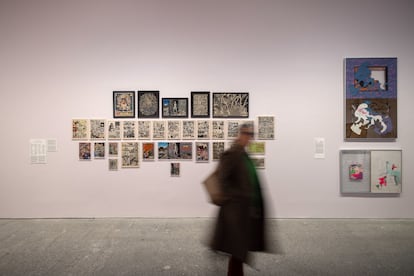
On one of the walls in the first rooms, dozens of drawings by Nazario — that is illustrator Nazario Luque, one of the pioneers of Spain’s underground comics scene in the 1970s — are on display. I lingered there for a moment, caught by the drawings, though not long enough, because at first glance I didn’t notice one of the characters. I had to keep up with Segade, look at works, jot down details for the article, and avoid bumping into the dozens of journalists invited that day. As I moved toward the next room, Borja Hermoso, my former editor in the Culture section, pointed out that man to me.
— Do you know the story behind that drawing?
— No idea, I replied.
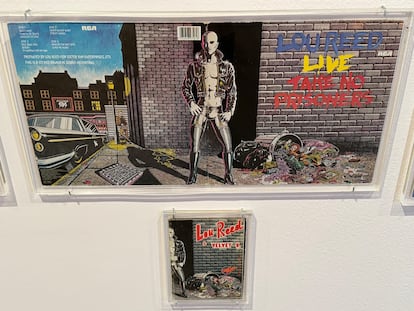
— It’s the one Lou Reed stole from Nazario for the cover of one of his albums. He appropriated it.
I continued the tour, but that comment stayed in my mind. The works belong to the Lafuente Archive, so my first message was to José María, the owner of this remarkable contemporary art collection, which includes more than 2,650 items by the illustrator — photographs, magazines, posters, prints, catalogues, audiovisual material, and original artwork. He immediately gave me Nazario’s phone number. “He’ll love telling you the story,” he said.
Half an hour later, I was on the phone with Nazario. I caught him in the middle of selecting a series of works for a project in Barcelona. “It’s the fifth time someone asks me for information, and it’s hard for me to climb up to the loft to check things,” he told me.
For a moment, I slipped into the intimacy of his home and compared his loft to mine, where the most interesting things stored are boxes of clothes waiting for summer. Nazario, however, goes up there to keep contributing to a chapter of art history — the one he helped shape by drawing the protagonists of subcultures, those other, less official cultures.
“Before we start talking, don’t you think they’ve hung them way too high? It’s always the same at the Reina Sofía,” he told me. “I went to see them at the opening — I hate leaving the house, but when they dedicate an entire wall to you, you have to go.”
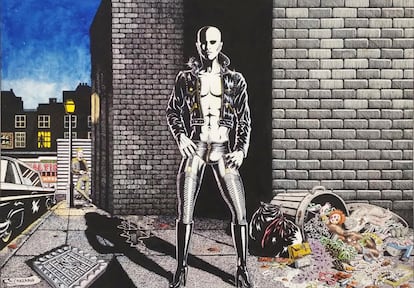
On that wall hangs the illustration he made for Rock Comix and the cover of Lou Reed’s album. The character has a shaved head, wears a leather jacket over a bare chest, shorts so tiny they look like underwear, held up by garter stockings, and leather high‑heeled boots. “A music critic showed the drawing to Lou Reed in London,” the illustrator recalls. At that meeting, the artist was thrilled with the character and said it would be perfect to illustrate a new project he was about to release, Take No Prisoners.
“The critic came back to Barcelona and told Gaspar Fraga, the magazine’s editor, and me about Lou Reed’s intention. We were excited, waiting to see when the album would come out,” Nazario continues. “The big surprise was that the album never appeared in Spain, but it did in other countries. That’s when I discovered they had used my drawing for a double cover and back cover.”
Lou Reed and his team modified the original by adding two side bands to turn it into a square. They erased Nazario’s signature and put another author’s name in its place. “It was an act of piracy,” the illustrator says.
“I imagine they did it out of that arrogance Americans have, the idea that in Spain stealing someone’s work is legal or wouldn’t have consequences,” he reflects. His first attempt was to contact some lawyers in New York, but the cost of a lawsuit was far too high.
Some time later, the album was released in CD format in Spain, and his drawing was used again for the cover. Nazario says that he and some friends bought several copies in Barcelona shops to gather evidence. That was when the lawyer of his friend Mariscal offered to take the case for free, only taking a percentage if they won.
“At first they practically declared me guilty, claiming that I was the one who had copied the album cover,” Nazario recalls. He gathered a group of witnesses who could attest to his authorship, eventually won the case, and was awarded four million pesetas (around $20,000) in compensation. “Just to shut me up,” he says now.
Because the cover featuring his character — without his signature — is still circulating in other parts of the world.
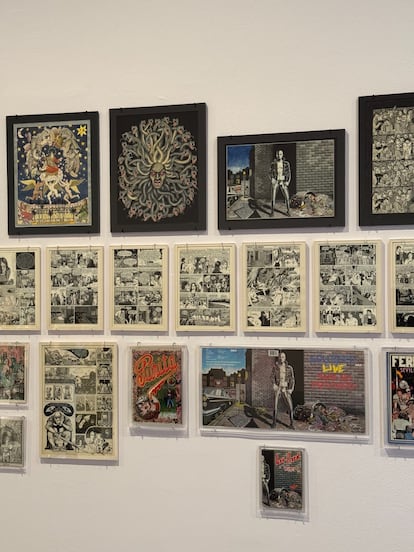
Before hanging up, I ask him whether seeing the drawing, the album cover, and a wall label explaining the plagiarism in a museum like the Reina Sofía gives him any sense of added vindication. He doesn’t seem particularly convinced by that part of the mission his works now fulfill in the space they occupy within the museum’s permanent collection.
“I see it as a bit anecdotal. There are others that are more important, like La Gloriosa Asunción de Ocaña al Reino de los Chulos.”
Sign up for our weekly newsletter to get more English-language news coverage from EL PAÍS USA Edition
Tu suscripción se está usando en otro dispositivo
¿Quieres añadir otro usuario a tu suscripción?
Si continúas leyendo en este dispositivo, no se podrá leer en el otro.
FlechaTu suscripción se está usando en otro dispositivo y solo puedes acceder a EL PAÍS desde un dispositivo a la vez.
Si quieres compartir tu cuenta, cambia tu suscripción a la modalidad Premium, así podrás añadir otro usuario. Cada uno accederá con su propia cuenta de email, lo que os permitirá personalizar vuestra experiencia en EL PAÍS.
¿Tienes una suscripción de empresa? Accede aquí para contratar más cuentas.
En el caso de no saber quién está usando tu cuenta, te recomendamos cambiar tu contraseña aquí.
Si decides continuar compartiendo tu cuenta, este mensaje se mostrará en tu dispositivo y en el de la otra persona que está usando tu cuenta de forma indefinida, afectando a tu experiencia de lectura. Puedes consultar aquí los términos y condiciones de la suscripción digital.