‘Hicks with very little taste’: Why Silicon Valley and the far right are so determined to build colossal monuments
The drive to erect enormous structures that reject modernity has united technology investors and the White House

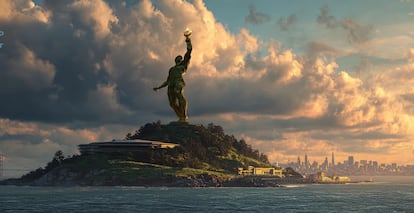
During a trip to San Francisco, Ross Calvin, entrepreneur and cryptocurrency engineering enthusiast, gazed at the city’s bay with a sense of wonder: it lacked a Statue of Liberty like the one in New York. Seven years later, he’s moving forward to realize his utopia: erecting a 137-meter-tall nickel-and-bronze statue of Prometheus on Alcatraz Island. The work would surpass the New York statue in height and cost approximately $450 million. The irony is that the titan of Greek mythology was a friend of humankind who defied the gods to help them. For the billionaire, Prometheus represents the “fundamental dynamism that defines the West.” He conveniently forgets that Prometheus was punished by Zeus, who chained him to a rock in the Caucasus Mountains and sent an eagle to devour his liver each day.
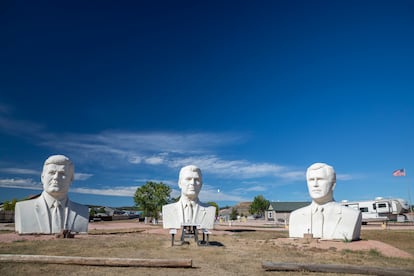
For the monument to be built, the businessman needs Donald Trump to reclassify the island, although according to U.S. Media, he expects him to be receptive given his fixation on aesthetics and symbols (what seems more difficult is getting the Republican to abandon the plan to reopen the prison). A few months ago, Trump himself approved the construction of a vast National Garden of American Heroes, where he will pay homage to 250 figures of the nation through statues created specifically for the occasion. These will depict figures such as Christopher Columbus, Kobe Bryant, and Whitney Houston at a cost of $34 million. The U.S. President is also building a gilded ballroom at the White House, and sketches of a kind of American Arc de Triomphe have been seen in Washington.
The owners of American tech companies have shifted ideologically toward Trumpism. Trump and Calvin share a common idea: to redefine their own version of Western values. They are not alone in rejecting modernity as a cultural identity. According to Bloomberg, Joe Lonsdale, co-founder of Palantir and a defense technology investor, has been funding initiatives with a “classical aesthetic” for years; Mark Zuckerberg commissioned a statue of his wife over two meters tall, wanting to revive “the Roman tradition of making sculptures of your wife”; Silicon Valley investor and entrepreneur Elad Gil wants to “bring back inspirational monuments on a grand scale”; meanwhile, university professor Mo Mahmood is raising funds for a massive statue of George Washington.
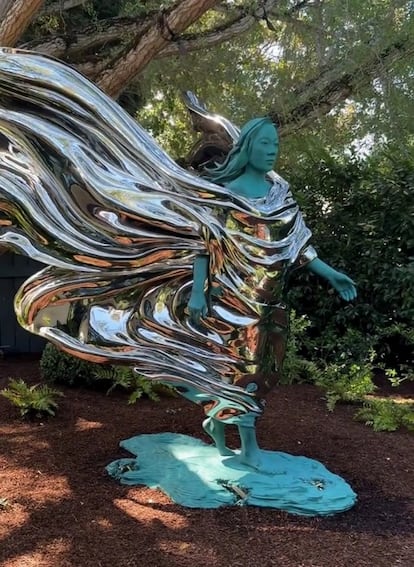
“Monuments seek to glorify and legitimize power. Etymologically, they are meant to be remembered. In this case, they are meant to impose a narrative or a memory,” explains Emilio Martínez, an urban sociologist at the Complutense University of Madrid (UCM) and author of the research project Space, Memory, and Social Bond. The obsession with monuments as a form of political exaltation is well-documented, and its history encompasses everything from equestrian sculptures of antiquity to Mussolini’s neo-imperial architecture or the extravagant classicism of Albert Speer, the Third Reich’s chief architect.
“These people are hicks with very little taste. Their aesthetic is incredibly vulgar. They confuse a monument with the monumental and the monumental with the colossal. That’s why these enormous works are disproportionate. They even depart from the classical view in which man is the measure of all things,” Martínez says about the tech billionaires. This researcher questions a supposed glorious present. “They use monuments that don’t commemorate any past, but rather seek to redefine the space. Since you don’t have a glorious past because you’re an upstart, what you do is create an event. With a lackluster present and an uncertain future, a strategy of political legitimization is employed.”
What’s happening in Spain?
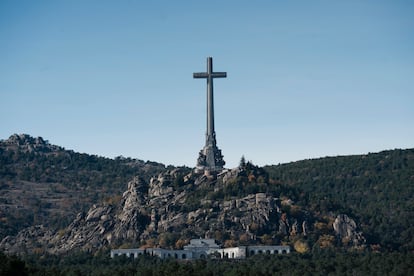
There is no identity without memory. Nor is there memory without a spatial, material, and symbolic anchor. During the Franco regime, influenced by the ideological tenets of Falangism, there was a certain fascist urban planning influence. “Especially the Housing Institute and other institutions of that kind. They sought to hark back to a previous past,” Martínez recalls. The Ministry of the Air and the well-known Valley of Cuelgamuros — the Valley of the Fallen before 2022 — also serve as examples of that Neo-Herrerian architecture that looked to the past to claim a supposed imperial rebirth.
Smaller in scale — but markedly reactionary — monuments continue to be erected in the Spanish capital to honor a supposed heroic past. In 2022, a statue of the Spanish Legion was erected on the main Castellana thoroughfare, praising its founder, the Francoist military officer Millán-Astray. It was built thanks to funding from the Army Foundation with a collective contribution of €50,000. Curiously, it stands just a few meters from the monument commemorating the Spanish Constitution. “It is an extraordinary sculpture,” then-mayor of Madrid José Luis Martínez -Almeida commented at the time (he had also changed the name of Justa Freire Street, named after a pioneering woman in Spanish education who was persecuted during the dictatorship, to that of the military officer).
A year earlier, in 2021, another statue was unveiled on Alberto Aguilera Street: this one dedicated to the “Last Ones of the Philippines,” embodied, pistol in hand, in the figure of Lieutenant Martín Cerezo. The Francoist filmmaker Antonio Román revisited the myth of the Siege of Baler in Last Stand in the Philippines ( 1945), at a time when the regime was attempting to distance itself from German and Italian fascism by fueling nostalgia for Spain’s imperial past. That discourse resonates today in far-right parties.
The monument was met with opposition, as it was seen as a sculpture glorifying colonialism. Not far away stands the monument to naval officer Blas de Lezo (1689-1741). According to historian Pablo Batalla, author of an essay on the subject, “they are related because they are heroes of the defense. This connects with a logic common to all European nationalist movements: faced with the imperialism of a century ago, a now defensive discourse, of a fortress besieged by multiple invaders (Arabs, cultural Marxism, immigrants…).”
But there are projects that do contemplate a monumental scale: when asked about other works of this kind in Spain, Martínez recalls the aspiration of the Association of Devotees of the Sacred Heart of Jesus to build a statue of Christ larger than the one in Rio de Janeiro. They have so far raised €95,000, although they still need another €17 million. “They represent Christianity and the reinterpretation of Western values,” he says. For him, something similar happens in Basque nationalism when it comes to commemorating identities: “They do so through spelling and regionalist elements, which is deeply rooted in identity.”
When the physical environment changes, memories and identities also shift over time. The monuments we see when we walk around convey one system of ideas or another. “All political systems, including democracies, try to promote their own perspectives. The problem arises when there’s a war of memories. Historical or collective memory is used as a weapon of legitimacy because it gives you a specific identity,” Martínez concludes. Now, those identities also want to be XXL.
Sign up for our weekly newsletter to get more English-language news coverage from EL PAÍS USA Edition
Tu suscripción se está usando en otro dispositivo
¿Quieres añadir otro usuario a tu suscripción?
Si continúas leyendo en este dispositivo, no se podrá leer en el otro.
FlechaTu suscripción se está usando en otro dispositivo y solo puedes acceder a EL PAÍS desde un dispositivo a la vez.
Si quieres compartir tu cuenta, cambia tu suscripción a la modalidad Premium, así podrás añadir otro usuario. Cada uno accederá con su propia cuenta de email, lo que os permitirá personalizar vuestra experiencia en EL PAÍS.
¿Tienes una suscripción de empresa? Accede aquí para contratar más cuentas.
En el caso de no saber quién está usando tu cuenta, te recomendamos cambiar tu contraseña aquí.
Si decides continuar compartiendo tu cuenta, este mensaje se mostrará en tu dispositivo y en el de la otra persona que está usando tu cuenta de forma indefinida, afectando a tu experiencia de lectura. Puedes consultar aquí los términos y condiciones de la suscripción digital.